Table of Contents
My Independent Investigation
Autopsy contradictions, Misleading evidence, Mozambique Police Reports & MAR and False & misleading Testimony by AFP Commander A.P Smith at the Inquest.
My Trips to Mozambique
Sting Operation – “Mad Nick”
The Radiology Report
The Inquest
The Inquest: Critical Facts Behind the Scenes
Reenactment Clear Crime Scene Photograph
Autopsy contradictions, Mutual assistance request, Mozambique police reports and misleading evidence.
Summary of circumstances;-
From early 2016, the pathology and forensic evidence surrounding Elly’s death did not add up. Soon after Elly’s highly suspicious death, I noticed clear contradictions between the overseas autopsies and the Melbourne autopsy.
The Melbourne pathologist from the Victorian institute of forensic medicine (VIFM) recorded the cause of death as “undetermined,” a conclusion that did not align with other evidence and overseas autopsies! I was not happy with these contradicting conclusions and began raising serious questions about the Australian system, its procedures, and its processes at this early stage, as it all did not add up at all in my book!
From the very beginning, I was deeply concerned by the Melbourne pathologist’s autopsy report and, more importantly, by what it failed to include!! As Elly’s father, I undertook my own investigative work because critical aspects of the evidence were not adding up. These concerns arose in real time and escalated immediately; what began as urgent questioning became years of sustained investigative work.
The discrepancies were so stark that they continually played on my mind, compelling me to formally request a meeting in 2017 with the Melbourne pathologist through the court in order to seek clarification and ensure the evidence had been properly considered. Knowing this was profoundly disturbing, as it directly contradicted the earlier autopsy findings!! The Melbourne report stated there was no “significant sand of concern,” referred only to a small residue in the airways, made no reference to sand in the lungs, and again concluded the cause of death as “undetermined”!
In contrast and confirmed with testimony given at the inquest in 2023, the initial autopsy conducted in Mozambique found an “ABUNDANCE” of sand in the airways and concluded that the manner of death was violent homicide! The second autopsy in South Africa confirmed that the airways were completely blocked with sand, documented notable trauma to the head and face, and explicitly raised the possibility of foul play. These two overseas autopsy reports were consistent with each other and were later confirmed during the inquest in 2023, where Dr. Klepp gave evidence stating in her words that “the airways were” “CHOCK-A-BLOCK” with sand”, supported by radiologist Dr. O’Donnell from the Victorian Institute of Forensic Medicine (VIFM) stating the sand detected was equivalent to “Bone density” with both lungs filled with sand to the lower levels. Dr Klepp was asked at the inquest did she agreed with a witness who was asked to identify Elly at the crime scene with his observations that Elly’s mouth was packed with sand and that this seemed susphious’
Dr Klepp’s reply was:
“Absolutely I agree as that is how I found her oral cavity” “CHOCK A BLOCK”! and this was seven days after Elly's death!!
A radiology scan conducted by Dr O’Donnell in mid-2019 came as a complete “shock” to the family. It showed high-density sand readings of 1,290 (HU) behind the posterior nasal cavity and 947 (HU) within the trachea, densities consistent with cement and bone, and both lungs completely filled with sand to the lower levels.
This critical evidence was entirely absent from the Melbourne autopsy report, despite the radiology scan being derived from a CT scan performed immediately prior to the Melbourne Pathologist autopsy examination on 22nd November 2016!at the VIFM!!
At a recorded meeting in September 2017, held with consent and attended by the Melbourne pathologist, the family, the Coroner’s Assistant, and the AFP, the pathologist stated to everyone at that meeting, he found “NO” sand whatsoever in Elly’s airways. Yet Dr O’Donnell confirmed with his 2019 radiology report, and under sworn evidence at the 2023 inquest, that both lungs were fully filled with sand, including areas within the airways showing high density levels equivalent to “BONE density”. This radiology scan was taken from a CT scan just prior the Melbourne autopsy examination on the 22nd November 2016!!
This directly contradicted the Melbourne pathologist’s cause of death conclusion of “undetermined,” which was wholly unacceptable and incorrect, and delayed Elly’s cause of death for seven years, evidence that in 2016 could have directed the Coroner toward a more accurate and highly suspicious cause of death from the outset which I informed them all about asking them all to contact Dr Klepp in 2016/17 but they would not listen to me in 2016/17!
The Coroner Mr Cain at the 2023 inquest revised the cause of death from Undetermined to aspiration of a large amount of sand obstructing the airways causing death following the compelling evidence given by Dr Klepp and Dr O’Donnell at the inquest in 2023 after seven long years!
It was in early 2016 that I first truly understood that my daughter’s death was not an accident a conclusion of suspicion that came directly from South African pathologist Dr. Klepp, who examined Elly’s body in the days following her death on the 16th November 2016, before the Melbourne autopsy. That is why I questioned the accuracy of the Melbourne autopsy report.
On 20th November 2016, I spoke with Dr Klepp by phone. During that conversation, I told her that an eyewitness at the scene, who had been asked to identify Elly had noticed that Elly’s mouth was packed full of sand and had immediately expressed concern about what may have happened to her.
Dr Klepp did not hesitate. She was clear and deeply concerned by what she had observed.
Dr Klepp told me that Elly’s airways were completely “PACKED” with sand, not a small or incidental amount, but fully obstructed she said. She emphasised that this was not a normal finding and could not be easily explained.
I then asked Dr Klepp directly whether she believed this could be foul play.
She told me that she suspected it could be, but that she would need to wait for the toxicology results before making a final determination about the circumstances of Elly’s death.
Dr Klepp also described bruising and abrasions around Elly’s mouth and lips. She explained that these injuries became more pronounced over time and were clearly visible when she examined Elly’s body on 16th November 2016, seven days after her death.
Taken together, these findings painted a deeply disturbing picture. In Dr Klepp’s professional opinion, the fully obstructed airways and increasingly evident facial injuries were highly suspicious and deeply concerning, further reinforcing that this was not consistent with an accidental death.
The following day after our phone conversation Dr Klepp contacted the Australian Embassy to formally express her concerns. The email below is reproduced word for word below as it was sent to the family, the Coroner, DFAT, and the AFP.
"Dr. Klepp has spoken to the father, and he has given her permission to request that any information or documentation be provided to her. Dr. Klepp also noted that she was waiting for toxicology results before determining the nature of Ms. Warren’s death, highlighting that she believed the facial injuries particularly bruising and abrasions around her mouth had become more marked with time and suggested that Ms. Warren had been held face down in the sand, resulting in death by aspiration."
The Australian Federal Police (AFP) had obtained the Mozambique autopsy report and the prosecutor’s report through unofficial channels. At that time, the family or coroner was not provided with copies of either report in 2016. However during a meeting on 19th December 2016, two AFP officers verbally informed me that the Mozambique autopsy report concluded that Elly’s death was the result of a “VIOLENT HOMICIDE.” They also stated that the investigation fell solely under the jurisdiction of the Mozambique authorities. I later discovered that there were options available for the AFP to become more actively involved, which were never discussed as an alternative at this meeting with the AFP/FILO’s!
Despite this knowledge, on April 6th, 2017, the Mozambique top criminal police Servico Nacional de Investigation Criminal (SERNIC), issued a police report concluding that Elly’s cause of death was an “overdose”! This was impossible, as Elly was always strongly against drugs. When I first saw the overdose report, it was completely impossible for Elly to have died from a drug overdose! I was so angry at this time that I immediately got on the phone, demanding solid explanations from the Australian authorities!
The Australian Department of Foreign Affairs and Trade (DFAT) then informed Mozambique police of their own autopsy report, which showed evidence and conclusions of a violent death. Shortly after, Mozambique issued a revised police report declaring that Elly’s death was now a “HOMICIDE”, just four days after the overdose report! DFAT later told the family that the overdose report had been a clerical error, but this explanation did not sit with me; it was completely unacceptable! There is no credibility in these police reports other than the fact that Mozambique had now officially classified Elly’s death as a “HOMICIDE” in their revised police report on the 10th April 2017. (This classification of Homicide becomes very important at this early stage and the reasons are explained later on)
The AFP should have taken notice and gone over to Maputo with a commander then, to sort this bloody mess out if they were serious about helping Elly’s family, not in 2023, seven bloody years later, while they were supposedly investigating on behalf of the Victorian coroner in 2016! To finally go over officially seven years later in 2023 is totally unacceptable! The AFP only acted because they were essentially pushed/instructed to get off their ass, to move heaven and earth for the family, as stated during a hearing by Coroner Mr Cain in 2023!
When I obtained these two conflicting Mozambique police reports, issued just four days apart, my blood was boiling! I was overwhelmed with frustration and anger. Imagine if this were your daughter or Child, how would you feel at that moment? I understand that families around the world face serious challenges, but this is Australia. You would expect our authorities to be fully engaged, providing support to an Australian family under such diabolical and tragic circumstances!
However, this represents only the first of numerous serious,
systemic, and undeniable discrepancies THAT I UNCOVERED
through years of relentless investigation into the murder of
my daughter!
The overdose finding was directly and conclusively contradicted by forensic toxicology evidence obtained in South Africa, which detected no drugs whatsoever in Elly’s system. In August 2017, comprehensive forensic toxicology testing was finally completed in Melbourne and unequivocally confirmed the South African findings, reporting:
“NO drugs were detected, all results NEGATIVE.”
Taken together, these independent and concordant findings constitute conclusive forensic evidence that categorically excludes overdose as a cause of death. Accordingly, the original Mozambique overdose police report was not supported by any toxicological evidence and was therefore forensically indefensible and demonstrably false, indicating fabrication rather than error!
The issuing of two contradictory police conclusions within days one of which preceded the revised homicide report without forensic justification and in the absence of drugs, fatally undermined confidence in the investigation!! These inconsistencies caused profound and ongoing distress and left me questioning not only the actions of the Mozambique authorities, but also the repeated assurances provided by the AFP!
Given these facts, I lost confidence not only in the Mozambique authorities, but with the assurances provided by the AFP and the AFP’s credibility in assisting Elly’s family!! No family should ever have to endure such an ordeal left without answers, faced with irreconcilable contradictions, and forced to navigate systems that repeatedly fail the very people they are meant to protect!
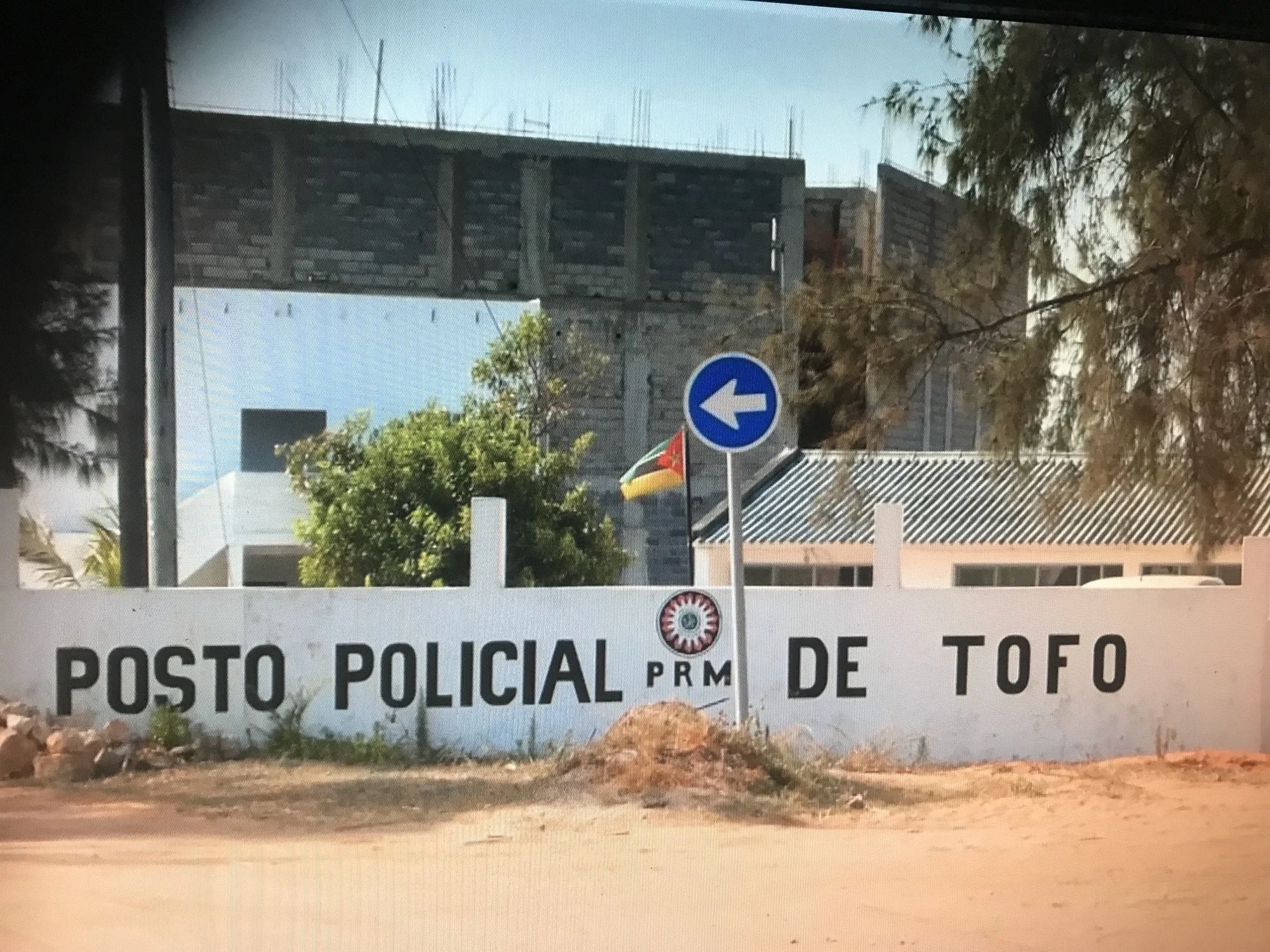
Tofo’s police station right of flag, small building
The AFP, SERNIC and the Homicide Classification
Instead of providing clarity, the contradictions surrounding the investigation caused immense distress for Elly’s family and raised serious questions about whether the investigation was properly conducted and whether the evidence available to Australian and Mozambique authorities was properly examined, recorded and acted upon.
In 2019, during my continued investigation, I discovered that both official SERNIC police reports excluded critical evidence. This included a clear crime-scene photograph showing Elly’s top ripped from her right shoulder down the side of her torso.
The photograph was significant because it documented the condition of Elly’s clothing at the crime scene and was consistent with circumstances suggesting a physical struggle.
The AFP had obtained the clear photograph in 2016 and provided it to Mozambique Chief Inspector Cudzi on 8th December 2016. Yet the clear photograph and ripped apart top was not included or referenced in the revised SERNIC police reports.
This was not an isolated omission. The documentary record reveals a series of contradictions concerning what the authorities knew, when they knew it, what evidence they had in their possession, what information was provided to Mozambique, and what information was ultimately presented to the Coroner.
The Two SERNIC Police Reports April 2017
The AFP Action Sheet records that two separate SERNIC police reports concerning Elly’s death were forwarded through DFAT to the AFP in April 2017.
The first report concluded that Elly had died from an overdose. However, there was no supporting forensic or toxicological evidence establishing an overdose, and the conclusion was inconsistent with the Mozambique autopsy, which had concluded that Elly’s death resulted from a “violent homicide”.
DFAT returned the overdose report to Mozambque police and stated:
“are you sure this is what you want to say when your own autopsy report states violet death homicide,”
Four days later, on 10th April 2017, SERNIC issued a revised report which classified Elly’s death as homicide.
This revised police report establishes that an official Mozambique police investigation had classified Elly’s death as “homicide” in April 2017, years before the AFP position later presented at the 2023 inquest.
At the time, the investigative chain through which these reports had been produced and transmitted had significant credibility concerns. Nevertheless, the revised Moz police report was an official SERNIC police report, recorded within that investigative chain, which expressly classified Elly’s death as “homicide”. It was sent to DFAT and subsequently forwarded by DFAT to the AFP.
What the AFP Confirmed in 2017
There is also direct recorded evidence of what the AFP itself understood at the time.
On 7th September 2017, during a recorded meeting with the Melbourne pathologist, I asked three AFP representatives whether the Mozambique authorities were treating Elly’s death as a homicide investigation.
They answered: “Yes, they are conducting a homicide investigation.”
The 2020 SERNIC police Director General’s Report
The evidence did not stop in 2017.
On 11th August 2020, the SERNIC Director General issued a further report concerning the criminal investigation into Elly’s death. That report identified the matter as:
“First Degree Murder.”
The report was provided to the AFP and DFAT on 20th August 2020.
The chronology was therefore clear:
• On 10th April 2017, SERNIC classified Elly’s death as “homicide”.
• On 7th September 2017, three AFP representatives confirmed during a recorded meeting that Mozambique was treating Elly’s death as a homicide investigation.
• On 11th August 2020, the SERNIC Director General identified the matter as “first degree murder”. That report was provided to the AFP and DFAT on 20th August 2020.
The 2020 report contained a critical statement concerning the investigation which cannot be understated. It directly raises a question about where Elly died and whether her body had been moved after death, because the report stated:
“The place of the crime is UNKNOWN.”
This is significant because Elly’s body had been found near the toilet block, yet the 2020 SERNIC Director General’s report recorded that the place of the crime was unknown. This report was in the Coronial Brief and was therefore before the Coroner at the inquest.
It is also significant because of the clear crime scene photograph. DFAT had obtained the photograph and sent it to the AFP, which in turn provided it to the SERNIC Chief Inspector responsible for the investigation Mr Cudzi and this is his report submitted to the Director General. The photograph had been taken by a fisherman at approximately 5am and clearly showed the condition of Elly’s body and clothing at the scene. Most importantly, it showed her T-shirt ripped and destroyed from the right shoulder down the right side of her body.
That was physical evidence visible at the scene at the time Elly’s body was discovered. Yet the clear photograph tells the truth and was not included in the Director General’s report, and the condition of Elly’s ripped T-shirt was not disclosed!
The significance is difficult to overstate. The same official report that stated “The place of the crime is unknown” did not record the clear photographic evidence showing the condition of Elly’s clothing at the location where her body was found.
The Change of Coroner
The change of Coroner in late 2022 was a major problem. Coroner Bracken, a former homicide detective, had been across the case. The matter was then transferred to Coroner Cain, who had to take over the case after years of investigation and a very large Coronial Brief. The significance of documents and contradictions within the brief was reduced under Mr Cain. Mr Cain then created his own brief, leaving out critical evidence.
The family tried to have some of this evidence reinstated by Mr Cain and we were successful with some evidence after sending correspondence to him. However, major evidence was still left out, including the recording of the meeting between the Melbourne pathologist and the videos I recorded in Mozambique, which had all been officially entered into the Coronial Brief by Coroner Bracken’s assistant in late 2018, where the Chief Inspector who was present at the crime scene Mr Cudzi stated to me:
“The murder did not happen where the body was found as the sand in her mouth was beach sand, not the dirty dark sand found at the toilet block, so the murder happened elsewhere.”
The Coroner’s assistant and Mr Bracken were both aware that Elly’s body had been moved post-mortem after I returned from my first trip to Mozambique in 2018. Mr Bracken organised a meeting with his assistant, Mr King Taylor, where I provided all of my evidence I discovered on my trip. This meeting was video recorded at the Coroner’s Court. Mr Bracken then asked me to provide a detailed factual statement, which I supplied and which was entered into the Coronial Brief.
This provides important clarity for the mentioned above 2020 SERNIC Director General’s report stating: “The place of the crime is UNKNOWN.”
These records are central to understanding the evidence later given by Commander A.P. Smith, particularly his evidence concerning when the AFP became aware that the Mozambique authorities were treating Elly’s death as a homicide investigation and what evidence had been provided to the investigators.
These records are central to the evidence later given by Commander A.P. Smith at the inquest.
Commander A.P. Smith False Testimony Concerning the MAR and When the AFP Knew Elly’s Death Was Being Treated as Homicide
Commander A.P. Smith gave evidence at the inquest on 23rd August 2023. His evidence is recorded at pages 74 to 107 of the transcript day two Elly Warren’s inquest.
At page 94, Commander Smith stated:
“that was the first time, for the first time we became aware through law enforcement, was in May when I ah, when I attended.”
Commander Smith was referring to his attendance in Mozambique in May 2023.
His evidence therefore placed the AFP’s first awareness through law enforcement that Elly’s death was being treated as a homicide investigation in May 2023.
That statement cannot be reconciled with the documentary and recorded evidence.
The revised SERNIC report had classified Elly’s death as homicide on 10th April 2017.
Three AFP representatives had confirmed on 7ht September 2017 that Mozambique was treating the death as a homicide investigation.
The SERNIC Director General’s report of 11th August 2020 identified the matter as first degree murder and was provided to the AFP and DFAT on 20th August 2020.
These records place the AFP’s documented knowledge of the Mozambique homicide classification years before May 2023!
There is further evidence at page 79 of the same transcript. Commander Smith stated:
“We were aware that Mozambique police were conducting inquiries in regards to it.”
That statement is significant because it confirms that the AFP knew Mozambique police were conducting inquiries concerning Elly’s death.
The contradiction is therefore not simply about what Commander Smith personally learned during his May 2023 visit.
His evidence placed May 2023 as the first time the AFP became aware through law enforcement that Elly’s death was being treated as a homicide investigation.
That chronology is contradicted by the official SERNIC reports and by the AFP’s own recorded confirmation in 2017 at the meeting with the family and Melbourne pathologist.
I therefore consider Commander Smith’s evidence very concerning when the AFP first became aware that Elly’s death was being treated as a homicide investigation to constitute “false testimony”.
The final legal characterisation of his evidence is a matter for the appropriate authority. The documentary record, however, establishes a direct and material contradiction between his evidence and information held by the AFP years earlier.
The Mutual Assistance Request
This contradiction is directly connected to the issue of the Mutual Assistance Request, or MAR.
The AFP’s position was that a MAR had not been submitted because the death had not been classified as a crime by the Mozambique authorities.
The documentary record shows why that explanation requires careful examination.
By April 2017, an official SERNIC report had classified Elly’s death as homicide.
By September 2017, three AFP representatives had confirmed that Mozambique was treating the death as a homicide investigation.
By August 2020, the SERNIC Director General’s report identified the matter as first degree murder.
A MAR would not have guaranteed that Mozambique would accept an Australian request or that it would have produced a different outcome.
That is not the issue.
The issue is that the formal request was never submitted.
Without submitting a MAR, Mozambique was never given the opportunity to formally consider and respond to an Australian government request for mutual legal assistance through that mechanism.
The 2021 Hearing
The MAR issue was raised during the 2021 proceedings after the AFP Action Sheet had been disclosed.
The Action Sheet was an official government document maintained under the responsibility of the AFP/SLO Superintendent based at the Australian Embassy in Pretoria. It recorded significant events concerning the investigation over the period following Elly’s death.
After the AFP finally disclosed its Action Sheet at a court hearing in early 2021, the AFP submissions also showed that a Mozambique government official had stated that a joint operation had been possible all along from the outset.
After I informed the Court of those AFP submissions, the Coroner, Mr Bracken, formally requested in February 2021 that the AFP submit an official request to the Director General.
The AFP did not follow through with a formal MAR.
Instead, the AFP sent only a “personal letter”, deceiving the family while the formal process for submitting a MAR was not followed.
That was not the formal government to government Mutual Assistance Request I had understood was available through the established legal process.
The 2023 Inquest Exchange
The MAR issue was also directly addressed during my oral submissions to the Coroner on 11th December 2023, recorded at pages 281 to 283 of the inquest transcript.
The exchange is important because it records the Coroner’s own consideration of the MAR issue and my clarification that the issue was not whether a MAR would guarantee assistance, but whether Mozambique had ever been given the opportunity to agree.
The exchange between Mr Cain and myself at my oral submissions on the 11th December 2023:
MR WARREN: Thank you, Your Honour, for giving me the opportunity today to present my submissions. That concludes my submissions.
HIS HONOUR: So the conclusions you're suggesting that I should come to are that the circumstances of Elly's death are a homicide?
MR WARREN: Yes.
HIS HONOUR: And that other evidence of some violence or poor treatment is the T-shirt that is ripped?
MR WARREN: Yes, Your Honour.
HIS HONOUR: That's relevant, that you think that a mutual assistance request should have been made earlier.
MR WARREN: Yes.
HIS HONOUR: But I think you accept that may not have involved a different outcome because we're still in the instruction phase other than an offer of help, which the Mozambique authorities may have taken up or may not.
MR WARREN: If I can just clarify that point, Your Honour. The instruction phase doesn't refer to the AFP helping with assistance.
HIS HONOUR: And if another country sent us a mutual assistance request, they might help, but there's no guarantee.
MR WARREN: Well, well, I, I was under the assumption that that's what the mutual assistance request was, was in place for.
HIS HONOUR: Well, I think that's not a correct assumption.
MR WARREN: It's not?
HIS HONOUR: No.
MR WARREN: Oh okay.
HIS HONOUR: But I'm sure Mr Yuile had something to say.
MR WARREN: Reading the MAR Act, though, I look at it this way — it actually does state that countries can assist some countries that are not advanced in DNA testing.
HIS HONOUR: It's voluntary.
MR WARREN: And they can send items over for testing.
HIS HONOUR: But it's only if they “agree.”
HIS HONOUR: But look, thank you, Mr Warren. That's been helpful. I now need to give Mr Yuile an opportunity to respond to any of those matters he wishes to respond to.
MR WARREN: I'd just like to say, though, we say “only if they agree” — we never gave them the opportunity to agree.
The final statement is central to my position.
I accepted that a MAR did not guarantee that Mozambique would provide assistance. Mozambique could have accepted the request or declined it.
But Mozambique was never given the opportunity to agree through the formal MAR process because no formal MAR was submitted.
That distinction is fundamental.
The Clear Crime Scene Photograph
The handling of the clear crime scene photograph provides another important example.
The AFP obtained the clear photograph on the 25th November 2016.
DFAT records confirm that the clear version was forwarded by the AFP/SLO to Chief Inspector Cudzi on 8th December 2016.
The AFP therefore had the clear image and had provided it to the Mozambique investigator.
However, the AFP/SLO statement submitted to the Coroner on 17th October 2017 contained only a blurred version of the photograph. The clear version was not included!
An Australian Government Solicitor letter dated 16th June 2023, sent to the Coroner, subsequently confirmed that the AFP/SLO stationed at the Australian Embassy in South Africa had included only the “blurred photograph” in his statement to the Coroner dated 17th October 2017. It also stated that the AFP and AFP/SLO had obtained the clear photograph from DFAT on 25th November 2016. This was the first time the AFP officially confirmed that it had been provided with the clear photograph in 2016, nearly seven years after Elly’s murder!
The significance of this cannot be overstated. The AFP had the clear photograph in its possession in November 2016, yet the photograph provided in the AFP/SLO statement to the Coroner in October 2017 was only the “blurred version”. The clear photograph was therefore known to the AFP long before it was finally acknowledged in 2023. For nearly seven years, the family and the Coroner were left without the AFP’s official confirmation that it had possessed this critical piece of crime scene evidence since 2016.
In my view, this is totally unacceptable. The AFP is Australia’s national policing agency, with legislated policing functions extending to the protection of Commonwealth interests from criminal activity in Australia and overseas, and with responsibility for assisting and cooperating with foreign law enforcement agencies. In circumstances involving the death of an Australian citizen overseas under suspicious circumstances, the AFP was the Australian law enforcement agency assisting within the investigative and coronial process.
The clear photograph was critical crime scene evidence. It was in the AFP’s possession, had been obtained in November 2016, and was subsequently provided to the SERNIC Chief Inspector Cudzi responsible for the investigation. The AFP should therefore have shown total respect for this critical evidence by properly recording and reporting in detail to the Coroner the contents of the only vital clear crime scene photogaph available. Instead, from the outset, the Coroner was provided only with the “blurred version”, which appeared in the AFP/SLO statement of October 2017.
That is not a minor administrative omission. It concerns the withholding from the Coroner of a clear contemporneous crime scene photograph showing the condition of Elly’s body and her ripped T-shirt. In my view, evidence of this importance should have been given the full attention and evidentiary respect required of Australia's national policing agency.
The clear photograph was ultimately provided to the Coroner by me in October 2018.
This raises a fundamental question: why was only the blurred photograph presented to the family and the Coroner when the AFP had already obtained the clear photograph and provided that clear version to the Mozambican investigator in December 2016?
The difference matters. The clear image shows Elly’s top ripped from her right shoulder down the right side of her torso. It documents the condition of her clothing at the crime scene and was directly relevant to understanding the circumstances surrounding her death.
The South African Autopsy and photographic Evidence
The same pattern extends to the South African autopsy evidence.
The AFP Action Sheet records that the AFP received photographs associated with the South African autopsy in 2016.
Those photographs showed marks and abrasions on Elly’s face and around her mouth, including significant swelling of her lip.
Yet those photographs were not included in the material directly provided to the Melbourne pathologist for the initial Australian assessment.
Dr Patricia Klepp also documented extensive packed sand within Elly’s airways during the South African autopsy.
She described the findings as highly unusual and raised concerns about the circumstances surrounding Elly’s death.
On 19th December 2016, AFP officers told me that the Mozambique autopsy had concluded that Elly’s death was the result of a “violent homicide.”
I also told the AFP officers about Dr Klepp’s findings, including the packed sand in Elly’s airways and her concerns about possible foul play.
Dr Klepp had provided contact details at the bottom of her autopsy report and a timeframe within which she could be contacted.
The opportunity to clarify the contradictory findings between the African findings and the Melbourne finding of an undetermined cause of death was therefore available. Yet no one contacted Dr Klepp directly before the Melbourne pathology opinion was formed.
The significance of this evidence became even greater when the later Australian findings were considered. The Melbourne examination in November 2016 did not identify significant sand or record that sand had filled both lungs, as confirmed in compelling evidence given by the radiologist at the inquest. A later CT review identified foreign material in both lungs consistent with sand, with very high density levels equivalent to bone density. In 2023, the Coroner amended the Melbourne pathologist’s finding of an undetermined cause of death, and the cause of death was amended to “aspiration of a large amount of sand.
Dr Klepp's evidence given at the inquest was also compelling stating the airways were “CHOCKABLOCK. along with other vital evidence.
These differences demonstrate why the original overseas evidence required careful examination and reconciliation.
The Mozambique Autopsy Report
The Mozambique autopsy report was another critical piece of evidence.
In December 2016, AFP officers verbally informed me that the Mozambique autopsy had concluded that Elly’s death was a violent homicide.
At that time, the family had not been provided with a copy of the report.
I subsequently had to raise the issue with the Coroner and ask why the family had not received the Mozambique autopsy report. I asked: “Under what legal grounds are you not providing the Mozambique autopsy report to the family?”
The significance is clear as the Australian authorities had information concerning the conclusion of the Mozambique autopsy, while the family did not have the report itself. This created another serious gap between what was known to authorities and what was available to the family seeking answers about Elly’s death.
The Evidence Taken Together
These matters cannot properly be understood by looking at one document in isolation.
The evidence forms a chronology.
The Mozambique autopsy was reported by AFP officers in December 2016 as concluding that Elly’s death was a violent homicide.
The AFP obtained the clear crime scene photograph in 2016 and provided it to Chief Inspector Cudzi on 8th December 2016.
Two separate SERNIC reports were provided through DFAT to the AFP in April 2017.
The first concluded overdose and was returned to the Moz police and a revised report was sent out four days later.
The revised report dated 10th April 2017 classified Elly’s death as homicide.
On 7th September 2017, three AFP representatives confirmed that Mozambique was treating Elly’s death as a homicide investigation.
The AFP/SLO statement submitted to the Coroner on 17th October 2017 contained only the blurred version of the crime scene photograph, despite the AFP having the clear version in its possession from the outset.
On 11th August 2020, the SERNIC Director General identified the matter as first degree murder, with that report provided to the AFP and DFAT on 20th August 2020.
In February 2021, the Coroner formally requested that the AFP submit an official request to the Attorney-General.
No formal MAR was submitted.
On 11th December 2023, I explained directly to the Coroner that the issue was not whether Mozambique would agree. The issue was that “we never gave them the opportunity to agree.”
Then, in August 2023, Commander Smith gave evidence placing the AFP’s first awareness through law enforcement that Elly’s death was being treated as a homicide investigation in May 2023.
The documentary record therefore establishes a direct contradiction in the chronology.
My Conclusion
After years of reviewing the documentary record, police reports, AFP records, photographs, autopsy evidence, recordings and the evidence given at the inquest, I believe these contradictions require serious examination. I have asked the Australian Government for an inquiry into my daughter’s death because the way her case was handled raises concerns that extend beyond my family and concern all Australians. However, my requests have so far fallen on deaf ears!
The evidence shows that information identifying Elly’s death as homicide was available to the AFP years before May 2023.
It shows that the AFP itself confirmed in September 2017 that Mozambique was treating Elly’s death as a homicide investigation.
It shows that the SERNIC Director General identified the matter as first degree murder in 2020.
It shows that the AFP possessed the clear crime scene photograph but submitted only the blurred version in its statement to the Coroner.
It shows that significant South African autopsy evidence was available but was not fully incorporated into the initial Australian assessment.
And it shows that, despite the information available, a formal Mutual Assistance Request was never submitted.
These are not isolated discrepancies.
Together, they raise fundamental questions about what the AFP knew, when it knew it, what evidence it held, what evidence it disclosed, what information was communicated to Mozambique, and why important investigative opportunities were not pursued.
The Coroner’s Court was primarily concerned with determining the cause and manner of Elly’s death. However, the AFP’s actions and inactions, the handling and non disclosure of important evidence, and the evidence concerning whether Mozambique had already classified Elly’s death as a homicide investigation were directly relevant to understanding the circumstances surrounding the investigation and the assistance provided to Elly’s family.
The evidence now available presents a chronology that cannot be reconciled with Commander Smith’s statement that May 2023 was the first time the AFP became aware through law enforcement that Elly’s death was being treated as a homicide investigation.
That contradiction remains unresolved.
The central question is therefore:
If the AFP knew years before May 2023 that Mozambique was treating Elly’s death as a homicide investigation, why was that knowledge not reflected in the later chronology, and why was a formal Mutual Assistance Request never submitted?
These exchanges demonstrate that the AFP never formally submitted a MAR from the Australian Attorney-General to the Mozambique Attorney-General, even though two official revised SERNIC reports had already classified Elly’s death as “homicide” several times well before May 2023.
However, after the AFP finally disclosed its action sheet at a court hearing in early 2021, it became clear, as documented within the AFP submissions, that a Mozambicque government official had stated that a joint operation had been possible all along from the onset.
After I informed the court of the AFP’s submissions, the Coroner at the time, Mr Bracken, formally requested in February 2021 at a court hearing that the AFP submit an official request to their Director-General. To the family’s dismay and disappointment, the AFP did not follow through with a formal Mutual Assistance Request (MAR). Instead, the AFP sent only a personal letter. This process of just a personal letter was far below the official MAR procedure. A MAR is a formal government-to-government mechanism used to request cooperation in criminal investigations, which carries far greater authority and weight between the Attorneys-General of both countries.
I only became aware of this personal letter later, after I formally requested to view the request myself through the Coroner, because I did not trust the AFP. My concerns were fully confirmed when it was revealed that no official MAR had ever been submitted, only a personal letter. This was completely unacceptable! It was a process of just a personal letter that would have been carried out behind the family’s backs, an intentional obfuscation of the official procedure. If I had not asked to see the request, the family would have been kept in the dark!
This episode shows exactly how the AFP operates, keeping things hidden, avoiding accountability and transparency, and misleading those they are sworn to serve under their duty. The AFP were fully aware that a ‘personal letter holds no weight’ whatsoever and can be easily ignored. In contrast, an official MAR requires a direct response, because it is sent to the Attorney-General directly. This is a clear reminder that anyone dealing with the AFP must always keep on their toes and follow up on everything for themselves. The factual evidence here and following examples below clearly demonstrate how the AFP deliberately disguised the full evidence by changing the wording and omitting vital facts within the official police documents, further highlighting their complete lack of transparency and accountability.
The contradictions between the SERNIC police reports, the deliberate exclusion of critical evidence, and the AFP’s failure to submit a formal MAR prove beyond doubt that my daughter’s death was never properly investigated and given no real opportunity for justice. The family was misled, denied answers, and left without justice, while critical investigative opportunities were squandered. The AFP Action Sheet references this critical SERNIC revised police report dated 10th April 2017, reducing a formal homicide finding to a generic “Mozambique document” and masking its true significance.
The AFP Action Sheet below references the SERNIC police reports, which explicitly confirm “HOMICIDE.” Yet the corresponding paragraph reduces this unequivocal police finding to a vague “Mozambique document” and records only a brief, superficial notation, omitting both the issuing authority and the homicide determination. In doing so, the Action Sheet actively deceives any reader regarding the evidentiary significance of the reports and materially misrepresents the severity of Elly’s death, despite forming part of an official government record.


These paragraphs are taken from the AFP/SLO official Action Sheet, which refers to the two Mozambique SERNIC police reports merely as “Mozambique Document.” Importantly, as the Action Sheet itself confirms, these are not Mozambique autopsy reports. During my oral submissions to the Coroner, Mr. Cain, on 11th December 2023, I explicitly clarified this distinction (Transcript Pg 284, 291). What this demonstrates, beyond any doubt, is that the AFP deliberately presented a misleading account to the Coroner. By minimizing and misrepresenting the reports, they concealed the true gravity of the findings, deprived the family of justice, and obscured critical investigative failures that were central to resolving Elly’s murder. That this misrepresentation appears in an official AFP record is particularly serious, as such documents carry a formal obligation of accuracy and transparency.
The AFP lawyer took full advantage of describing the 10th April 2017 document as a “Mozambique document” from a doctor, when in fact it is an official SERNIC police report. At the inquest, the AFP lawyer attempted to mislead the coroner by downplaying the report’s status. The document is a formal police report from Mozambique’s top criminal investigation authority, explicitly stating homicide, yet the AFP action sheet refers to it generically, omitting the issuing authority, the homicide determination, and its case file number, 775/2016.
The 10 April 2017 SERNIC report clearly states in its opening paragraph:
1)“We hereby inform Your Excellency that legal proceedings are currently underway before the Provincial Director of SERNIC in Inhambane in relation to Criminal Case No. 775/2016, a homicide, in which the victim was the aforementioned Australian citizen, single, 20 years old, daughter of Paul Warren and Nicole Caffakella.”
Below is the first paragraph taken word for word from the official police report sent to the AFP and DFAT on the 11th August 2020 from their DIRECTOR GENERAL!
2) Crime- case No. 775/2016 is running at the SERNIC provincial office of Inhambane. Which the public prosecutor’s office is conducting against individuals yet unknown allegedly indicted for the practice of the legal type of first degree Murder. foreseen and punishable under the terms of art. 157 of the penal code (PC),the victim of which was the Australian ELLY ROSE WARREN .single, 20 years old on the date of her death, student who was staying at the tourist resort named UYANI PARYANGU ,located in the Tofo beach, city of Inhambane ,that occurred on the 9th November 2016.
Also In the body of the report as I have stated, states the site of “CRIME UNKNOWN” as their facts obviously prove Elly’s body was moved after her death to the toilet block location!
Despite this explicit confirmation of homicide, the AFP Action Sheet reduced the first report in 2017 to a vague “Mozambique document,” effectively masking its true evidentiary significance and misrepresenting the seriousness of the findings. Had the AFP treated this as an official police report, it would have mandated the review and submission of a formal Mutual Assistance Request (MAR) from the Australian Attorney-General to the Mozambique Attorney-General, the proper protocol for offering investigative support in a confirmed homicide.
During the inquest, the transcript shows that the AFP and coroner misunderstood or misrepresented this critical point:
MR WARREN: Do you agree that the AFP had enough information to state that this was a crime at the time?
HIS HONOUR: Probably not.
MR WARREN: Well, they had the police reports.
HIS HONOUR: But they had information that came from another jurisdiction. They hadn't conducted their own criminal investigation.
MR WARREN: We never gave them the opportunity to agree.
These exchanges demonstrate that the AFP had sufficient official confirmation of homicide in April 2017 but failed to submit a MAR. As a result, the Mozambique authorities were never given the opportunity to consider, agree to, or act on a MAR, because one was never sent in 2016 or 2017. This failure represented a missed opportunity, misrepresented the state of the investigation to the family, and effectively denied us justice while obstructing any proper investigative response.
Together, the 2016 Mozambique autopsy report and the two SERNIC police reports the first from April 2017 and the second from August 2020 sent from Their “DIRECTOR GENERAL” unequivocally confirm that Elly was a victim of homicide. The autopsy, obtained by the AFP in 2016, clearly recorded her death as a violent homicide, and both police reports consistently reinforce this classification under case file No. 775/2016. Taken together, these three documents hold overwhelming evidentiary weight, formally establishing that Elly’s death was a homicide well before 2023. Yet, despite this clear and consistent record, the AFP continued to reference the reports ambiguously, misrepresenting their significance and failing to take the necessary steps, including issuing a formal MAR.
It is noted that in the AFP’s submissions to the Coroner and the court, it is stated that “no police authority had ever stated Ms Warren’s death was a crime/homicide before May 2023.” This statement is directly inconsistent with official records and evidence previously obtained, including SERNIC police reports and documented statements from Inspector Cudzi, which clearly indicate that concerns regarding criminality or homicide in relation to Ms Warren’s death were raised well before May 2023.
The discrepancy between the AFP’s submissions and these prior official statements is significant and has the potential to misrepresent the investigative record to the Coroner and the court.
This inconsistency is deeply concerning not only for Elly’s family but also for the integrity of investigative and judicial processes relied upon by all Australian families in similar circumstances. In his official submissions to the Coroner, dated 18th December 2023, Mr Cain on behalf of the AFP Commissioner presents information, specifically at paragraph 18(b) on page 7, that does not align with the key documented facts of the case, as demonstrated by the evidence outlined below.
‘At no “POINT “ before the meeting on 19th of May 2023 between commander smith and the deputy attorney-general for criminal matters in Mozambique ( and others) ( May 2023 meeting) had the Mozambique law enforcement authorities stated that Ms Warren’s death was a “HOMICIDE”. no police officer, investigator or prosecutor ever said that.’!
The AFP were given the prosecutors report along with their autopsy report in 2016 but the family or coroner has never seen this prosecutors report to this year 2026. it is clearly documented in the AFP summary in the coronial brief that they obtained the Mozambique Autopsy report and the prosecutors report in 2016.
The cumulative effect of these contradictions, omissions, and misrepresentations raises serious concerns and borders on deliberate deception!! The Australian Federal Police had serious evidence that they were aware of with full knowledge that Elly’s death had been officially classified as homicide. Once the AFP became aware of this classification well before 2023 therefore it warranted the preparation and submission of a formal Mutual Assistance Request (MAR) to the Mozambique Attorney-General. Instead, the AFP failed to act, misrepresented critical evidence in their own Action Sheet, and withheld vital information and material evidence in misleading both the family and the coroner!
This was not a simple oversight or bureaucratic error. It reflects a systemic failure that denied an Australian family justice, obstructed a proper homicide investigation, and left my daughter’s murder unresolved. Nearly a decade later, the AFP’s inaction continues to frustrate the family, leaving clear evidence of wrongdoing unexamined and raising serious questions about accountability and transparency in cases involving Australians overseas.

Note: The above refers to when AFP/SLO passed the blurred photo to the Mozambique inspector in charge, Mr Cudzi, on 20th November 2016 by email, after receiving it from DFAT. In the AFP action sheet, it is only referenced as “photo taken by fisherman”. At this stage, the blurred photo revealed very little discernible evidence, and it was not possible to distinguish the critical details of the crime scene, including Elly’s ripped top.

Note: This is the clear crime scene photograph referred to above. In the AFP action sheet, it is still described only as a “copy of the photo by the fisherman,” a characterisation that reduces what is, in fact, a clear and critical crime scene photograph, dated 8th December 2016, containing vital evidence, including Elly’s ripped apart top, to a vague and misleading description that downplays its evidentiary significance and materially misrepresents the severity of Elly’s death.
The image is of high clarity and reveals critical details at the crime scene that are not visible in the earlier blurred version. This crystal clear version was provided to Inspector Cudzi by the AFP Senior Liaison Officer via email on 8th December 2016, fourteen days after the AFP Senior Liaison Officer had received it from DFAT on 24th to 25th November 2016.
To illustrate the importance of this clearer version, a reenactment photograph highlighting the ripped apart top is provided at the bottom of this Investigation account.
The coroner and the family were never informed in 2016 about
the clear version of the photograph showing Elly’s top ripped
apart.
We were, instead, only provided with a “BLURRED” version. I attempted to explain this to Mr. Cain during my oral submissions on 11th December 2023 (Transcript Pg. 274), and his response was:
His Honour: “Mr. Warren: I am not sure where this is taking us.”
Mr. Warren: “Well, Your Honour, the clear photo shows Elly’s top ripped apart in 2016.”
His Honour: “The ripped top is not in dispute here.”
What I was trying to convey was that it took two years for the coroner’s court to become aware that Elly’s top had been ripped apart, and this crucial evidence was deliberately withheld by the AFP!! It was me who uncovered the facts the top was ripped apart to the coroner. While I may not have fully articulated this to Mr. Cain at the time, I am confident he understood that the coroner remained unaware of the ripped apart top in 2016 and for the following two years. This represents a clear and serious failure by the AFP, leaving the family misled, denied justice, and without critical information. It raises a fundamental and damning question: why did the system, and AFP, so profoundly failed my family? was it diplomatic reasons, were the AFP aware of the Mozambique cover-up?!!!
Mr. Cain then questioned:
Mr. Cain asked, “What difference would it have made if it was in 2016, 2017, 2022, or 2024?”
This above from Mr Cain is in reference to the Mutual Assistance Request (MAR), with respect, this question invites speculation. Courts and coronial proceedings are required to deal with evidence and established facts, not hypothetical outcomes based on alternative timelines.
The reality is that we will never know whether a Mutual Assistance Request would have made any difference, because no MAR was ever sent to the Attorney General of Mozambique to give them the opportunity to either agree to or refuse the request. Without that request ever being sent, the process that could have tested international cooperation was never even initiated.
As a result, any suggestion about what might or might not have happened remains purely speculative. The only established fact is that the option to pursue a Mutual Assistance Request was not taken, as critical evidence capable of further supporting that a crime had occurred was not disclosed by the AFP in 2016/2017. Consequently, the opportunity for Mozambique’s Attorney General to consider and respond to such a request never existed because the request itself was never sent Notably, the SERNIC police reports later clearly classified Elly’s death as a homicide well before 2023.
The fact remains that a “CLEAR” crime scene photograph taken on 9th November 2016 clearly shows Elly’s top ripped apart. This evidence existed from the very beginning of the investigation and was known to the Australian authorities in November 2016 not long after Elly’s highly suspicious death, yet it was never disclosed to the family or to the coroner by the AFP!
The issue, therefore, is not speculation about what a MAR might have achieved in different years, but rather the failure to properly acknowledge and pursue material evidence that was already available in 2016, which would have further supported the classification of Elly’s death as a crime or homicide!
It is also notable that in his findings, Mr. Cain stated that there was “no cooperation whatsoever” from Mozambique authorities. He records that this position was conveyed to him by the Australian Federal Police (AFP), based on the documentary material and evidence presented at the Inquest.
That conclusion is demonstrably incorrect and is contradicted by multiple, independent pieces of evidence showing sustained cooperation over several years at both operational and institutional levels.
The revised SERNIC police report dated April 2017 formally classified Elly’s death as a homicide. This alone disproves any assertion that there was “no cooperation whatsoever.” While the report was issued under precarious circumstances and must be treated with caution, it nevertheless represents formal engagement by Mozambique authorities at an early stage.
During 2016, Inspector Cudzi actively assisted the AFP. This cooperation included facilitating official meetings, granting permission for the AFP Senior Liaison Officer to attend the crime scene, allowing photographs to be taken, and authorising the collection of evidentiary material, including a trace sand sample. Personal belongings belonging to Elly and other items were also made available. However, critically, the vital clothing Elly was wearing at the time of her death was not collected. In addition, the AFP Senior Liaison Officer took detailed notes during meetings the crime scene doctor, senior Mozambique government and police authorities, further demonstrating operational cooperation.
By late 2016 or early 2017, the official Mozambque autopsy report, explicitly recording a violent death or homicide, had been formally provided to the AFP. This transfer caused concern within DFAT, as it had not been informed that the report had already been obtained.
Further cooperation is evidenced by the second SERNIC police report dated 20th August 2020, issued by the SERNIC Director General in response to a formal request from Australian government agency DFAT for an update on the case.
In May 2023, following Mr Cain’s statement that the AFP needed to “move heaven and earth” to assist the family, the AFP deployed a senior commander to Mozambique on an official mission, more than seven years after Elly’s death.
During that visit, senior Mozambique prosectorial authorities, including the Deputy Attorney-General, reaffirmed that Elly’s death continues to be treated as a homicide. They confirmed that suspects had been identified but that there was insufficient evidence at that time to lay charges, and this highlighted the critical evidentiary importance of Elly’s clothing.
Taken together, these facts establish clear, ongoing, and documented cooperation from Mozambique authorities over several years. The assertion that there was “no cooperation whatsoever” is therefore not supported by the evidence and represents a fundamental error of fact.
This conclusion is further reinforced by the AFP’s own submissions to the Coroner’s Court in December 2021 and February 2022. At paragraph 40, it is explicitly recorded that a Mozambique government official confirmed that a joint operation with the AFP was possible in relation to this matter.
This acknowledgment is significant. It demonstrates that cooperation was not only available but supported at a governmental level, and it raises serious and unavoidable questions as to why the opportunity for a Mutual Assistance Request (MAR), which carries far more weight than a personnel letter request, was not fully pursued, particularly given the critical importance of cross-border collaboration in a case of this nature. The reason is, in fact, straightforward: the AFP were aware of the MAR’s authority and its direct line from Attorney-General to Attorney-General. They chose not to send the official MAR because they feared that Mozambique might accept it, which would have made the AFP formally accountable and directly involved in the case. As they are not trained homicide detectives, this responsibility would have been difficult, and as a result, they avoided their duty to provide full support to Elly’s family and, therefore, to all Australians overseas who need support in similarly diabolical or extreme circumstances!
During my oral submissions at the inquest, I chose not to raise the Mozambique cover-up or the possible switching of Elly’s top at the crime scene. At that time, the Mozambique police were conducting a renewed investigation, and I did not want to risk interfering with their work. I was also advised, because of the close relationship between the court and VIFM, not to push my concerns about the “VIFM pathologist” or the “Melbourne VIFM laboratory” too far, as it could be seen unfavorably by the coroner as they have solid connections together and are placed in the same building at the coroner’s court. While I found this advice extremely frustrating and unacceptable, I had to be careful about what I said. It was deeply upsetting not to be able to present the full truth at my oral submissions!
The Victorian Institute of Forensic Medicine (VIFM) laboratory had possession of the clear crime scene photograph in 2016, as confirmed in the AFP lawyer’s recent letter and official records. Yet, the laboratory did not provide a report on the clear photograph to the coroner or the Melbourne pathologist, despite it clearly showing highly susphious circumstances Notably Elly’s ripped apart top and half naked body.
This critical evidence, the clear version of the crime scene photograph, was available to VIFM in Melbourne in 2016. It should have been thoroughly analysed at that time, and a full report provided to the coroner at the outset from one of the countries top forensic laboratories. Despite this, no such report was issued!
The photograph contained highly suspicious and sufficient detail to warrant a thorough forensic examination. Elly's top had been destroyed, ripped from her right shoulder down across her torso, along with other critical aspects of the scene, including the position of her body, lying face down on a firm surface and partially unclothed, with breadcrumb sand present on one side of her buttocks only. These were matters of clear evidentiary importance that required proper analysis in 2016.
If a full report had been provided to the Coroner in 2016, including all available forensic evidence at that time, it would have enabled a clearer understanding that Elly’s death was highly suspicious. In those circumstances, a Mandatory Assessment Review for a Mutual Assistance Request would have been justified, ensuring that the AFP formally submitted an offer of assistance to Mozambique. This would have been made through an official process between the Australian Attorney-General and Mozambique’s Attorney-General, facilitating cooperation with a country that lacked the forensic capacity to undertake such a complex homicide investigation.
The chain of trace evidence shows that VIFM failed in its duty. By not properly analysing and reporting on this photograph, they blocked a full and accurate understanding of Elly’s death and denied the family timely access to the truth. VIFM had this vital evidence but took no action, which is completely unacceptable for one of Australia’s leading forensic laboratories.
Evidence of this importance is exactly why it is sent to the laboratory: to be carefully examined and properly reported on. I tried to raise this issue with Mr Cain regarding VIFM, but it was clear he was not willing to fully engage, likely because it involved the court’s own forensic laboratory. I had to tread carefully and could not push the matter too far. The failure to act on such critical evidence was a serious breach of duty and significantly prevented the family from gaining a complete and accurate understanding of Elly’s death in 2016.
However, I was not aware that VIFM had access to a clear crime scene photograph between 2016 and 2017. I did not know that such a photograph existed, and neither did the Coroner. Instead, we were only provided with a “blurred” image by DFAT and the AFP between 2016 and 2018. What I was aware of at the time were the conflicting autopsy reports, which raised serious concerns. Following meetings with the Melbourne pathologist and the AFP in 2017, I was left deeply dissatisfied. It became clear to me that if any progress was to be made, I would have to take matters into my own hands.
After this, I began planning a trip to Mozambique (Tofo) to follow in my daughter’s footsteps. At this stage, I still did not know about the “CLEAR” photograph showing Elly’s ripped apart top. I was simultaneously organising the inquest with the Coroner’s Court, which required extensive preparation. It was not until February 2018, after growing increasingly frustrated with the AFP, that I decided to go to Mozambique around the same time of year Elly had been there in October and November 2016.
My Trips to Mozambique
By 2018, I had lost all confidence in any Australian authorities, particularly the AFP, and I certainly had no confidence in the Mozambique authorities to obtain justice for the family. In October 2018, two years after my daughter Elly’s death, I decided to travel to Mozambique myself to see where Elly had died and to retrace her steps. I hoped that, even after two years, I might uncover solid evidence. I had no idea what to expect, but the locals were friendly, generally viewing visitors from other countries as wealthy and approachable.
On the second day, I was informed by a local that someone had important information for me. I met with this person, and he showed me a “CLEAR” photo of Elly at the crime scene with her top ripped from her shoulder down her torso. This was the first time I had ever seen this explicit image; until then, I had only seen a blurred version. I was shocked and could hardly bear to look at the clear photo knowing it was Elly with her black bare feet visible. Astonishingly, as I later discovered, the Australian Federal Police and DFAT had possessed this clear photo since 2016 but had never disclosed it to the family, coroner, or the Melbourne pathologist, thereby concealing that Elly’s top had been completely destroyed, ripped apart! The AFP had even provided the photo to the Mozambique Chief Inspector, yet the coroner in 2016 remained unaware of its existence until I sent this clear version to the Coroner’s Court in October 2018 to the then coroner (Bracken), while still in Tofo on my trip to investigate Elly’s murder!
DFAT had already provided this photograph to the Police Coronial Support Unit (PCSU) in 2016 and sent it to the VIFM laboratory. As I have mentioned I raised this during my oral submissions to Mr Cain, attempting to make it clear that the coroner’s “team” had clear possession of this critical clear image of vital evidence from the beginning. However, in 2018, Mr King Taylor, the coroner’s assistant, confirmed that the photograph had simply been filed away and not shared or properly examined at the time. Importantly, both the AFP and the Mozambique Chief Inspector also had possession of this critical clear version of the crime scene photograph taken by the fisherman telling the truth in 2016 but did not disclose this vital evidence in any official reports.
This clear crime scene photograph was one of the most important pieces of evidence I obtained during my first trip. Despite this, it was not acted on or disclosed by Australian or Mozambique authorities until I uncovered it myself in October 2018.
The fact that such vital evidence was effectively buried, despite being held by authorities in both countries since 2016, is wholly unacceptable and raises serious questions about the integrity, transparency, and adequacy of its handling!
This evidence should have been carefully considered in 2016, particularly when determining whether a crime or homicide had occurred. Instead, it was not acted upon. This goes beyond a simple oversight. The manner in which this evidence was handled raises serious questions as to whether the potential consequences of recognising a possible homicide, including the need to formally escalate the matter through an official Mutual Assistance Request and offer direct assistance, were properly confronted!
I had also spoken with two local individuals who later proved to be highly significant witnesses. They had been allowed onto the crime scene at approximately 6:00 a.m. to identify Elly’s body. Both reported that she was in a different position than shown in the fisherman’s clear photograph, noting that she was not lying flat but positioned similarly to a Muslim prayer posture. This raised serious concerns that the scene had been deliberately manipulated to make her death appear accidental, as if she had fallen forward headfirst into the firm pathway.
Given that the police had control of the scene from around 5:30 a.m., this information cast deep suspicion over the official investigation. It was clear that the handling of the scene was not merely careless. It pointed to a systematic failure and potentially deliberate obstruction by authorities whose actions reflected corruption, disregard for proper procedure, and a shocking lack of accountability. From that moment, I understood that extreme caution was essential, as the very people entrusted with justice could not be relied upon to uncover it.
However, I did raise the matter later on with Chief Inspector Cudzi in his office at the criminal headquarters. He became visibly upset, waving and pointing his finger at me. Being in their country, I understood it was not in my best interest to pursue the issue aggressively, but I made him aware of my concerns.
These two witnesses who informed me about Elly’s changed body position were video recorded, and the coroner’s court possesses all these video recording which the then coroner Mr Bracken placed into the evidence brief. Mr Charlie Bezzina, a retired Melbourne homicide detective, reviewed the recordings and confirmed this by stating to me “This is Golden Evidence Paul.” Both witnesses independently corroborated each other’s accounts. Additionally, a security guard reportedly saw Elly around 2 a.m., information relayed to me by staff at the Tofo De Mar Hotel, further highlighting the lack of effective police investigation. This was later dismissed at the inquest as it was too dark with no street lights you could not see where you were walking let alone establishing it was Elly from a distance as he admits he could not see the clothes the person was wearing at the time.
During my eight-day stay in Tofo, it became clear that the local police were the group to be most careful around. While locals were friendly and welcoming, they were intimidated by the local police, some of whom carried AK-47s. The locals confirmed that tourists caught committing minor offenses were often jailed for days to extract money, showing the coercive power of the police in Tofo. However this is how they made sure they got paid!!
I arranged a meeting with the local police superintendent, who directed me to the Criminal Investigation Police in Inhambane. I organised a translator and a lawyer for these official meetings. The local superintendent facilitated a meeting with the Chief Inspector, Mr Cudzi, who was responsible for Elly’s case. His office was a 20-minute drive away in Inhambane, the headquarters of SERNIC, the top criminal police division.
The following day, in Inhambane, Inspector Cudzi confirmed what we had already strongly suspected based on our time in Tofo and the evidence we had been working through. However, this was the first time it was officially verified.
I asked the Chief Inspector directly whether he was aware that Elly’s body had been moved after her death. At the time, the area where her body was found was a firm, rocky surface. Although we visited the site two years later, my instincts from the beginning told me something was wrong. Based on Dr Klepp’s conclusions, it would not have been possible for Elly’s airways to have been packed with sand at the toilet block location.
The Chief Inspector then confirmed:
“She was not murdered there. The sand where the body was found was not the same sand found in her airways from that location. Her body was moved there after her death.”
It later came to light that an AFP liaison officer had taken a sand sample from the scene just one week after Elly’s death. However, this sample was never submitted as evidence or included in any official statement. As a result, a second comparative sample was never taken from Elly’s body, despite the same officer being informed at a meeting with the Chief Inspector, just nine days after her death, that there were suspicions her body had been moved post-mortem.
This demonstrates that critical forensic opportunities were missed, and key evidence was either overlooked or mishandled, significantly undermining the investigation from the outset.
There are also strong grounds to suspect that Elly’s clothing was interfered with before the scene was formally inspected and documented.
Two local police officers attended the scene at approximately 5:30 a.m. It has also been reported that a prominent businessman from Tofo, with significant local business interests, was present at the scene at that time.
Shortly after, around 6:00 a.m., those same officers obtained Elly’s clothing from the place where she had been staying.
According to Elly’s mother, Nicole, two of Elly’s favourite black T-shirts were never returned.
This detail is critical.
When the Chief Inspector and the crime scene doctor attended the scene later that morning, at around 9:00 a.m., neither of them reported seeing a top that had been ripped apart, despite photographic evidence taken at approximately 5:00 a.m. clearly showing significant damage.
It is not plausible that this damage was overlooked.
The crime scene doctor later removed money from Elly’s bra and examined her body, including the removal of her clothing. Both the doctor and the Chief Inspector were present at the scene and had direct, immediate access to observe Elly’s condition from the outset.
The damage to the top was not minor. It was severely torn, ripped from the right shoulder all the way down the torso. This level of destruction would have been obvious to anyone conducting even a basic examination.
In addition, Elly’s body position had been altered. She was no longer lying flat, but had also been moved into a Muslim prayer position, head-first into the pathway.
Given these circumstances, it is not credible to suggest that such extensive damage to her clothing went unnoticed.
Taken together, these facts raise serious and unavoidable questions.
If Elly was wearing a ripped top, and that top was not observed or reported by senior investigators just hours later, then something does not add up.
One reasonable explanation is that the original damaged top was removed and replaced with another item of clothing before the scene was formally examined at 9am.
If that occurred, it would explain the complete absence of any reference to a ripped top in the official police reports.
It would also represent a serious breach of evidence integrity at the very earliest stage of the investigation.
This is not a minor discrepancy. It points to the possibility that critical evidence was altered, removed, or replaced, undermining the reliability of everything that followed.
The Chief Inspector’s omission is particularly significant. Despite attending the scene that morning, he made no mention of a ripped top in his report.
I only fully recognised the extent of the damage after returning home, as I was unable to properly examine the photograph at the time due to its distressing nature. Once viewed clearly, the damage was unmistakable.
By 2016, this evidence had been provided to the AFP. From that point forward, the Chief Inspector could not claim to be unaware of it.
This leaves two possibilities. Either he failed to observe and document a critical piece of evidence at the scene, or he became aware of it later and failed to correct the record.
Either way, a vital piece of evidence was not properly recorded or acknowledged!
This leads to one unavoidable question. How could both the Chief Inspector and the crime scene doctor, after removing all of Elly’s clothing and directly examining her body, fail to identify and report a top that had been completely destroyed and ripped apart. Such damage could not reasonably have been missed!
As I have previously stated, all video recordings from my trip to Mozambique in October 2018 were formally submitted into evidence in the Coroner’s Court in December 2018. This followed a meeting with the Coroner, Mr Bracken, with the assistance of Mr King Taylor.
These recordings included Video No. 75, in which Inspector Cudzi explicitly stated that Elly had been murdered and that her body had been moved.
In addition to the video material, the Chief Inspector requested that I prepare an official statement incorporating all of the evidence I had obtained. He was clearly impressed by the factual evidence I had gathered and recognised its importance, which is why he wanted it formally documented. This included the clear and critical evidence I had collected, which was formally handed over to him. This statement detailed his own assertions, including his confirmation that Elly’s body had been moved after her death, along with other key evidence relevant to the case.
After I completed the statement, it was formally stamped and certified by a Notary, confirming its official status. I then personally provided a certified copy to the Chief Inspector in his office, ensuring he was formally in possession of this evidence.
Despite its significance and formal certification, this document was not included in Mr Cain’s brief. This omission is deeply concerning, given that it was an official document directly reflecting statements made by the Chief Inspector and formed part of the evidence I submitted.
While in Tofo, I encountered a local businessman who had been present at the crime scene that morning along with the fisherman who discovered Elly’s body and took the photo, though he told no one he had done so. The businessman appeared to influence how the local police handled the crime scene. At the time, he directed the police and told them to rope off the area and not let anyone in. This later proved very important because Nicole, Elly’s mother, had hired an investigator who visited the scene a couple of months after me and had access to all my recordings from Tofo. When the investigator interviewed this businessman again, he completely changed his story, claiming that he had not told the police to rope off the crime scene. I had, however, recorded exactly what he said at the time, when I was in Tofo a few months earlier, which is a matter of fact and cannot be disputed.
During my trip, I also met Dr. Klepp, the South African doctor who conducted Elly’s second autopsy. She confirmed the abundance of sand in Elly’s body, highlighting discrepancies with the Melbourne pathologist, who had found none. This reinforced my frustration with the Melbourne pathologist and AFP, as her evidence could have clarified the cause of death much earlier in 2016. As it turned out at the inquest in 2023 seven bloody years later Dr Klepp’s evidence was compelling and changed the Melbourne pathologist undetermined conclusion to Aspirating a large amount of sand obstructing the airways causing death!!!
This trip was incredibly beneficial, and I realized that I should have gone immediately when Elly’s suspicious death happened. I trusted the AFP’s advice, as probably most Australian families would but this is my only regret: not taking the very first flight over when it happened.
The evidence I obtained in just a few days was extraordinary and undeniable. The clear crime-scene photograph, the witnesses who confirmed tampering of the scene by local police, and video statements from the Chief Inspector, who said, “Elly was not murdered where the body was found,” all pointed to the same conclusion: Elly had been murdered elsewhere, moved after her death, and placed at that location to make it appear accidental. Initially, this deception worked, as the local police ran with the story. The Chief Inspector confirmed the truth, noting that the sand found in her mouth did not match the sand at the scene, proving without question that Elly’s body had been relocated after she was murdered.
I also obtained other crucial information, including the behavior of local residents and the extent to which they were intimidated by the local police. I gathered statements from a businessman on video who provided key facts, as well as testimony from two witnesses, also on video, who confirmed that the crime scene had been tampered with. For those who do not know, Mr. Charlie Bezzina is a retired Melbourne detective, highly respected for his work. When he became involved in 2019, he emphasized the importance of acting immediately, explaining that the first few days on the crime site are critical for securing vital trace evidence. His advice reinforced the necessity of acting independently and decisively in such circumstances overseas, particularly in third-world countries, to preserve the trace evidence, truth and obtain answers.
This was invaluable advice from Mr. Bezzina for anyone facing similar circumstances overseas: don’t hesitate like I did. Knowing what I know now, I deeply regret not acting more quickly and decisively.
Upon my return in 2018, Mr King Taylor instructed me to provide all information and evidence from my trip, including the video recordings. These were entered into the brief for the Coroner’s Court. However, when Coroner Cain took over in 2022, he was never fully brought up to speed on the case. Many of the facts had been effectively buried over the years, and as he created his own brief, much of this vital evidence was effectively left out.
After this trip, I confronted the Melbourne pathologist autopsy report again and expressed my deep dissatisfaction with the way the autopsy had been handled in a letter to the coroner at the time Mr Bracken. I also demanded answers from the Australian Federal Police (AFP) about their inaction, despite the evidence I had managed to gather in just eight days.
Although I sent daily emails and follow-ups, the AFP did not respond until March 2019. Their response warned me not to copy third parties into correspondence, stating that the information was for “official use only” and raising concerns about compromising coronial and diplomatic processes. This was extremely frustrating, particularly as key investigative evidence remained undisclosed by the AFP.
What made this even more troubling was that the evidence I had obtained during my brief eight-day investigation was significant. Later, I discovered that both the AFP and the Department of Foreign Affairs and Trade (DFAT) had received the “CLEAR” photograph in 2016. The image clearly showed that Elly’s T-shirt had been ripped apart. Despite its importance, this critical evidence was never disclosed to our family or to the coroner at any time to this day by the AFP avoiding all there responsibilities as the governing Australian police authority for overseas!
I have spoken about this vital evidence and the AFP’s motives, but this was the moment it all began to unravel and expose the AFP. Vital evidence had existed within Australian government agencies as early as 2016, yet neither our family nor the coroner ever received this critical crime scene photograph from the AFP. The image clearly showed that Elly’s T-shirt had been ripped apart from the shoulder all the way down her torso, strongly indicating that a violent struggle had taken place. Evidence of this nature demanded respect, serious attention and a detailed report to the coroner by the Australian Federal Police, Australia’s national policing authority responsible for serious criminal evidence involving Australians overseas. Yet the AFP the very agency tasked with supporting the coronial investigation failed to provide this evidence, leaving our family and the investigation completely in the dark.
Instead, this crucial evidence remained undisclosed for years!
When Coroner Mr Bracken took over the investigation in 2018, he was also unaware that this photograph even existed. It was only after my trip to Mozambique in October 2018 that I personally provided the “CLEAR” photograph to the coroner’s office. This meant that a key piece of crime scene evidence had been in the possession of Australian authorities since 2016, yet it was not disclosed to the coroner responsible for investigating Elly’s death by the AFP.
Had this evidence been properly reported and disclosed when it first came into the possession of the Australian Federal Police in 2016, Elly’s coronial investigation may have taken a far more direct path toward justice from the outset. This was not minor evidence this was critical crime scene material, clearly showing that Elly’s T-shirt had been ripped apart, proving that a violent struggle had occurred and that the circumstances of her death were deeply suspicious. The AFP’s failure to act on or disclose this evidence allowed the investigation to stall, leaving our family without answers for two long years!
For anyone in similar situations: exercise extreme caution and be highly sceptical about relying on the AFP. From my experience, their guidance is often non-transparent, providing only partial or selective information, only what they want you to know (HALF-TRUTHS). They may appear serious and actively involved, but over time it becomes painfully clear that much of this is just to fool you and the media so you get off their backs. As the facts above demonstrate, they withhold critical evidence, use misleading language to avoid accountability, and their lack of genuine commitment can cost you precious time and jeopardize essential investigative evidence.
With some media, it is a “scratch my back, I’ll scratch yours” situation, so they are often unwilling to report anything untoward about the AFP.
Go over yourself immediately. The first few days on-site are absolutely critical for securing the truth and obtaining vital evidence and answers. Hire a private investigator if possible, and take every step to preserve all evidence, especially the clothes worn at the time of death and any trace evidence. Had I understood this then, I would have been on that very first flight, leaving nothing to chance. As I’ve said, this remains my biggest regret!!
My second trip to Mozambquie
On my second trip, twelve months later, I returned to post a reward, hoping that someone might finally come forward with information. Tofo is a small village where everyone knows each other, and many locals appeared afraid to speak, largely due to police intimidation and the influence of local powers. As a result, I was unable to obtain any factual information beyond what I already knew. It was extremely disappointing that no one approached me with additional information, even with the reward being offered. A sum of money like that would represent a small fortune for many people there.
I was particularly careful returning home, avoiding the airport as I had not seen the police at all on my second trip so I started to get suspicious and instead of flying back to Maputo I got a taxi as I avoided the airport however I in-counted extensive police roadblocks and armed personnel. My taxi driver, who knew Elly personally, ensured a safe journey to Maputo, charging 15,000 Metical (350 AUD).
It wasn’t until 2021, after Nicole Elly’s mother engaged a lawyer in Mozambique, that the local police investigation was reopened in 2022 The authorities reaffirmed again that my daughter’s death was indeed a homicide. A 2023 meeting with AFP and Mozambique officials in Maputo further confirmed that the evidence had always proved Elly was murdered and that KEY suspects existed, highlighting the critical importance of her clothes for DNA evidence!!!
Sting Operation Mad Nick
First I need to explain that Mad Nick is a private German investigator. He saw the 60 Minutes program on Elly and as he was very familiar with Mozambique he then decided to contact me in June 2020.
He offered his services Pro Bono to help me with Elly’s investigation.

I mentioned the tip off to Nick (Pictured above) that I received in March 2020 and he started to look into it for me. He said he has run undercover operations before with huge success and then told me about some of his operations. They were secretive as the authorities he was working for did not want people to know he was the person responsible for the successful operation and not them, and he was fine with this.
He told me we can run a similar operation here that may just work, therefore the sting operation was in motion as it was something we did which could have paid off. The reason we did this was because I received a tip off in March 2020 from a lady on Facebook.
The lady had just stayed in Tofo and had some information about a man called Toni who was in charge of the gang and drug trade in Tofo. She told me her kids came home from the market one night and asked their caretaker where they were staying if he knew a man called Toni. He told her kids I can't say anything except that Toni is not a nice man, you need to keep away from him. The next day the lady asked the caretaker about Toni. He said do you know about the Australian girl? And she said yes. Tony and his gang were behind that. She said he is very dangerous and has tattoos all over with a teardrop tattoo on his face. He would hang out near Branco’s pizza place.
Nick and I both thought this is a tip off which was genuine. Nick said we need to run an operation and we needed to interview some girls over there who we can send in to make friends with Tony (Antonio) and run a sting operation. It took some time and money but we actually got in off the ground and had a girl sending actual recordings back to us on Tony. They were about some crimes he had committed in the past but not about Elly.
The issue we had is she just couldn't mention Elly all of a sudden after so many years, this would have given her away and arouse suspicion. We had just arranged to set up at the toilet block for more pictures to go up of Elly which had been taken down to start some talk around Tofo again to help her. However as we were setting this up the girl got scared with some of the things Tony was saying to her and she was very worried so we decided to stop and pull her out as it was too dangerous before we got any solid information on Elly. In the end this was a disappointing outcome but we had to try given the information we were given.
We are currently working on another suspect who has left Tofo and we are looking into the information we have on him. I can’t say too much more about this other than the information we have obtained is promising and he is well protected!!
The Radiology Report
You may be wondering why a radiology report was so critical. It became pivotal because the findings directly challenged the credibility of the Victorian institute of forensic medicine (VIFM) pathologist who conducted Elly’s autopsy in Melbourne. In fact, the coroner’s court initially seemed reluctant to have this Radiologist doctor appear as a witness, likely because the facts in the radiology report did not reflect well on the Melbourne autopsy from the coroners court own VIFM.
Mr. Charlie Bezzina, a well-respected retired Melbourne homicide detective, began assisting me in 2018. One day, reviewing the extensive marks and bruising on Elly’s face with a fat lip, he asked me if there had been any fractures to Elly’s head. I realised immediately that this was a critical point and said, “That’s a good question I will find out.” This led directly to obtaining the radiology report, which revealed and unquestionably proved crucial evidence that had been overlooked or unrecorded in the Melbourne autopsy. The report confirmed no internal injuries on Elly’s head, but revealed some critical evidence in very high density levels of sand found in Elly’s airways. I was shocked with this evidence and I needed a second opinion from another pathologist In Dr Byron Collings who confirmed the sand in the radiology report was “substantial”. The imaging at the time supported the Mozambique and Dr. Klepp’s original findings that Elly’s airways had an abundance of sand packing her airways, and further demonstrated the inconsistencies in the Melbourne pathologist’s conclusions!
This radiology report was not just another piece of evidence it became a linchpin in understanding the violent circumstances of Elly’s death and underscored the systemic failures that had occurred in 2016 and 2017. Without it, the full picture of her injuries and the timeline of events would have remained obscured, allowing critical investigative opportunities to be missed.

Mr Charlie Bezzina
I rang Mr. King Taylor, the coroner’s assistant, early in 2019 and asked him about possible fractures to Elly’s head given all the marked abrasions and bruising on her face. He said he did not know and would have to ask the autopsy pathologist. To my amazement, the Melbourne pathologist did not know either, but Mr. Taylor informed me that I could request a radiology scan from the CT images of Elly’s body. I was astonished that this had not been done in 2016 with all the abrasions and marks on Elly’s face. The South African autopsy photo proves this evidence and were taken in 2016 before the Melbourne autopsy seven days after Elly’s death.
I told Mr. Taylor I wanted the radiology scan done, and to my amazement, it showed Elly’s airways were full of sand, with extremely high density levels of 1290HU and 947HU, and no fractures to the head. When I received the report from Dr. O’Donnell, I was shocked at how much sand remained in Elly’s airways. I am no doctor, but reading and viewing the report gave me a clear idea of the scale. All of this was later confirmed at the inquest, as Dr. O’Donnell stated that both lungs were full of sand with very high density levels in the upper and lower airways equivalent to Bone density from his report.
The Melbourne pathologist was asked about the radiology scan by Mr. Taylor in mid-2019. All he could say was that it was “impossible to quantify the sand in the airways.” Knowing Elly’s airways were full of sand, I arranged to see another pathologist, Dr. Byron Collins, who told me, “I can't explain how he missed the sand in his autopsy examination. All I can say, Paul, is the radiology imaging shows it’s there all the way down her airways and into both lungs.”
From day three of the inquest on 24th August 2023, Dr. Lynch stated: “I confess, I saw what I've described as a small amount of sand in the airways, but I didn't think to take it as a sample. I have specifically commented that there was a small amount of residual sand, and this would be, ah, mixed with the body fluids related to decomposition and also to the embalming process.”
Dr. Klepp, in evidence at the recent inquest, confirmed she had removed a tampon from Elly and placed it in a plastic bag inside her body for transport to Melbourne. The Melbourne pathologist had not found the tampon in his examination. When asked, he said:-
“it is possible I may have missed it.”
What shocked me even more was the compelling evidence from Dr. O’Donnell and Dr. Klepp at the inquest. Dr. O’Donnell stated that Elly’s lower lung trees were completely full of sand, with the density at the back of the nose measured at 1290HU and the lower airways at 947HU, near bone density (around 1000HU). I have detailed this in my oral submissions transcript blog. These numbers indicate just how packed the sand was, and how impossible it seems that the Melbourne pathologist could have missed it, yet his autopsy conclusion was undetermined. This has caused so much trouble for the family, because the other two autopsies had clearly recognized the cause of death, and this is the major reason why it has taken seven years.
I could not present all this during my oral submissions on 11th December 2023, because I was advised it would not have been in my best interest it would have been the last thing the coroner, Mr. Cain, would have wanted to hear about one of their own VIFM doctors. My legal team also overheard that the Melbourne pathologist was referred to as “Linchy” at some stage in the inquest.
The Inquest 2023
Seven years after my daughter Elly’s death, just before the inquest in August 2023, the Mozambique authorities “reaffirmed yet again” that Elly’s death was a homicide at a meeting when the AFP finally sent a commander to meet with the Mozambican officials. They have suspects, but insufficient evidence to convict, making Elly’s clothes critical for DNA testing. The Melbourne coroner, however, after conducting an inquest, could only state that it was possible Elly’s death was a homicide. This low-confidence finding has profoundly let the family down, despite highly suspicious circumstances and compelling evidence indicating that my daughter was murdered.
It was crucial for the coroner to clearly recognize Elly as a homicide victim and support the Mozambique authorities’ conclusion. The judge in Mozambique had adjourned the case in June 2023, waiting for the outcome of the Australian inquest before deciding the next steps in their investigation. The Melbourne coroner’s lack of confidence has likely undermined any chance of justice for Elly and our family.
When dealing with the Victorian Coroners Court, even if a loved one’s death is straightforward overseas and officially recorded as homicide, it still must be determined in Australia. I learned this the hard way. If a doctor at the Victorian Institute of Forensic Medicine (VIFM) completes an autopsy, they are expected to align with the overseas doctors’ conclusions. If not, it creates “major obstacles”. In Elly’s case, the Melbourne pathologist concluded “undetermined,” despite both Mozambique and South African doctors finding her airways abundantly packed with sand.
Dr. Klepp, a South African pathologist, testified at the inquest that Elly’s airways were, and I quote, “chockablock” with sand, even after the Mozambique autopsy on 14th November 2016, just five days after Elly’s death, and following her own examination on 16th November 2016, seven days after her death. This was a primary reason I requested a meeting with the Melbourne pathologist in 2017. I had already been informed by Dr. Klepp by phone in November 2016 about the packed sand. Yet, at the meeting on 7th September 2017, the Melbourne pathologist claimed there was no mention of packed sand, stating:
“I did not see any sand whatsoever.”
I attempted to explain both Dr. Klepp’s conclusions, the eyewitness account from the crime scene, and the findings of the Mozambique autopsy, but this critical evidence was ignored and disregarded by the Melbourne pathologist.
This highlights a systemic problem: when the Melbourne pathologist disagrees with overseas doctors, the coroner often defers to VIFM, leaving families at a disadvantage. However, Dr. Klepp’s compelling evidence given at the inquest regarding the sand ultimately led the coroner to change the Melbourne pathologist’s original “undetermined” cause of death.
Mr. Cain then concluded the cause of death as “aspiration of a large amount of sand.” However, this description downplays the reality that the sand was densely packed, or “chockablock,” as described in detail by Dr. Klepp in her evidence. In doing so, it diminishes the severity of the findings and reflects the earlier failure in 2016 to properly account for the extent of packed sand present, particularly given that both the Mozambique and South African autopsies concurred that the airways were fully obstructed by sand, causing death.
The earlier undetermined and incorrect conclusion by the Melbourne pathologist likely influenced how the case was initially handled in 2016 and 2017. Had he sought further advice from Dr. Klepp, she could have explained the initial impact of the packed sand and why it was highly suspicious, including her observation that the evolving marks suggested it was possible Elly’s head had been held down. He was aware that the initial overseas autopsies had found substantial sand, as he had been provided with these reports. I personally informed the Melbourne pathologist at a meeting in September 2017 of Dr. Klepp’s conclusions, and both the AFP and DFAT had email records of her concerns regarding the packed sand she found during her examination.
The issue appears to stem from the Melbourne pathologist’s failure to account for all the sand during the 2016 autopsy, as confirmed by the radiology report. Dr. O’Donnell’s evidence clearly highlighted the extent of this oversight and its impact on determining the cause of death. Yet, this critical and contradictory evidence was not fully addressed in Mr. Cain’s findings. In Elly’s case, the inquest eventually revealed the true circumstances surrounding her cause of death, but this came seven years too late, with the inquest held in August 2023. The exclusion of such essential expert analysis for so many years raises serious questions about the thoroughness of the investigation and the adequacy of the conclusions drawn. For families seeking justice, this delay demonstrates how procedural oversights can materially compromise outcomes, leaving fundamental questions unanswered and prolonging the suffering of those left behind.
Had the Melbourne pathologist conducted a video conference with Dr. Klepp in 2016, or even just phoned her, I am certain he would have recognized the full extent of sand obstruction in Elly’s airways much earlier. This would likely have established the cause of death years before 2023, highlighted further suspicious circumstances, and prompted the AFP to submit a Mutual Assistance Request (MAR) in 2016. Yet, despite already having prior knowledge and access to a clear photograph of Elly’s ripped top, the Mozambique autopsy, and the police report confirming homicide in 2016, the AFP failed to take this essential step. The confirmed cause of death, airways densely packed with sand, would have elevated Elly’s death to a highly suspicious category. Along with the other compelling evidence, this should have clearly justified the AFP sending a MAR to provide direct assistance to a country lacking the necessary resources to conduct a technically complex homicide investigation!
A major issue was that the AFP never provided the crystal-clear crime scene photograph, which clearly showed Elly’s top completely destroyed and ripped apart, directly to the Melbourne pathologist or the coroner. Nor did they provide the South African autopsy photographs documenting the severe marks on Elly’s face. Official records confirm that the AFP had acquired all of this vital evidence in 2016, and the AFP themselves stated in official records that they were supporting the coroner in her coronial investigation from 2016.
Despite having all critical evidence, the AFP’s prolonged inaction and mishandling over the years exposed systemic failures within the agency and severely hindered the pursuit of justice for Elly. Seven years of delay, ignored evidence, and missed opportunities are completely unacceptable. These failures represent a profound breakdown in the systems responsible for investigating and prosecuting homicide, leaving the family to endure prolonged trauma and uncertainty. This was not a minor oversight it is a glaring institutional failure, demonstrating how systemic neglect can deny justice even when the facts are clear.
I attempted to inform Mr. Cain of the discrepancies I observed with the AFP during my oral submissions, but he dismissed the issue, stating it was outside the jurisdiction of the Coroners Court and that any concerns with the AFP would need to be taken up directly with them. This was profoundly disappointing, and it raises serious questions about the protection and recourse available to other Australian families. If Elly’s family is denied accountability and answers regarding the AFP’s shortcomings, what hope do other families have in similar circumstances?
There can be no question, based on official records and proven facts, that the AFP failed Elly’s family. Yet if the AFP are not held accountable, how can this systemic inadequacy ever be addressed? The current approach leaves Australian families, especially those seeking justice for loved ones who are victims of serious crimes committed overseas, effectively forced to conduct their own investigations. This is particularly concerning when the countries where the crimes occur lack the resources and technical forensic capabilities to carry out a proper homicide investigation. This is wholly unacceptable when families are simply trying to obtain factual answers and closure. As it stands, the system fails to protect ordinary Australians and denies them the certainty, accountability, and justice they rightfully deserve!!!
Inquest and Systemic Failures
The coroner holds complete control over an inquest. Even when submissions are made, the coroner typically gives priority to the opinions of Melbourne VIFM doctors. In Elly’s case, it was evident that the Melbourne pathologist did not fully understand the evidence. Without Dr. Klepp’s compelling testimony and Dr O’Donnell's we would still have no confirmed cause of death!
Initially, the court refused to call radiologist Dr. O’Donnell, even though his report clearly showed that Elly’s airways contained high-density sand, with both lung trees fully filled. At a recorded meeting with consent, the Melbourne pathologist stated that he found no sand whatsoever in Elly’s airways. In contrast, Dr. O’Donnell’s radiology report, taken from the CT scan conducted just before the Melbourne pathologist’s autopsy on 22nd November 2016, recorded extremely high-density sand readings: 1290 HU in the upper airways and 947 HU in the lower airways. These findings confirmed Dr. Klepp’s observations and the Mozambique autopsy and directly supported the conclusion of packed sand and violent homicide.
The upper airway reading of 1290 HU reflects the actual density at the time of death, equivalent to pottery or cement, meaning Dr. Klepp’s post-autopsy washing could not have dislodged it. While the lower airway might have been slightly affected by washing, both lung trees were fully packed, which can only occur when someone is alive and breathing sand deep into the lungs.
My lawyer and I had to fight to have Dr. O’Donnell recognized as a witness. The court initially appeared to protect the Melbourne pathologist, highlighting how institutional bias can impede justice. Without the testimonies of Dr. O’Donnell and Dr. Klepp, we would still have no confirmed cause of death. Dr. Klepp was not initially guaranteed as a witness, as Mr. Cain made it clear he would not compel her to testify, stating she would need to appear of her own accord. She only agreed to participate just days before the inquest.
During the inquest, my barrister requested that Mr. Cain allow the doctors to be cross-examined separately. Questioning all three at once could be confusing and might obscure critical discrepancies. Mr. Cain said he would consider the request and adjourned.
During that adjournment, another person representing a separate authority followed Mr. Cain into chambers, an unusual and highly improper action that may have influenced his decision. When proceedings resumed, Mr. Cain denied our request. This cross-examination sequence was critical because it would have revealed serious contradictions, particularly about the presence of sand in Elly’s airways. Dr O’Donnell and Dr. Klepp confirmed a significant amount of packed sand filling both lungs, while the Melbourne pathologist reported finding none whatsoever!
At the time, I was unaware of the coroner’s discretion in this matter, but both my barrister and solicitor were deeply concerned and explained the potential implications. That evening, my barrister consulted colleagues and advised me the following morning that we had grounds to seek Mr. Cain’s removal, confirmed by senior legal advisors. However, pursuing this action would have required a completely new inquest before a different coroner, essentially restarting the process after seven years. To avoid further trauma to the family, I chose to continue with the existing inquest.
Despite acknowledging gaps in the evidence at a hearing in February that year, before the inquest, Mr. Cain initially excluded several key witnesses. Most concerning was his refusal to call Dr. O’Donnell, the senior radiologist whose report objectively confirmed high-density sand in Elly’s airways prior to the Melbourne autopsy, independent pathologist Dr. Byron Collins, private investigator Mr. Roos, and retired homicide detective Charlie Bezzina. All of these witnesses had previously provided statements or reports to the court, and all agreed that the factual evidence indicated Elly’s death was a homicide. Only after strong representation from my lawyer was Dr. O’Donnell at least allowed to testify at the inquest. The transcript below captures Mr Cains reluctance to call Dr O’Donnell:
(Inquest transcript, 23 August 2023, page 129)
29, His Honour: “Yes. Let me deal with Dr O’Donnell in the first
30, instance. He was an input into Dr Lynch’s report and he’s only
31, here because your client requested it.”
Systemic Limitations
The coroner refused separate cross-examination of the three doctors, despite its importance in highlighting contradictions.
Vital witnesses were initially excluded, and their evidence was misinterpreted or presented in a misleading way.
The coroner generally defers to VIFM doctors’ reports, creating strong institutional bias.
Even with representation, navigating the system requires careful strategy, including avoiding direct criticism of VIFM doctors.
The AFP’s failures worsened the situation.
No Mutual Assistance Request (MAR) was submitted to Mozambique.
Evidence was misrepresented in their Action Sheet and with evidence given.
Critical information was withheld from the family and the coroner from the outset.
During the inquest, I attempted to hold the AFP accountable, including Commander Smith and Mr. Scruton, but Mr. Cain was reluctant to criticize their actions.
Conclusion
Elly’s cause of death was ultimately established through the compelling evidence of Dr. Klepp and Dr. O’Donnell, showing that her airways were obstructed by a large amount of densely packed sand, leading to her death. This evidence left Coroner Mr. Cain no choice but to revise the Melbourne finding from undetermined to reflect the true cause.
The inquest also exposed systemic failures. The AFP, VIFM, and procedural biases left the family unsupported for years. Critical evidence was ignored or misrepresented, essential experts were initially excluded, and institutional priorities appeared to favor protecting internal interests over delivering justice. Without persistent advocacy and expert testimony, the family would likely still have no confirmed cause of death or recognition of homicide.
This case exposes the barriers families face in seeking justice for Australians overseas and underscores the urgent need for far-reaching accountability and transparency.

Reenactment Clear Crime Scene Photograph
My reenactment photo below, based on the clear crime scene photograph, shows the exact position of Elly’s body and clearly illustrates that her top was ripped from the right shoulder down the right side of her torso, while the left side remained intact, covering the shoulder and arm as it should. Mr Charlie Bezzina, a retired Melbourne homicide detective, has reviewed both the original clear photograph and my reenactment. He confirmed that the damage to the top is a very good representation of the destruction seen in the actual photograph. While the reenactment cannot be exact, it accurately reflects the body’s position and the significant evidence of the ripped top; in the original photo, the underwear was around the knees.
Now, imagine being the detective or doctor who arriving at this crime scene at 9am standing over a body in this condition. Would you fail to record or report that the top had been ripped apart? The fact is, the actual clear photograph taken by the fisherman that morning showing the top destroyed is not mentioned in any official police reports or statements from either Mozambique or Australia to the day, nor is it referenced in the Coroner’s conclusion. Why? Because this photograph exposed the early morning cover-up by the local Mozambique police, concealing the true circumstances of Elly’s death by all authorities!