
Concealment of Critical Evidence in the Coronial Investigation of Elly Rose Warren
This report examines the failures, omissions, and misrepresentations that undermined the Australian coronial investigation into the death of Elly Rose Warren.
It is important to distinguish the roles of the authorities involved. The Australian Federal Police (AFP) and the Department of Foreign Affairs and Trade (DFAT) were acting to assist the Australian coronial investigation. By contrast, the actions of the Mozambique Police, including a deliberate police cover-up, occurred outside the Australian coronial process and were not under its control or oversight.
Based on verified evidence, this report demonstrates that information supplied by the Australian Federal Police, the Department of Foreign Affairs and Trade Honorary Consul (H/C), and the Mozambique Police was incomplete, inaccurate, or misleading. These deficiencies materially distorted the evidence placed before the Coroner and the Coroner’s Court of Victoria. Taken together, the conduct reveals a systematic pattern that concealed critical evidence, weakened the coronial brief, and obstructed Elly’s family’s ability to understand the circumstances of her death and pursue justice. The consistency and cumulative effect of these failures demonstrate that they were not isolated errors or accidental oversights, but part of a broader and sustained breakdown in transparency and accountability!!



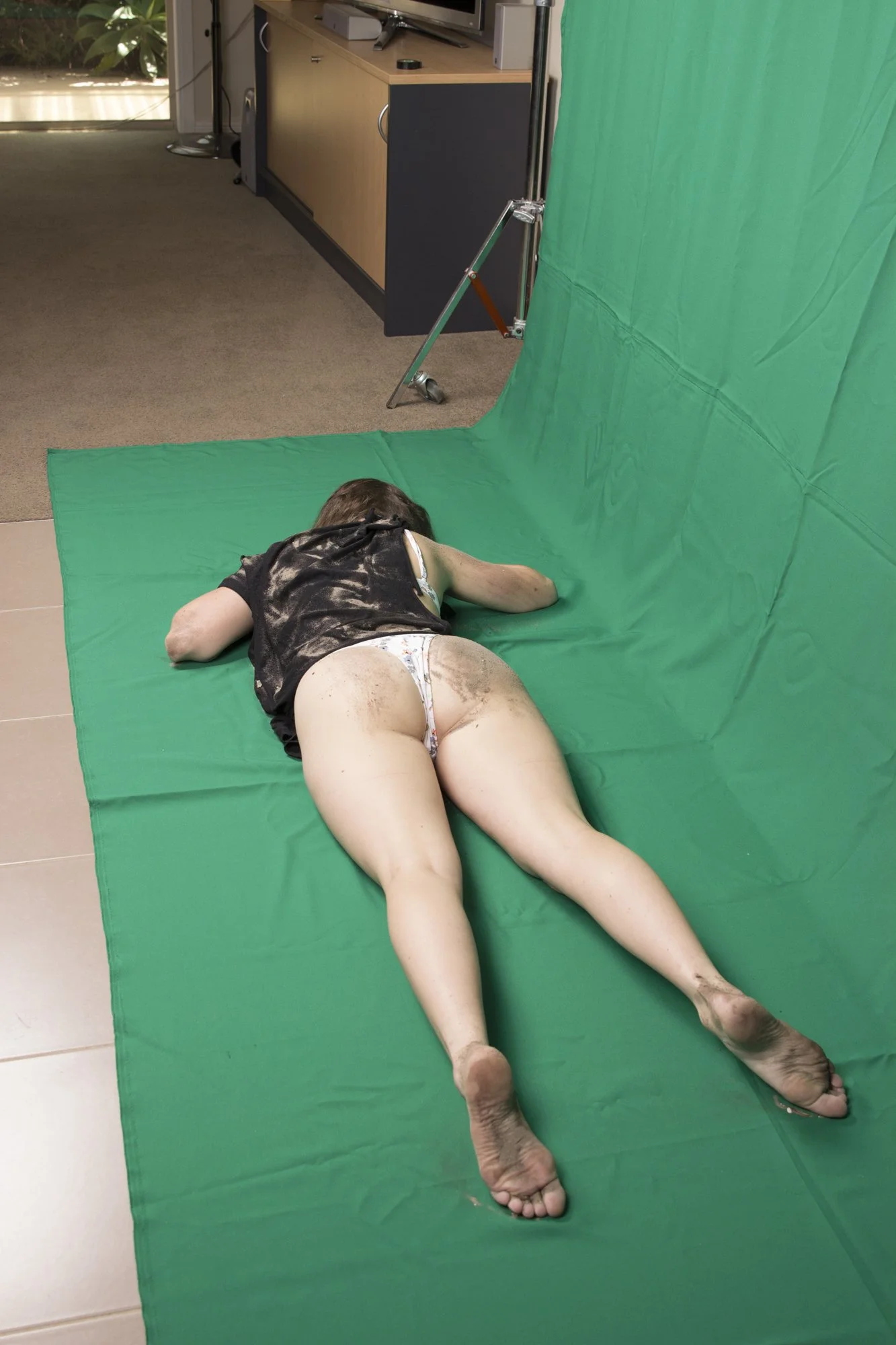
The Clear Photograph and Re-enactment Images
The re-enactment photograph above, included with this report, demonstrates how Elly’s ripped-apart top would have appeared while standing. A second re-enactment photograph, shown at the end of this report, replicates the condition of the damaged top and the position of Elly’s body as seen in the original clear photograph taken by the fisherman who discovered Elly’s body at around 5:00 a.m. Together, these images confirm the importance of the original clear photograph and the critical evidence it contained, which was not properly disclosed or assessed by any authorities from the outset.
In the early stages following Elly’s death, the Honorary Consul (H/C) became directly involved with key evidence obtained from a Tofo local fisherman who was a primary eyewitness. Shortly after Elly’s death, the H/C visited Tofo on the weekend of 12–13th November 2016, where the fisherman informed him that he was the first to find Elly’s body in the early hours and had taken a photograph of her body. Because the fisherman’s phone could not download the image, the H/C photographed the phone screen himself, producing a blurred image showing only the outline of the body with underwear around the knees. The H/C then sent this blurred image via WhatsApp to Australian embassy staff in Pretoria. The fisherman’s contact details were recorded in the H/C’s report (inquest transcript pages T116–T124).
After the H/C had left Tofo, the fisherman emailed him a clear version of the photograph. This crystal-clear image clearly showed Elly’s top ripped apart, providing indisputable evidence of a struggle, information that was not reported during the H/C’s initial visit to Tofo or in his report to the Australian Embassy in Pretoria. The H/C subsequently forwarded the clear photograph to embassy staff in Pretoria, and correspondence from DFAT and the AFP confirms this chain of events and timeline with documented records.
We contacted the H/C again in October 2025, and he admitted that he had received the clear photograph by email from the fisherman after leaving Tofo and had passed it on to the Australian Embassy. As official recorded documents substantiated, this sequence of events and the transmission timeline of the clear photograph were clearly established, leaving no doubt as to its provenance and handling.
Despite this, the H/C’s official statement to the Coroner in July 2023 made no mention of the clear photograph or the events that took place after he left Tofo. During inquest testimony, he stated that he had “no follow-up contact” with the fisherman and was only aware of the blurred image he personally took and sent to the Australian Embassy on 13th November 2016. This directly contradicts the official recorded documents and correspondence submitted to the Coroner, which clearly show that he received the clear photograph from the fisherman after leaving Tofo and had subsequently forwarded this clear version to the Australian Embassy. The inquest transcript pages (T125, T128) therefore reflect misleading testimony, misrepresenting the sequence of events and omitting critical evidence regarding Elly’s death!!
By the time of my oral submissions to Mr Cain on 11th December 2023, the timeline establishing how the clear photograph and Elly’s ripped-apart top had been obtained by DFAT had already been compromised by the H/C’s prior testimony!! During my submissions, I referred to both the clear photograph and the ripped-apart top. After I concluded, the Coroner asked the AFP Counsel if he had anything to add or comment on about my submissions.
Counsel for the AFP challenged the integrity of the broken “timeline chain” (T-287 below), creating a real legal risk that this primary evidence could have been ruled inadmissible or excluded from the inquest entirely. However, Mr Cain stated that he accepted the sequence of events relating to the clear photograph at that time, and accordingly it remained in evidence. My lawyer advised me that the H/C should only be challenged if absolutely necessary, as further examination carried the risk of procedural complications and an uncertain response from the Coroner. In light of the Coroner’s acceptance of the timeline for the clear photograph, I therefore decided not to further expose or challenge the H/C at that stage.
Notwithstanding this, the chain of evidence was disrupted following the H/C’s prior testimony at the inquest, affecting the continuity of the timeline. From that point onward, we were unable to question other witnesses, including the AFP/SLO and the Melbourne pathologist, about the clear photograph or Elly’s ripped-apart top. This significantly limited the family’s ability to present our full case to the Coroner!
I was extremely frustrated, as I had significant unanswered questions for both the AFP/SLO and the Melbourne pathologist regarding this evidence. In particular, the AFP/SLO had included only the blurred photograph in his official statement and had, in fact, passed the “explicit naked” clear photograph of our daughter to the Chief Mozambique Inspector on 8th December 2016, as official records confirm, without the family’s knowledge or consent a failure to fulfil their responsibility to inform the family, as I only discovered this vital evidence for myself two bloody years later! This further disrupted and complicated the timeline! The clear photograph was never entered into the AFP/SLO’s statement, leaving critical gaps in the record, including in relation to how it ended up in the hands of the Chief Inspector! The Melbourne pathologist was never provided with this vital evidence in either 2016/18! Later, in the official records, including SERNIC’s report dated 10th April 2017 and 20th August 2020, the Mozambique authorities did not disclose this critical evidence of the clear photograph and the ripped-apart top!
I understand that this photograph was vital crime scene evidence, particularly as it clearly showed signs of a struggle, including the ripped-apart top, and that the Mozambique authorities needed access to it, but failing to inform the family of the explicit naked photograph of our daughter represents a serious and unacceptable breach of professional and ethical duty by the AFP! It was critical in establishing that the circumstances of our daughter’s death were highly suspicious at an early stage, as in April 2017 the top SERNIC police in Mozambique formally classified Elly’s death as a homicide. As noted in the first paragraph of both Mozambique official police reports, Ms. Warren is a victim of homicide and one was sent by their “DIRECTOR GENERAL”. However, the AFP never informed the family of the photograph’s existence, nor did they seek the family’s permission to share it! This was highly unprofessional and completely unacceptable given the serious circumstances of our daughter’s suspicious death in 2016. In my view, these omissions were particularly serious, given that both the AFP/SLO and the Melbourne pathologist held professional responsibilities arising from their qualifications and experience. As a result, critical aspects of the evidence remained unexplored, severely limiting the inquest’s ability to fully examine the circumstances!
My barrister and solicitor had also warned me that any attempt to raise the clear photograph or the ripped-apart top would likely be challenged by AFP counsel, a risk that ultimately proved well-founded. AFP counsel was particularly vigilant “like a hawk” in invoking the broken timeline during my oral submissions. This non-disclosure and procedural restriction prevented proper cross-examination and obscured clear evidence of a struggle. It is important to emphasise that these constraints directly blocked the family from “fully presenting critical evidence of a struggle”, underscoring the serious and ongoing impact of the H/C’s prior testimony!
At the time, I did not fully grasp how serious this compromise of the evidence was. Only later, at the end of the day, when my barrister explained it to me, did I understand its full gravity. The clear photograph was our primary piece of material evidence, and the timeline showing how it was obtained and transferred was critical in the court process. Once that timeline was broken by the H/C’s testimony, the inquest was effectively destroyed for Elly’s family. We were completely restricted in presenting our full case to the Coroner, as we could no longer properly examine or rely on this crucial evidence.
AFP Handling and Accountability
AFP records confirm that the experienced AFP/SLO Superintendent, as noted on page 21 of his official action sheet, confirmed that the H/C had the clear photograph one week after Elly’s death. He personally analysed it again in 2018, confirming it was the same photograph the H/C had obtained shortly after Elly’s death, consistent with the timeline showing that the fisherman emailed the clear photograph to the H/C soon after leaving Tofo.
This raises serious concerns, as the AFP/SLO entered only the blurred photograph in his official statement, despite having prior knowledge of the clear photograph in November 2016. It was not until October 2018, when I brought back the clear photograph from Tofo, that he subsequently analysed it, confirming that it was the same clear photograph the H/C had obtained one week after Elly’s death. The photograph I brought back on my trip to Tofo in 2018 was therefore the same critical piece of evidence the clear photograph that the AFP/SLO analysed in 2018.
Critically, the AFP/SLO included only the blurred photograph in his official statement to the Coroner on the 17th October 2017, as documented in his action sheet. This is officially confirmed by Australian government solicitor (AGS) records. These records show that the blurred photograph was entered only in the AFP/SLO statement because it was the image the H/C had obtained from the fisherman on 13th November 2016, which, as the recorded facts demonstrate, was blurred. At that point, only the blurred photograph was in the hands of the H/C as the H/C had not yet received the clear photograph, which he only obtained soon after leaving Tofo following 13th November 2016!
I must also clarify the AFP Action Sheet at this point, as its contents are extremely important and are referenced frequently throughout my investigation. The Action Sheet documents the chronological sequence of key events, including dates, communications, and detailed correspondence from the time of Elly’s death and continuing for the following two years. It records factual information and was maintained under the responsibility of a highly experienced AFP/SLO Superintendent posted at the Australian Embassy in Pretoria, South Africa. This is an official government document and was entered into the coronial brief. The 23 page AFP action sheet is on this website at the end of a blog (Response to the AFP statement 27th may 2024)
The AFP/SLO did receive the clear photograph from DFAT on 25th November 2016, as confirmed by official documents contained in the AGS letter to the Coroner dated June 2023 and subsequently included within the coronial brief. This is further corroborated by records confirming that the AFP/SLO Superintendent later passed this vital evidence, the clear photograph, to the Mozambique police on 8th December 2016. DFAT Assistant Secretary Claire McComish also officially confirmed in correspondence dated 22nd March 2019 that DFAT provided the clear photograph to the AFP/SLO Superintendent, and that it was subsequently provided to the Mozambique police by the AFP/SLO on 8th December 2016. This is also confirmed in the action sheet recording that the AFP/SLO transmitted the Fisherman’s photograph for a second time by email to the Chief Inspector on 8th December 2016, which is identified in official records as the clear version.
However, despite the significance of this critical crime scene evidence, the AFP/SLO Superintendent failed to disclose in his statement at the time that he had received the clear photograph from DFAT on 24/25 November 2016 and subsequently passed it on to the Mozambique authorities on 8th December 2016. This omission concealed a crucial part of the evidentiary record provided to the Coroner, particularly the timeline regarding when the “clear crime photograph” was first received by the AFP and subsequently provided to Mozambique police!
As a direct consequence, the critical evidence of the clear photograph was not entered into the coronial brief by the AFP. Instead, only the blurred photograph was entered into evidence during that period. The clear version was ultimately entered into evidence by myself after I emailed it to the Court during my visit to Mozambique in October 2018. Until that time, neither the Coroner nor Elly’s family were aware of the existence of the clear photograph.
This sequence of events raises serious concerns regarding the completeness and transparency of disclosure by the AFP and AFP/SLO, and indicates a material failure to properly record and communicate critical crime scene evidence relevant to the coronial investigation.
This was a case involving a young deceased Australian girl under highly suspicious circumstances, and such crucial evidence should have been handled with far greater diligence, transparency, and respect. A detailed report on the clear photograph, clearly showing vital signs of a struggle, should have been provided to the Coroner in 2016 when the AFP received this critical evidence!
As the controlling Australian police authority for overseas suspicious crimes, the AFP was the accountable body, particularly given their deep involvement in supporting the Coroner with Elly’s coronial investigation. The AFP/SLO went to Tofo with a DFAT representative, attending vital meetings and taking detailed notes, visiting the crime scene, taking photographs, and retrieving a trace evidence sand sample from the scene during these critical early stages. Critically, they failed to formally enter into evidence the clear, highly suspicious crime scene photograph, which clearly showed Elly’s top completely ripped apart, evidence of a struggle leaving this vital piece of evidence unreported in the coronial brief. This represents a serious lapse in both statutory and professional responsibility.
The photograph was clearly critical, showing highly suspicious circumstances. Elly’s top was ripped apart and completely destroyed, leaving no doubt that a struggle had taken place. Despite the AFP/SLO analysing this evidence again in 2018, he still failed to disclose to the Coroner that the top was ripped apart destroyed a key detail directly demonstrating the severity of the circumstances and the violent nature of the incident. To this day, there is no correspondence from the AFP acknowledging the existence of the clear photograph showing the ripped-apart top. This represents a clear failure by the AFP and the AFP/SLO to properly support Elly’s family and the coroner and to ensure that the full truth surrounding her death was fully presented!
Neither the Victorian State Coroner nor Elly’s family were aware of the clear photograph until I personally visited Tofo and obtained it directly from the fisherman. I then submitted the photograph to the Coroner’s Court, more than two years after Elly’s death, as the AFP had never informed the Coroner of its existence. This clear photograph depicted a half-naked Australian citizen with her top completely ripped from her shoulder down her torso, providing undeniable evidence of a struggle, evidence for which the AFP, as the responsible authority, were fully accountable!
While DFAT had provided the clear photograph to the court, they were not responsible for entering such critical crime scene evidence. Because the clear photograph unequivocally shows serious circumstances at a crime scene, including a ripped-apart top and evidence of a struggle, the AFP had a statutory and professional duty to report this to the Coroner during the initial stages of the investigation, a duty that was blatantly disregarded! It is particularly concerning that this failure occurred under a senior Superintendent of the AFP/SLO, a highly experienced officer nearing retirement. Notably, the AFP had also officially confirmed, by statement, that they were supporting the coronial investigation, highlighting that this failure was not due to lack of involvement but represented a serious breach of their responsibilities!
Therefore the VIFM laboratory governed and under the same roof as the coroner’s court had possession of the clear crime scene photograph in 2016, as confirmed by the AFP lawyer’s letter and official records. Despite this, no report was provided to the Coroner or the Melbourne pathologist, even though the image clearly showed Elly’s ripped-apart top. it was just filed away!! This critical evidence should have been thoroughly analysed and reported at the outset by the VIFM laboratory!! The failure to do so represents a significant breach of duty, materially limiting a full and accurate assessment of Elly’s death and denying the family and coroner timely access early to the truth from the onset!
The handling of the evidence by the AFP/SLO was notably ambiguous. Both the blurred and clear photographs, were generically referred to as the “Fisherman’s Photo,” while the Mozambique police report was labeled merely as a “Mozambique Document” in the official AFP/SLO action sheet! The documents were not explicitly distinguished as clear or blurred, nor was the official SERNIC homicide report from April 2017, which unequivocally stated that Ms. Warren’s death was a “HOMICIDE,” properly highlighted in its top paragraph.
This ambiguity effectively obscured the significance of the evidence from the Coroner and Elly’s family while maintaining the appearance of procedural compliance. By failing to clearly identify and prioritise these critical documents, the AFP/SLO created a misleading record that downplayed the gravity of the case, indicating that this was a very serious matter involving highly suspicious circumstances that warranted further investigation.
AFP Commissioner’s Submissions to the Coroner’s Court
What is extremely disturbing for Elly’s family is the misleading of evidence to the Court by the AFP at the highest level of command. In his official submissions to Coroner Mr Cain, dated 18th December 2023, the AFP Commissioner, specifically at paragraph 18(b), page 7, presented information that misrepresents key facts of the case, as demonstrated by the evidence set out below, quoted verbatim from the Commissioner’s submissions:
“At no point before the meeting on 19th May 2023 between Commander Smith and the Deputy Attorney-General for Criminal Matters in Mozambique (and others) (May 2023 meeting), had the Mozambique law enforcement authorities stated that Ms. Warren’s death was a ‘homicide.’ No police officer, investigator, or prosecutor ever said that.”
In reality, Mozambique law enforcement officially classified Ms. Warren’s death as a “HOMICIDE”, as confirmed in the two official SERNIC police reports (April 2017 and August 2020) issued by the Director General of SERNIC, the highest-ranking police authority. The autopsy also confirms that Elly died a violent death, HOMICIDE, further supporting this classification.
By contrast, the AFP Commissioner’s submissions to the Coroner are factually incorrect and misleading, as they claim that Ms. Warren’s death was not classified as a crime before May 2023 by any Mozambique police authorities. The official records, including both SERNIC police reports and the autopsy report, clearly demonstrate that Elly’s death was formally classified as a homicide long before 2023. These submisions therefore misrepresent the official record, omit critical evidence, and give an inaccurate account of the investigation, undermining the integrity of the case and misleading both the Court and the family.
Although the clear photograph was technically provided to the Court by DFAT in 2016, it was merely filed away and never formally entered into evidence. It was not until my October 2018 trip to Tofo that I personally provided the clear photograph to the Coroner. The Court confirmed that they had never seen it before this, which is completely unacceptable. This represents a failure of duty by the Australian authorities to supply and report on critical evidence in the initial stages, which may have affected the outcome of the investigation in 2016–17. Had the Coroner been aware of this critical evidence clearly showing Elly’s ripped-apart top, appropriate investigative steps could have been taken much earlier, including the submission of an official Mutual Assistance Request, providing formal Australian support to a country with limited resources to conduct a thorough homicide investigation.
AFP Commander A.P. Smith subsquently also gave an untrue account of the evidence at the inquest, consistent with that same position, stating that the Mozambique authorities had not classified Ms Warren’s death as a homicide before May 2023.
The documentary evidence establishes that statements made by two of the highest-ranking AFP personnel to Coroner Mr Cain at the inquest constituted false testimony. This is corroborated by the documentary records, transcripts, submissions, and evidence given under oath at the inquest by the AFP’s highest-ranking authorities. Taken together, this evidence demonstrates that the AFP’s account to the Coroner was inconsistent with the official Mozambique records and the evidence available to the AFP well before May 2023.
Mozambique Cover-Up Either Way You Look at It
EITHER WAY YOU LOOK AT THESE FACTS IT IS WITHOUT DOUBT A COVER-UP BY THE LOCAL TOFO POLICE ON THE MORNING OF THE 9th NOVEMBER 2016!
There is no mention of Elly’s ripped-apart top in any police reports from Mozambique or Australia, nor in statements from the crime scene doctor, the chief inspector, the Mozambique investigation team, or in meetings with the AFP on the ground in Tofo on 17–18th November 2016. The AFP/SLO and DFAT, present at these meetings in Tofo, took “detailed notes” from the doctor who attended the crime scene at 9:00 AM and from the chief inspector. These notes are recorded in the AFP/SLO’s official Action Sheet, yet there is no reference to the top being ripped apart whatsoever, not from anyone to this day! ( How is this even possible!!)
The same doctor later examined Elly’s body at Inhambane hospital that afternoon, removing all of her clothes and recovering money from her bra, as documented in an email from DFAT to the AFP and sent to the family. Still, in none of these records, including the AFP Action Sheet was there any mention of the ripped top, despite a clear photograph taken by a local fisherman at 5 AM showing it completely ripped apart and destroyed.
“THIS CLEAR PHOTOGRAPH “TELLS THE TRUTH” AT THE CRIME SCENE AT 5 AM ON 9th NOVEMBER 2016.”
This photograph constitutes solid factual evidence. The facts allow for only two possibilities, both of which indicate a cover-up:
The ripped apart top was present at the crime scene, but nobody reported it!
The ripped apart top was not on Elly’s body at 9 AM, when the main Mozambique crime unit attended the scene with the doctor and chief inspector, suggesting Elly’s body was moved or altered post-mortem!
Supporting this, the two official Mozambique police reports from 2017 and 2020 also omit any reference to the clear crime scene photo or ripped top, yet the photograph itself exposes the truth, as confirmed by Mr. Charlie Bezzina to the family.
Establishing Motives: Influence and Obstruction
This chapter examines the possible motives behind the actions of the Honorary Consul, the Australian Federal Police (AFP), and the Mozambique Police. While their conduct forms part of the same chain of events following Elly Warren's death, I believe their motivations were different and should be examined separately. Only by considering each party individually can the full context of the events, omissions, and alleged obstructions be properly understood.
The Mozambique local Police
Based on the documentary evidence, witness accounts, and my own investigation over many years, I believe the Mozambique local Police may have been influenced by a prominent local businessman with significant business interests in Tofo.
This conclusion is supported not only by documentary evidence but also by a recorded conversation I had directly with the businessman himself recorded on my trip to Tofo in 2018. During that conversation, he told me that he instructed the Mozambique Police to rope off the crime scene and prevent anyone from entering. This was his own account of what occurred.
This raises fundamental questions about why a private citizen, rather than the police, appeared to be directing the management of a potential crime scene. It also raises serious concerns about whether the investigation was compromised from its earliest moments by outside influence.
The integrity of any homicide investigation depends upon the independence of the police and the proper preservation of the crime scene. If a private individual was able to direct police actions immediately after Elly's death, the obvious question is why this was permitted and what effect, it had on the investigation that followed that morning with reguards to Elly’s body position and damaged top!!
The Australian Authorities
The conduct of the Honorary Consul and the Australian Federal Police raises separate but equally important questions. Unlike the concerns surrounding the initial crime scene, these issues relate to the subsequent handling of information, disclosure, communication with Elly's family, and cooperation with the Coroner's investigation.
As demonstrated throughout this website, the documentary record reveals significant inconsistencies, omissions, and failures of disclosure. When these matters are viewed collectively, they raise serious concerns about whether the full truth and all relevant facts were disclosed to Elly's family and to the Coroner!!
This chapter does not assume motive without evidence. Instead, it examines the available documents, recorded conversations, witness accounts, and official correspondence to consider why these actions occurred and whether they were the result of incompetence, institutional self-protection, external influence, or deliberate decisions. Whatever the explanation, the evidence demonstrates that critical questions remain unanswered and that independent scrutiny is both justified and necessary!!
Motive of the Honorary Consul
The Honorary Consul was the first Australian official to attend the scene in Tofo, arriving only three days after Elly Warren’s death. In any investigation, the first official representative to attend a location so soon after such serious circumstances would normally be regarded as a key witness.
Despite this, the AFP never obtained a formal statement from him during their investigation. Only a brief, unsigned page of notes about his visit to Tofo was included in the investigation brief. These notes were not a sworn statement and were never formally presented as evidence until later.
As the inquest approached I soon realised as it became apparent that the AFP had never requested an official statement from the Honorary Consul. This raised a troubling question: why had the AFP not obtained evidence from the very first Australian official who attended the scene? Before the inquest commenced, i asked the Coroner could we obtain a formal statement from the Honorary Consul, which was provided on 19th July 2023.
Critically, the statement omits key facts. During his visit to Tofo, the Honorary Consul was shown a photograph on the phone of a local fisherman. He took a photograph of the image from the fisherman’s phone; however, the image he captured was blurred. The statement does not disclose that, after leaving Tofo, the fisherman later emailed him a clear version of the same photograph!
This omission is highly significant. The clear photograph showed the condition of Elly’s clothing in unmistakable detail: her top was completely destroyed, the fabric ripped apart from the right shoulder and torn down the right side of her torso. This was not a minor tear, her t-shirt had been violently shredded from shoulder seam all the way down her torso.
The condition of the clothing raised serious questions about the circumstances of Elly’s death and the nondisclosure of critical evidence by the Mozambique police. By excluding the fact in his statement about received the clear photograph and having had No follow up, the Honorary Consul avoided questions that would have directly challenged the Mozambique authorities’ cover up with the clear photo and ripped apart top at the inquest.
At the time, the Honorary Consul and his family were living in Mozambique. Giving sworn evidence in an Australian court that exposed failings or misconduct by the Mozambique police would have placed him and his family in a vulnerable position. Retaliation, harassment, or intimidation by the authorities was a very real risk. By leaving this information out of his statement and testimony this had broken the chain of evidence of how the clear photo came into the hands of DFAT and the existence of the clear photograph and the serious questions it would have raised, never entered the courtroom because he was protecting his family living in Mozambique.
Motive of the AFP
For the AFP to be fully accountable and to offer assistance through a Mutual Assistance Request (MAR) in relation to an investigation conducted by another country’s authorities especially when the evidence indicated a highly suspicious death of an Australian citizen, they required confirmation from the Mozambique police authorities to acknowledge that a homicide or crime had been committed.
From the outset, the AFP failed to disclose vital information and evidence they already possessed. They did not provide this information to the Coroner from the beginning, even when clearly relevant, effectively avoiding their responsibility. This included failing to initiate a MAR to support a country with limited resources to conduct a comprehensive homicide investigation.
The misleading nature of AFP submissions is reflected at the highest level by the AFP Commissioner. In official submissions to the Coroner dated 18th December 2023, the AFP Commissioner misrepresented key facts, claiming that prior to a May 2023 meeting with the Deputy Attorney-General for Criminal Matters in Mozambique, no Mozambique police authority had classified Ms. Warren’s death as a homicide. Commander Smith who went over to Maputo in May 2023 with his evidence given had also mislead the court stating no official police authority even stated it was a homicide/ crime before before his meeting in May 2023 in his testimony.
In reality, the Mozambique police had officially classified Elly’s death as a homicide, as confirmed in two SERNIC police reports (April 2017 and August 2020) issued by the “DIRECTOR GENERAL” of SERNIC, the highest-ranking police authority. The autopsy further confirms that Elly died a violent death. The AFP Commissioner’s submissions misrepresented these facts, omitted critical evidence, and gave the Coroner and the family an inaccurate account of the investigation events.
Additionally, although the clear photograph of Elly’s ripped-apart top was technically provided to the Court by DFAT in 2016, it was merely filed and never formally entered into evidence. It is not DFAT’s responsibility to manage serious, highly suspicious crime evidence the AFP, as the governing authority in these circumstances, holds full responsibility even in passing this vital evidence over to the chief Mozambique in 2016 it is solely the responsibility of the AFP! It was not until my October 2018 trip to Tofo that the clear photograph was personally provided to the Coroner, who confirmed they had never seen it before. This represents a profound failure of duty by the AFP and Australian authorities to report and present critical evidence in the early stages of the investigation. Had this photograph been properly disclosed, appropriate investigative steps, including a formal MAR, could have been undertaken, providing Australian support to a country with limited resources to conduct a thorough homicide investigation!
Taken together, the AFP’s actions reveal a deliberate and systematic pattern of avoidance and misrepresentation. By failing to disclose critical evidence, misrepresenting the official record, and withholding support that could have enabled a proper homicide investigation, the AFP actively obstructed accountability. Their conduct was not incidental or negligent, it was a clear exercise of self-preservation, designed to limit exposure and responsibility rather than to pursue justice by initiating a MAR that could have allowed direct involvement with proper evidence collection and forensic examination if the Mozambique government had agreed to the MAR which holds far more weight than a police to police agreement as the Mozambique police did not have the resources to conduct a proper intensified homicide investigation!
The AFP may also have been aware of the Mozambique authorities’ cover-up and, bound by an unspoken code of conduct toward another country’s police, avoided exposing these failings. Acting otherwise could have opened a “can of worms” diplomatically, potentially straining international relations, but at the cost of justice for Elly Warren. The evidence demonstrates without doubt that the AFP’s motive was to protect themselves by not sending the MAR, which carries far greater weight than a simple police-to-police request, maintain diplomatic discretion, and avoid scrutiny leaving the family without full truth or a better chance of achieving justice and effectively shielding the Mozambique authorities from proper examination.
Overall Conclusion
Taken together, the actions of the Honorary Consul and the AFP reveal a consistent systemic pattern of deliberate omission, avoidance, and self-preservation. The AFP/SLO had prior knowledge of Vital evidence which was not disclosed and reported on to the coroner. The Honorary Consul, while a key witness, withheld critical information about the clear photograph of Elly’s destroyed top to protect himself and his family from potential retaliation by Mozambique authorities. The AFP, through the deliberate actions of the AFP Commissioner, failed to disclose vital evidence, misrepresented the official record to the Coroner, and avoided initiating a formal Mutual Assistance Request that would have enabled a proper homicide investigation. Both parties’ actions, though driven by different pressures, resulted in the obstruction of justice, the shielding of the Mozambique authorities from scrutiny, and the denial of truth and accountability to Elly’s family. The evidence demonstrates without question that these omissions and failures were not incidental or negligent, but intentional, reflecting clear motives to protect themselves, maintain diplomatic discretion, and avoid scrutiny, at the cost of justice for an Australian citizen and family.
Summary of Systematic Failures
Taken together, the evidence shows that multiple authorities were aware of critical evidence within days of Elly’s death but failed to disclose it. Clear evidence of a struggle was withheld, misrepresented, or ambiguously handled. While the Mozambique police cover-up occurred outside the Australian coronial process, the AFP and DFAT had a clear duty to present all relevant evidence accurately and transparently, a duty they blatantly disregarded!! This systematic pattern of non-disclosure and misleading conduct undermined the coronial process and contributed to a profound miscarriage of justice!
Important evidence, including sand visible inside Elly’s body on the radiology report, was never collected as a forensic sample during the Melbourne autopsy on 22nd November 2016. The radiology report clearly shows high-density areas inside Elly’s body at the time of the Melbourne autopsy, indicating that a sand sample should have been taken. Although the AFP collected a sand sample from the crime scene on 17–18 November 2016, this sample was never compared to the sand inside Elly’s body. During a meeting with the Chief Inspector, the AFP/SLO was informed by the Mozambique Chief Inspector that they suspected the body had been moved post-mortem.( AFP ACTION PAGE 9) Despite this knowledge, the AFP failed to collect a proper sample from the body or notify the Coroner. Because no sample from the body was ever taken, this critical evidence was never tested, representing a major missed opportunity to forensically determine whether Elly’s body had been moved post-mortem!
The clear photograph of Elly’s ripped-apart top, which was available in 2016, was not properly disclosed. Had it been, the Coroner would have been in a stronger position to assess this critical evidence, revealing the top as ripped apart and indicating that a struggle had taken place. This could have raised further suspicions surrounding Elly’s death and potentially prompted the AFP to submit a formal Mutual Assistance Request (MAR) from the Attorney-General, ensuring proper investigative support. By withholding the photograph and using misleading wording in the AFP action sheet, the AFP effectively avoided their statutory duty, prevented full accountability, and obstructed justice!
The sand sample taken by the AFP/SLO was never officially entered into evidence and was not included in his official statement! Why not? After all its vital trace evidence!! By failing to report these facts and key evidence, including the sand sample and the clear photograph showing Elly’s ripped-apart top, the AFP systematically obscured critical evidence. By not submitting this evidence or the clear photograph, the AFP prevented both the Coroner and Elly’s family from accessing the full truth, directly impeding justice!

Concluding Analysis
The official records from both Mozambique and Australia omit critical evidence, namely the clear crime scene photograph that unmistakably shows Elly’s top was ripped apart at the crime scene on 9th November 2016. This omission appears across all police reports, all statements from both countries, Both official Mozambique official police reports (director general) the AFP/SLO Action Sheet, official communications, and the detailed notes of the attending doctor and Chief Inspector, as documented within the AFP/SLO Action Sheet.
The clear version of the crime scene photograph constitutes vital forensic evidence, clearly showing signs of a physical struggle, including Elly’s half-naked body and her ripped-apart top. The Mozambique authorities specifically required access to this image because it contained essential indicators of a struggle. Yet the family was never informed by the Australian Federal Police that this explicit photograph of our daughter existed in 2016/18, nor was the family’s consent sought before it was shared with the Chief Mozambique Inspector. This represents a serious breach of professional and ethical responsibility. The family only became aware of the photograph’s existence two years later, leaving both the Coroner and the Melbourne pathologist completely unaware of vital evidence during the investigation into our daughter’s highly suspicious death.
Later, it was also discovered that the AFP had obtained the South African autopsy photographs in 2016. However, these critical images clearly showing marks and abrasions to Elly’s face, particularly around her mouth and lips, including a swollen lip, were never provided to the Melbourne pathologist by the AFP!! The withholding of these autopsy photographs and clear photo showing Elly’s ripped apart top represents a significant failure of the AFP’s duty to disclose all critical evidence and to ensure full transparency in providing vital material to the appropriate experts who required this vital evidence.
The failure to document or disclose such critical forensic evidence undermines the integrity of the investigation, misleads the family and the Coroner, and severely limits the ability to fully examine circumstances that provide further proof a crime had been committed. Furthermore, Mozambique’s highest criminal authority had classified our daughter’s death as a homicide well before May 2023. Two official SERNIC police reports explicitly state that Ms. Warren is a victim of “HOMICIDE,” with the second report formally verified and transmitted by their “Director-General”. These official SERNIC reports were supported by their autopsy report, concluding our daughter’s death as violent homicide. These findings triggered a clear mandate for the AFP to review its processes and submit an official Mutual Assistance Request (MAR) to provide investigative support to a country with limited resources to conduct a homicide investigation. Given that this classification was verified by the Mozambique authorities and considering the highly suspicious circumstances of our daughter’s death in 2016, the AFP should have offered the MAR to the Mozambique Attorney-General for consideration early in the investigation.
Critical information and evidence relating to our daughter’s suspicious death were withheld, misrepresented, or ambiguously handled by the AFP, the Department of Foreign Affairs and Trade (DFAT), and the Honorary Consul, while significant aspects of the Mozambique homicide investigation were effectively covered up and occurred outside the Australian coronial process.
The failure to formally enter the clear photograph showing Elly’s ripped-apart top, combined with the South African autopsy photographs and other undisclosed evidence, created substantial gaps in the evidentiary record and materially limited the Coroner’s ability to fully assess the circumstances of Elly’s death in 2016–17. Incomplete or misleading statements to the Victorian State Coroner further constrained the inquest in 2023 and prevented Elly’s family from fully evaluating the critical evidence.
As the governing Australian police authority for overseas matters, the AFP had a clear responsibility to formally enter all critical crime scene evidence into their official statement, submit it to the Coroner’s coronial brief, and report it directly to the Coroner at the outset. This would have fulfilled their “sworn duty” to support families under the distressing circumstances of a highly suspicious death of a loved one overseas. The verified facts demonstrate a consistent pattern of non-disclosure and ambiguous handling of evidence, undermining the thoroughness of the coronial investigation, restricting Elly’s family’s access to critical information, and impeding justice!
Official Correspondence and Documentation
Official correspondence and the H/C’s inquest testimony reinforce prior knowledge and responsibility. All the documents referenced below are fully verified and entered into the Coronial brief:
DFAT Assistant Secretary Claire McComish official letter confirmed on 22nd March 2019 that the AFP SLO Superintendent passed the clear photograph to the Mozambique Chief Inspector on 8th December 2016 (letter displayed at the bottom of this report).
An Australian Government Solicitor (AGS) letter dated 16th June 2023 confirms the AFP received the clear photograph from DFAT on 25th November 2016 but entered only the blurred version into the coronial brief (relevant page displayed at the bottom of this report).
Official letter to Mr Cain 19th June 2023 (AFP commander Smith’s report from attending a meeting in Mozambique with the Mozambique Duty Attorney General who reaffirm their director generals homicide classification from their police reports in 2017 and 2020.
The H/C’s inquest testimony (transcript pages T116–T128, displayed at the end of this report) demonstrates that he personally handled the blurred photograph and later received the clear photograph, yet did not report or follow up appropriately in his official statements.
The AFP/SLO action sheet (page 21, displayed at the bottom of this report) shows the Superintendent analysing the clear photograph in 2018 but still failing to disclose the ripped-apart top to the Coroner, further withholding serious evidence at this time.
My oral submissions to Coroner Mr Cain, including interactions with the AFP lawyer addressing the timeline of the clear photograph, are recorded on page T287.
All relevant transcripts and records are attached below as supporting evidence to substantiate this report.
Reenactment Clear Crime Scene Photograph
Reenactment Clear Crime Scene Photograph
My reenactment photo below, based on the clear crime scene photograph, shows the exact position of Elly’s body and clearly illustrates that her top was ripped from the right shoulder down the right side of her torso, while the left side remained intact, covering the shoulder and arm as it should. Mr Charlie Bezzina, a retired Melbourne homicide detective, has reviewed both the original clear photograph and my reenactment. He confirmed that the damage to the top is a very good representation of the destruction seen in the actual photograph. While the reenactment cannot be exact, it accurately reflects the body’s position and the significant evidence of the ripped top; in the original photo, the underwear was around the knees.
Now, imagine being the detective or doctor who arriving at this crime scene at 9AM standing over a body in this condition. Would you fail to record or report that the top had been ripped apart? The fact is, the actual clear photograph taken by the fisherman that morning showing the top destroyed is not mentioned in any official police reports or statements from either Mozambique or Australia to this day, nor is it referenced in the Coroner’s conclusion. Why? Because this photograph exposed the early morning cover-up by the local Mozambique police, concealing the true circumstances of Elly’s death by all authorities involved!! WHY!
“(Protecting Foreign Relationships by the AFP)”
In the context of a matter identified as a suspected murder from the outset involving an Australian citizen overseas, any suggestion that the preservation of foreign relationships could limit or temper investigative action is wholly indefensible. Such considerations cannot override the fundamental obligation to respond with the highest level of scrutiny and rigor. It is inconceivable that, were this case to involve the daughter of an AFP Commissioner or the Prime Minister, those same considerations would be permitted to constrain action; the matter would have been pursued exhaustively, without compromise, and without exception. The existence of any perceived distinction in approach points to a profound and unacceptable inconsistency!
Verified Official Records

Inquest transcript page 116 Honorary consul 23rd August 2023.
The photograph the Honorary Consul took of the fisherman’s phone came out blurred, showing only a vague outline of Elly’s body.
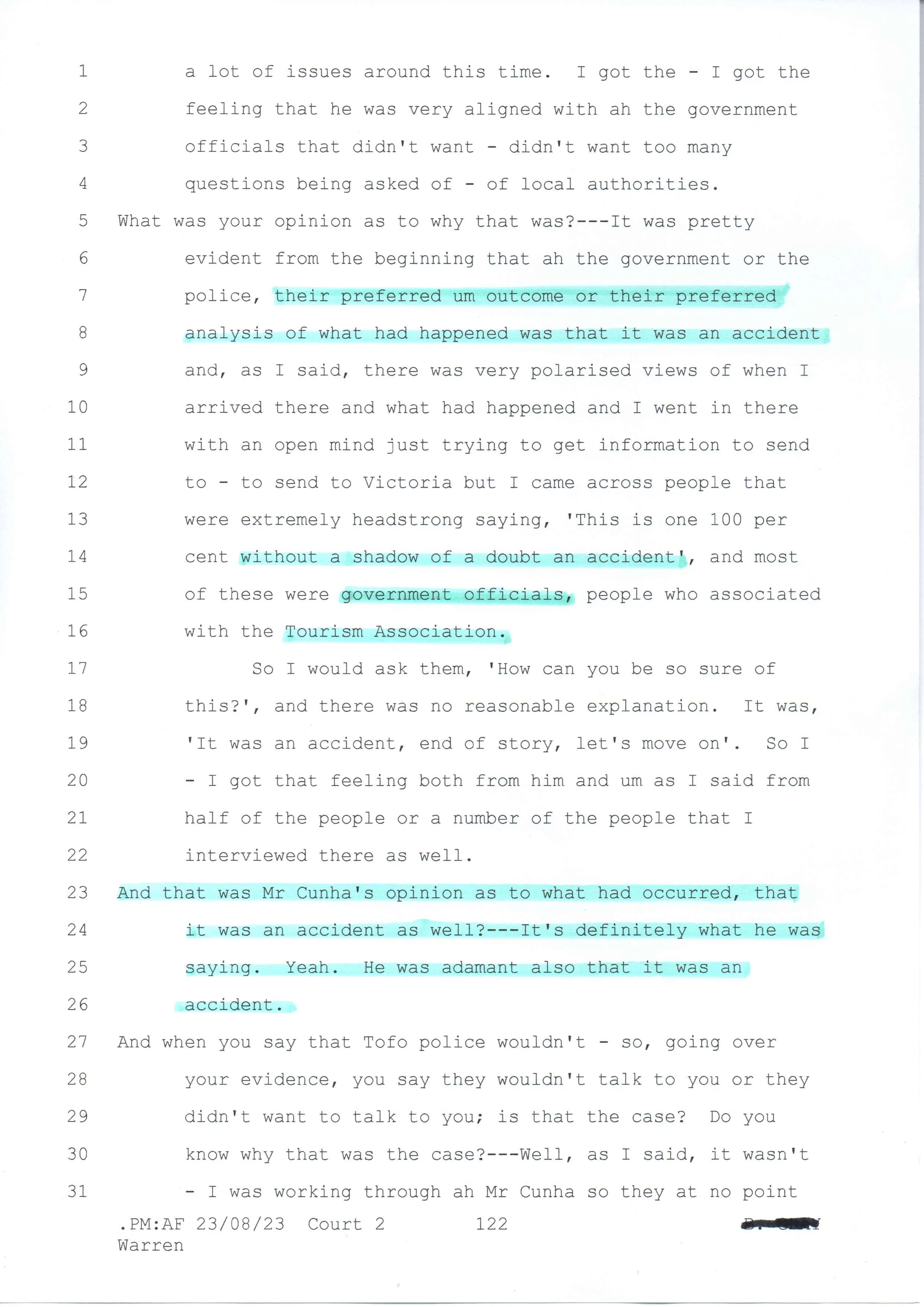
Inquest transcript page 122 Honorary consul 23rd August 2023
During the H/C’s visit to Tofo, just three days after Elly’s death, all official accounts claimed it was an “accident,” yet there was no mention of her ripped-apart top, despite this being clearly visible in the photograph later obtained.

Page 21 of the AFP/SLO action sheet is indeed very revealing. It shows that the AFP/SLO Superintendent had analysed the “clear photo” of Elly’s body, yet there is no mention of the ripped-apart top in any report to the Coroner in 2018. This exclution is critical because the ripped top directly exposes the Mozambique police cover-up at the crime scene.
This was no junior officer. The AFP/SLO Superintendent stationed in South Africa was highly experienced, with years of service, retiring in 2019. He became aware of the ripped-apart top just one week after Elly’s murder, yet he could not and did not expose the Mozambique authorities. From the outset, this evidence was effectively swept under the carpet by all involved authorities.
When the Australian Federal Police, tasked with protecting citizens overseas, conceal such crucial evidence, it begs a stark question: what hope does any Australian family have of justice when both foreign and domestic authorities act to cover it up?

This official letter from DFAT’s Assistant Secretary, Claire McComish, sent to the family on 22 March 2019, was the first confirmation that the AFP had possessed the clear photo back in 2016. The letter explicitly states that the AFP/SLO passed the clear photograph to the Mozambique chief inspector on 8 December 2016. Yet, critically, this photo was never included or acknowledged in the AFP/SLO official statement to the Coroner, effectively being withheld from the record.
The clear photo was never provided to the family at the time. It wasn’t until I obtained it in 2018 that its existence became widely known, which undoubtedly would have caused concern among those who had deliberately kept it from the investigation. This letter shows that DFAT only disclosed the photo after the fact, long after crucial opportunities for transparency and justice had passed.

Page 2 of the official letter sent to the Coroner by the Australian Government Solicitor (AGS) on 16 June 2023 explicitly confirms that the AFP received the clear version of the crime scene photograph from DFAT on 25 November 2016. This letter also establishes, as a matter of record, that the Honorary Consul forwarded the clear photograph to Australian Embassy staff in Pretoria, South Africa.
This correspondence constitutes solid factual proof that the AFP had possession of the clear photograph in 2016. Despite this, the AFP did not disclose the existence of the clear image to the Victorian State Coroner, nor did they provide any report addressing its contents during the critical 2016/18 period. The clear photograph reveals the ripped apart and destroyed top, a detail of obvious forensic significance that raises serious questions about the original treatment of the scene by Mozambique authorities.
The AGS letter further confirms that the Honorary Consul did, in fact, obtain the clear photograph after he had l left Tofo from the local fisherman and subsequently sending it to Embassy staff in Pretoria. This is not conjecture or inference; it is now formally acknowledged by the Australian Government’s own legal representative in correspondence to Coroner Cain. It does not become more official than this official letter from the AGS.
Notably, this letter marks the first formal admission seven years after Elly’s death that the AFP had received the clear photograph in 2016. This acknowledgment directly contradicts the earlier evidentiary picture presented to the Coroner and the family.
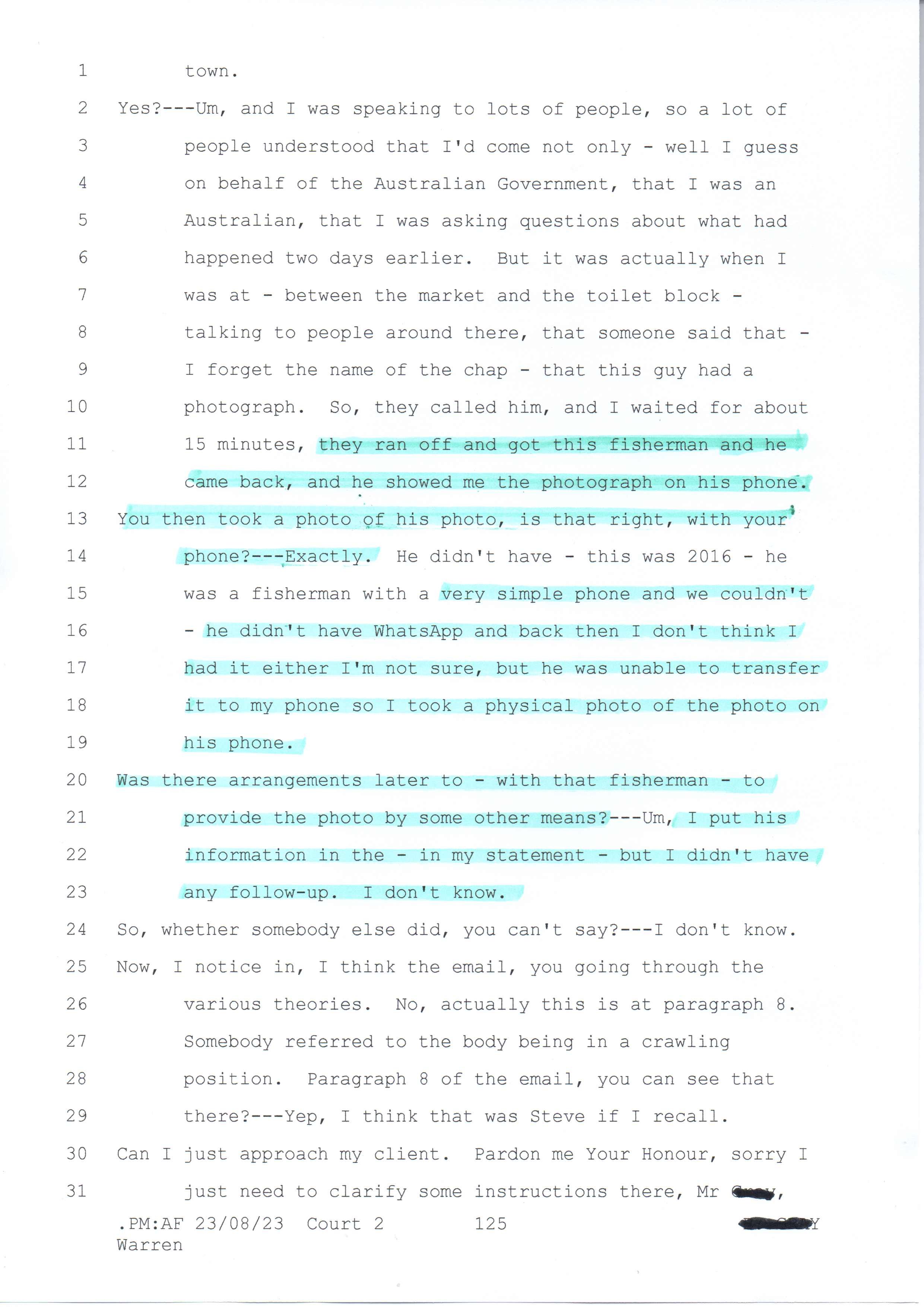
Inquest transcript page 125, Honorary Consul, 23 August 2023, is highly significant. On this page, the Honorary Consul explicitly states that he had no “follow up” with the fisherman to obtain the clear photograph. This statement directly contradicts the solid, documented evidence confirming that he did, in fact, receive the clear photo shortly after leaving Tofo and forwarded it to the Australian Embassy in Pretoria. Official correspondence from DFAT and the Australian Government Solicitor (AGS) confirms that the AFP/SLO Superintendent received the clear photograph from DFAT on 25 November 2016 and subsequently passed it to the Mozambique police on 8 December 2016.
The discrepancy in the Honorary Consul’s testimony creates a critical gap in the official record, as it conceals the existence and handling of this vital evidence. The clear photograph clearly shows Elly’s ripped-apart top, a fact that exposes the Mozambique police cover-up at the crime scene. By claiming no follow-up occurred, the Honorary Consul effectively obscured the timeline of evidence transfer and misrepresented his role, which had direct implications for the inquest and the coroner’s understanding of the case.
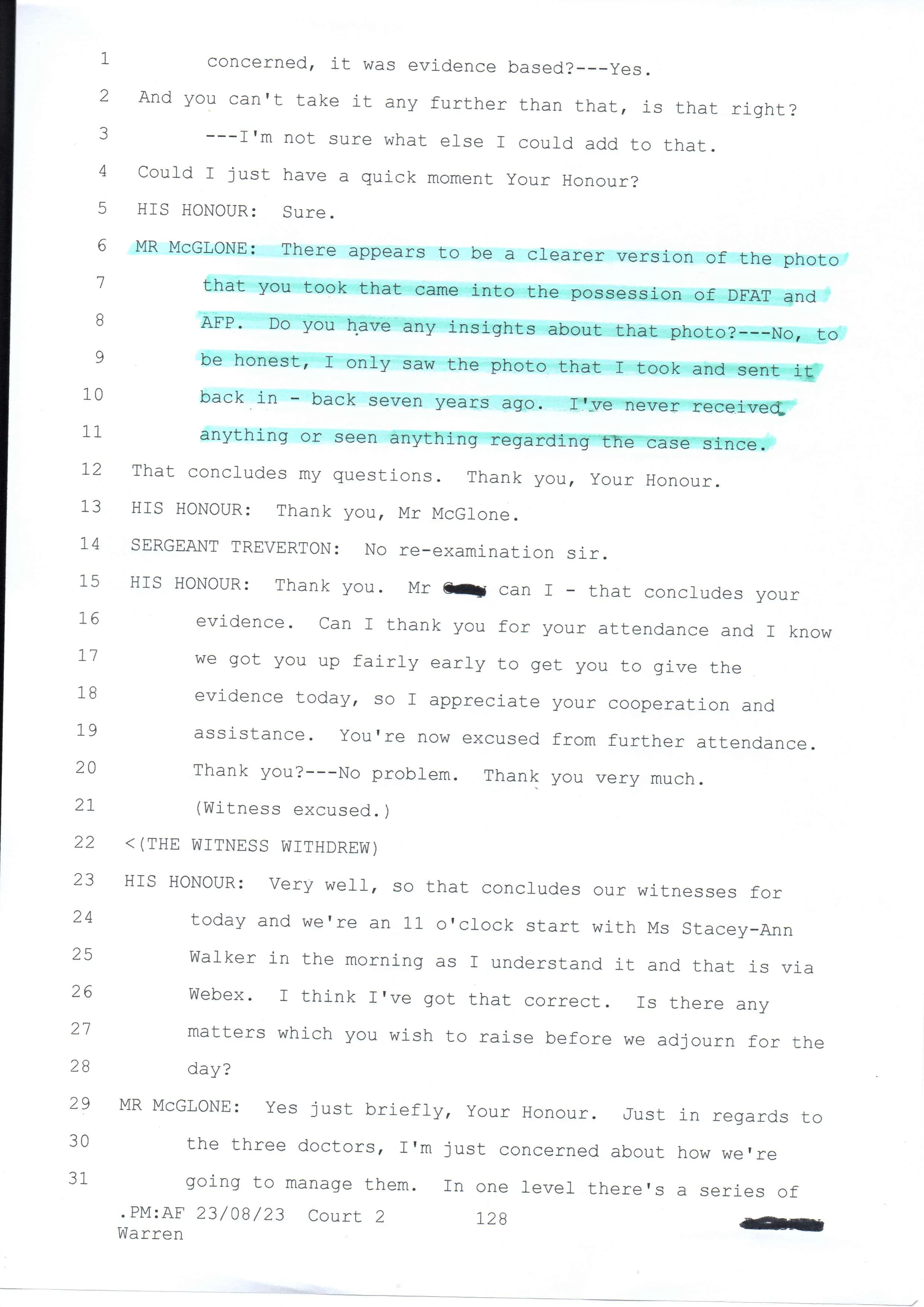
Inquest transcript page 128, Honorary Consul, 23 August 2023, is equally significant. My barrister, noting the previous evidence given by the Honorary Consul on page 125, realised that the timeline and chain of custody for the clear photograph was effectively broken. Attempting for a second time to clarify the matter, my barrister asked again about the clear photo. The Honorary Consul unequivocally stated that he knew nothing about a clear photograph.
This testimony directly contradicts the documented evidence showing that the H/C had received the clear photo shortly after leaving Tofo and forwarded it to the Australian Embassy in Pretoria. By denying knowledge of the clear photograph, the H/C created a critical inconsistency in the inquest record, further obscuring the chain of evidence and delaying recognition of the ripped-apart top, key detail exposing the Mozambique police cover-up.

During my oral submissions above to Coroner Mr Cain on 11th December 2023, I addressed the clear photograph and the ripped-apart top. At that point, the AFP lawyer raised questions about the broken “timeline chain” of how the clear photo was provided. This presented an opportunity to challenge the Honorary Consul’s testimony. However, Mr Cain intervened, stating that he was satisfied with the sequence of the steps, effectively accepting the timeline and keeping the clear photo in evidence.
This moment underscores how the broken chain of evidence and the H/C’s prior testimony prevented direct scrutiny, yet the critical photograph remained formally recognized, highlighting both the significance of the evidence and the limitations imposed on questioning the H/C and AFP/SLO during the inquest.
Conclusion – Inquest Transcript Pages 125, 128 & 287
The inquest transcripts of the Honorary Consul (H/C) reveal critical discrepancies regarding the clear crime scene photograph of Elly’s body.
On page 125 (23 August 2023), the H/C stated he had no “follow up” with the fisherman to obtain a clear photo. This is highly significant, as records confirm he had already received the clear photograph shortly after leaving Tofo, showing Elly’s ripped-apart top a detail that directly exposes the Mozambique police cover-up.
On page 128 (23 August 2023), my barrister, noting the broken timeline chain from page 125, attempted to question the H/C again about the clear photo. The H/C again denied any knowledge of a clear photograph, further highlighting the contradiction between his testimony and the documented evidence confirming he obtained the photo in November 2016.
Finally, on page 287 (11 December 2023), during my oral submissions to Coroner Mr Cain, I raised the clear photo and ripped-apart top. The AFP lawyer questioned the broken timeline of how the clear photograph had been provided. I was prepared to challenge the H/C directly, but Mr Cain stated he was satisfied with the sequence of steps, keeping the clear photograph in evidence. This intervention prevented direct scrutiny of the H/C’s misleading statements while confirming the photograph’s critical evidentiary status.
Together, these pages demonstrate that the H/C’s inquest testimony was both misleading and incomplete. By deliberately obscuring the timeline of the clear photograph, the H/C prevented the family from exposing the ripped apart top and from presenting this critical evidence to other key witnesses, including the AFP/SLO and the autopsy doctors. As a result, the family was unable to challenge or question the handling of the case effectively, critical lines of inquiry were blocked, and the full extent of the evidence showing Elly’s ripped-apart top and clear signs of a struggle, remained hidden for years!!!! This severely undermined the family’s ability to fully present their case to the Coroner and limited the inquest’s capacity to uncover the truth!!!