Updated flow chart, Elly’s Murder investigation over a decade

ELLY WARREN – MURDER INVESTIGATION FLOW CHART (2016–2026)
Table of Contents – Systemic Flow Chart (Chronological Structure)
Introduction and Background to the Case
Initial Discovery and Early Investigation (2016)
Mozambique Autopsy, Police Findings and Early Classification of Death
AFP Involvement and Initial Handling of Evidence (2016–2017)
DFAT, Consular and International Agency Coordination
Radiology, Forensic and Medical Evidence Review (2017–2019)
SERNIC Reports and Mozambique Homicide Classifications (2017–2020)
Coronial Investigation and Proceedings in Australia
Disclosure Issues and Crime Scene Evidence Handling Concerns
Mutual Assistance Request (MAR) Process and International Cooperation
Witness Selection, Expert Evidence and Evidentiary Gaps
Complaint, Escalation and Oversight Pathways (AFP / Government Agencies / Ombudsman)
Coroner’s Findings, Submissions and Competing Expert Opinions
Post-Inquest Government Correspondence and Accountability Responses (2023–2025)
Official Closure of Mozambique Case and Continuing Investigations (2024)
Commonwealth Ombudsman Review and Systemic Accountability Findings (2025–2026)
Ongoing Advocacy, Public Interest Disclosures and Case Updates (2025–2026)
Systemic Issues and Broader Implications for Coronial and Overseas Death Investigations
Conclusion – Continuing Questions and Unresolved Matters
My Commonwealth Supplementary Report, other emails and Section, AFP ACT 1979 40SC and 40SA
Elly's Murder Investigation – Complete Chronological Timeline (2016–2026)
Purpose of This Chronology Flow Chart
This chronology flow chart has been prepared to present a comprehensive, factual and evidence based account of the investigation into the murder of my daughter Elly Rose Warren in Mozambique over almost ten years.
It brings together my investigation including official records, forensic reports, government correspondence, police investigations, expert opinions, witness evidence, coronial proceedings, court transcripts, recordings and accountability processes into one chronological timeline of events.
The chronology has been compiled from contemporaneous documents and verified evidence obtained throughout the investigation. Its purpose is to allow readers to clearly understand how the investigation developed, what information was available to authorities at different stages, what decisions were made, and how significant evidentiary issues emerged over time.
Presenting the events in chronological order allows each issue to be considered in its proper context rather than as isolated events viewed with hindsight. It also highlights the development of key issues including evidence preservation, forensic opportunities, disclosure, international cooperation, witness evidence, investigative accountability, and ongoing oversight concerns.
The observations and conclusions presented later in this report are drawn from the chronology, official records, and documentary evidence set out throughout this timeline. Where opinions or conclusions are expressed they are identified as those of Elly’s family and are based on the documented evidence presented.
While detailed, this chronology represents only a summary of the much larger body of verified material collected throughout this investigation. It reflects almost ten years of information gathering, document review, evidence analysis, and investigative work undertaken by Elly’s family in the ongoing pursuit of answers, transparency, and accountability regarding the circumstances surrounding the murder of my daughter, Elly Rose Warren.
2016 – 2017, Initial Investigation and AFP/DFAT Engagement
9th November 2016 – Death
Elly Warren was found deceased in Tofo Mozambique under highly suspicious circumstances.
Fisherman takes a vital crime scene photo at around 5am. Tells No one he took the Photo at the crime scene.
Mozambique Police Open investigation Chief inspector suspects body was moved as sand is different in Elly’s mouth to where she was found at the crime scene. Warrants Homicide investigation with suspicious circumstances discovered at crime scene.
Elly’s mouth was found packed chockablock with sand. In the photograph taken by the fisherman at 5am Elly’s t- shirt is totally ripped apart however the ripped apart top is not reported by the Mozambique Chief inspector or Doctor at the crime scene at 9am on the 9th November 2016.
A witness who was asked by police to identify Elly’s body also finds it strange that her mouth is packed full with sand on the firm surface where her body was found. Also no mention of ripped apart top from witness!
12-13-14th November 2016 – Autopsy
Maputo Central Hospital conducts, autopsy on 14/11/2016. Concluding violent death homicide. Airways packed full with sand (abundant as recorded in autopsy report) Elly’s body was transported by road from Tofo due to extensive flooding at the time closing all local airports. Therefore Moz-Autopsy was conducted 5 days after Elly’s death and her airways were still packed with sand.
12-13th, The Australian Honorary Consul attended the crime scene. Fisherman informs him that he had taken a photograph of Elly’s body when he found her at 5am. There are two versions, one blurred and later the fisherman sends the photo to the Honorary Consul by email which is the clear version clearly showing Elly’s top ripped apart.
The Australian Honorary consul sends both versions blurred and clear separately to the Australian embassy in Pretoria.
Clothing worn by Elly at death is retained at Maputo hospital for family or authorities to retrieve.
Clothing Elly was wearing at the time of her death critical for DNA; the hospital. aware of importance due to homicide findings by their doctor. retrains clothes but after time when no one retrieves clothes they are eventually incinerated.
16th 17th &18th November 2016 – AFP/SLO & DFAT translator Arrives in Inhambane. meeting with the Chief Inspector Attended the crime scene and had very important MeetingS with officials. (Elly’s clothes at time of her death were not retrieved for DNA analysis from maputo hospital by the AFp or DFAT)!!
16/11/2016 South African Autopsy conducted by Dr Klepp also discovers a large volume of sand in Elly’s airways and states; The cause of death as aspirating a very large amount of sand while still alive combined with abrasions and bruising especially around her mouth and lips which had become more evident over time 7 days after therefore Dr Klepp suspected Foul Play and stated this to me over the phone not long after she conducted her preliminary autopsy report only waiting for toxicology results before determining the circumstances of Elly’s death.
AFP /Senior Liaison Officer (SLO) and DFAT/SLO translator deployed to Mozambique to support Victorian Coroner 17&18th November 2016.
17th AFP/SLO and DFAT/SLO meet the Chief Inspector in Inhambane SERNIC Headquarters having to change flights both ways at Maputo. Where the Maputo central hospital was holding Elly’s clothes she was wearing at the time of her death! This was only 3 days after her autopsy at the Maputo hospital!! The AFP & DFAT did not attend Hospital when in Maputo twice once going over and again on there return at this vital times!!
Chief Inspector obliging granting AFP/SLO and DFAT Translator permission to visit the crime scene in Tofo 20mins drive away.
Chief inspector was cooperative in allowing AFP/SLO to enter Tofo to investigate on behalf of the coroner informing the AFP/SLO that he can pick up Elly’s other clothes suitcase and backpack belongings on their return to Inhambane airport for their flight back to Maputo then onto Johannesburg.
Mozambique police were uninterested in vital clothing Elly’s was wearing at the time of her death. The inspector who accompanied her body from Tofo to Maputo for the autopsy had left her clothes there at the hospital as they were not capable of any DNA testing. Therefore these vital clothes were never placed into evidence by SERNIC detectives. (facts taken from Action sheet)
The AFP/SLO and DFAT’S translator attended vital meetings with crime scene doctor, Chief inspector, prosecutors and chief health minister taking vital notes all entered in the AFP action sheet as facts. However there is no mention of Elly’s ripped apart top, Why not?
17th-18 November the AFP/SLO had taken vital notes from meetings and some belongings, but not clothing worn at the time of Elly’s death, however when in Maputo changing flights it was possible to attend Maputo central hospital where Elly’s autopsy was conducted three days earlier 14th November to obtain evidence (Clothes) and talk with hospital staff and doctor.
It must be noted the Mozambique authorities were “obliging” allowing the AFP and DFAT to “interview” the Crime scene Doctor while in Tofo taking vital notes which were entered into the AFP action sheet. This meeting was held on the same day the 18th November 2016 on there return flight Back to Maputo where Elly’s autopsy was conducted only three days earlier!!
The AFP/SLO obtains a vital sand sample from crime scene. The AFP/SLO was made aware that they suspect Elly’s body of being moved post-mortem by Moz chief inspector. AFP Action Sheet records vital notes for records. No report from AFP/SLO on any critical evidence mentioned above to the coroner in 2016/17. Trace evidence, “clear” photo showing ripped apart top and sand sample was not officially entered into evidence with the AFP/SLO statement only the “blurred photo” was entered in as evidence by the AFP/SLO!!! Note the “vital official AFP action sheet” was never submitted to the coroner in 2016/17!!
The conduct of the local Tofo police in the early hours of 9th November raises serious and troubling questions regarding the handling and documentation of critical evidence. As time has passed, further information has emerged which raises additional questions about the integrity of the early stages of not only the Mozambique investigation, but also the AFP’s handling of critical evidence!!
Elly’s murder occurred on 9th November 2016. At approximately 5:00am that morning, her body was discovered by a local fisherman, who also photographed Elly’s body at the crime scene. That photograph clearly shows Elly’s top ripped apart, a detail that is significant as it indicates she had been involved in a physical struggle prior to her death. Later at the inquest a witness who saw Elly at 11.30pm on the evening of the 8th November 2016 told the court Elly’s behaviour was normal and their was no ripped clothing on Elly at this time around six hours before her body was found by the fisherman at 5am the next day.
Later that same morning, at approximately 9:00am, the main Mozambique investigating team attended the scene. This included the crime scene doctor and the Chief Inspector, both of whom later participated in official meetings held on 17th and 18th November 2016 involving the AFP/SLO and a DFAT translator.
Despite the involvement of these senior Mozambique investigators and the formal cooperation between agencies as there was no documented acknowledgment of one of the most important physical pieces of evidence: Elly’s destroyed ripped apart top!!
The critical question is: why was this never addressed or placed into evidence?
If Elly’s top was already ripped apart and clearly visible at the crime scene when the Mozambique investigators arrived at approximately 9:00am on 9th November, why did neither the crime scene doctor nor the Chief Inspector report, document, or refer to this damage to the AFP/SLO as it is not refenced in his Action Sheets from notes taken during the official meetings held on 17th and 18th November 2016?
It is possible that Elly’s top was “switched or replaced” at some stage by local authorities some time before 9am, however this cannot be stated as absolute fact. Based on the solid available facts surrounding the ripped apart t-shirt Elly was wearing at the time of her murder the pieces of the puzzle start to come together as there are only two main possibilities and both raises serious concerns regarding the handling of the ripped apart top trace evidence by Mozambique authorities. Both possibilities calls into question the integrity of the Mozambique investigation and the management of key evidence!!
What can be stated with certainty is that the 5:00am photograph provides clear visual evidence that Elly’s top was already ripped apart at the time her body was discovered by the fisherman. This establishes the condition of the clothing at the earliest recorded point at the scene. Despite this, there are serious and unresolved inconsistencies in how this critical evidence was recorded, documented, and referenced throughout the investigation. (The ripped apart top is not mentioned in any police, doctors official statements/reports from either country to this day!!) These inconsistencies raise significant questions about the continuity, integrity, and reliability of the evidence from the time of discovery through to later examinations and official reporting by all authorities involved!!
According to the available records, no entry was made in the AFP/SLO Action Sheets regarding the condition of Elly’s top, despite the existence of photographic evidence that clearly shows her top ripped apart from the right shoulder and all the way down the right side of her torso.
Two of Elly’s favourite black T-shirts did not come home with her luggage!
Taken together, this represents a fundamental and unexplained failure to record, address, or account for critical physical evidence, “raising serious concerns” about the integrity, transparency, and reliability of the investigative record, the Mozambique investigation and AFP support of the coroner’s coronial investigation as a whole leaving significant unanswered questions about how such key evidence was handled and documented from the crime scene in 2016!!
Elly’s autopsy was conducted at Maputo Central Hospital on 14th November, three days earlier, at a time when her clothing was still available for retrieval. The family later contacted the hospital director in 2019/2020, who confirmed to both the family and independent investigator Mr Roos that clothing is retained for a period of time to allow retrieval by family members or authorities before eventual incineration. At the same time the AFP/SLO while on the ground in Tofo investigating on behalf of the Australian Coroner obtained a vital sand sample from the crime scene and was informed by the Chief Inspector that investigators suspected Elly’s body had been moved post-mortem. AFP Action Sheets also recorded important notes concerning the sand sample and the suspected movement of Elly’s body.
Despite the significance of this evidence, no report by the AFP/SLO regarding the sand sample, the suspected post-mortem movement of Elly’s body, or the availability of the clothing Elly was wearing at the time of her death was ever provided to the Australian Coroner, despite the AFP/SLO actively supporting and obtaining trace evidence (Sand) for the coronial investigation in 2016/2017. While Elly’s suitcase, backpack and other clothing were retrieved, the very clothes she was wearing at the time of her death were never recovered, secured or forensically preserved for vital DNA testing, representing a major and irreversible investigative failure in a highly suspicious death from the outset.
Furthermore, a second sand sample was never sought from Elly’s body for forensic comparison and potential DNA matching with the sand sample obtained from the crime scene. Critically the original sand trace evidence sample taken from the crime scene by the AFP/SLO was never officially entered into evidence or disclosed to the Coroner in his formal statement!!
(Note later in 2019 a Radiology report proves there was “ample sand” present at the Melbourne autopsy on the imagery for a second forensic sample from Elly’s body for forensic matching also recording very high density reading of 1290Hu 947Hu equivalent to cement and bone density levels with both lungs filled with sand!!”
Outcome: vital Opportunity for DNA analysis lost by the AFP/SLO in not attending Maputo hospital when in Maputo for change of flights going over and returning only three days after Elly’s autopsy!! The chief inspector was obliging in granting permission to the crime scene and to obtain Elly’s other clothes on or the next day after 17th-18th. Informed the AFP/SLO they suspected the body was moved still No report to coroner. (This was confirmed at the inquest with evidence given by the AFP/SLO that the chief Moz inspector had “alluded to the fact he suspected Elly’s body had been moved” which is recorded in his own action sheet at the time!) Sand trace evidence sample not enter in AFP/SLO official statement to the coroner. There were some very important notes (Vital Factual Evidence) entered in the AFP/SLO action sheet which was not disclosed to the coroner in 2016/17! The important AFP/SLO Action Sheet is not revealed to the coroner by the AFP until 2020/21. The then coroner Mr Bracken asked the AFP at a hearing did they not take any investigation notes or records!! The AFP then had no choice to “expose their Action Sheet” as they were directly asked by the Court/Coroner five years after Elly’s murder!!
( Note: AFP Statement and My Response complaint report to the AFP commissioner dated the 27th May 2024 in “search for the truth” on this website has the full “AFP action sheet” 23 page documented at the bottom of the complaint report to the AFP commissioner)
20–22 November 2016 – Dr Klepp’s Findings, Embassy Notification, and the Melbourne Autopsy
Following concerns regarding the circumstances of Elly’s death, the family arranged for a second autopsy to be conducted in South Africa by Dr Klepp on 16th November 2016.
On 20th November 2016, I spoke directly with Dr Klepp by telephone. During that conversation, she explained that Elly’s airways were packed with sand and expressed serious concern that, when considered together with the marks and abrasions around Elly’s mouth and lips, the findings suggested a suspicious death. I asked Dr Klepp whether she believed foul play may have been involved. Her response was:
“It is looking that way, Mr Warren.”
On 21st November 2016, Dr Klepp contacted the Australian Embassy and reported that the facial injuries had become more evident over time. Based on her examination, she suspected that Elly’s head may have been forcibly held face down in the sand causing her to aspirate a large quantity of sand and resulting in her death.
On 22nd November 2016, a third autopsy was conducted in Melbourne. The family was unaware that the Coroner had requested a further autopsy. Had the family known a third autopsy was to be undertaken it is unlikely that a second autopsy in South Africa would have been approved. The family was only informed of the Melbourne autopsy at the last minute.
Dr Klepp’s findings were consistent with the Mozambique autopsy conducted on 14th November 2016, which recorded an abundance of sand within Elly’s airways and concluded that the death was a violent death or homicide. Dr Klepp likewise confirmed the presence of sand throughout Elly’s airways and identified injuries around the mouth and lips that caused her to suspect foul play.
In contrast, the Melbourne pathologist concluded on 22nd November 2016 that the cause of death was undetermined!
Approximately eleven months later, during a recorded meeting attended by the family, the Melbourne pathologist stated:
“If I was asked in court, ‘You didn’t find any sand did you?’ I would have to say, ‘No I didn’t.’”
This statement highlighted a fundamental conflict within the medical evidence. Two separate overseas forensic examinations had identified substantial quantities of sand within Elly’s airways, whereas the Melbourne pathologist maintained that no sand had been identified.
The significance of this contradiction increased further in 2019 when radiological review of the CT scan imaging demonstrated the presence of sand throughout Elly’s airways and more significantly that both lungs were filled with sand. These findings were consistent with the observations recorded in both the Mozambique and South African autopsies and supported the conclusion that significant packed sand aspiration had been present from the outset.
At the 2023 coronial inquest, the Court heard compelling evidence from Dr Klepp and radiologist Dr O'Donnell. Following consideration of that evidence, the Coroner ultimately reclassified the cause of death. That reclassification reflected the significance of the combined medical and radiological evidence and marked a substantial departure from the Melbourne autopsy's original conclusion that the cause of death was undetermined!
Despite this, the starkly conflicting medical opinions were never fully reconciled. The fundamental question of how two autopsies and later radiological evidence identified extensive sand aspiration while the Melbourne pathologist maintained that no sand was found, was never adequately explained in the Coroner's final findings.
As a result, a significant inconsistency remains at the heart of the medical evidence. Although the Coroner ultimately reclassified the cause of death after hearing the later evidence with the contradiction between the Melbourne autopsy and the findings of the Mozambique autopsy, Dr Klepp and the radiological evidence was never fully resolved.
These unresolved contradictions continue to cause considerable distress to Elly’s family. The concern is heightened by the fact that the Melbourne autopsy formed a central part of the Victorian coronial investigation and was conducted by a pathologist from the Victorian Institute of Forensic Medicine, an organisation closely connected to the Victorian coronial system.
For many people, the contradiction is difficult to understand. The Mozambique autopsy recorded an abundance of sand in Elly’s airways and classified her death as a violent death or homicide. Dr Klepp independently found Elly’s airways were “Packed Chockablock” with sand and expressed concerns about possible foul play. The Melbourne pathologist, however, concluded that the cause of death was undetermined and later stated that no sand had been found. Radiological evidence reviewed in 2019 subsequently demonstrated sand throughout Elly’s airways and that both lungs were filled with sand findings that were consistent with the earlier Mozambique and South African autopsies.
After hearing the evidence of Dr Klepp and radiologist Dr O'Donnell at the 2023 coronial inquest the Coroner ultimately reclassified the cause of death.
However the central question remains: how could two autopsies and later radiological evidence identify extensive sand aspiration, while the Melbourne autopsy concluded that no sand was present and the cause of death was undetermined?
That question has never been fully answered or adequately addressed in the Coroner's findings.
25TH- 19th November/december 2016 – crystal clear Crime Scene Photo
DFAT provides AFP/SLO and therefore the AFP with a clear crime scene photograph on the 25th November 2016 clearly showing Elly’s half naked body and top ripped from her shoulder all the way down her torso. Still No report sent to the coroner by the Australian governing police authority the AFP! In fact to this day there has been no report on the clear crime scene photograph to the coroner from the AFP who is in total control of serious police matters overseas!!
Notes: No report sent to the coroner! Vital evidence of a struggle clearly seen in photograph; not submitted to coroner in 2016/17 by the AFP/SLO or AFP!!
AFP/SLO and therefore the AFP after having the “clear” crime scene photo to analyse for 14 days they then hand this vital evidence over to the Chief inspector by email on the 8th December. (recorded in his action sheet on this date) The coroner is still not informed and still No report sent to the coroner even though this evidence clearly shows highly suspicious cirumstances showing a struggle has occurred with the top clearly ripped apart!!
Later none of the above vital evidence is entered in his official AFP/SLO’s report or statement sent to the coroner. Its as if this vital evidence “never existed” by the AFP! The AFP/SLO statement was sent to the coroner on the 17th October 2017 and he has still not disclosed the “clear photo” or that “he handed it over to the chief inspector”. Also the trace evidence, sand sample was not entered into his official statement to the coroner making the coroner unaware and therefore was not officially entered into evidence for the coroner!! later in 2023 with an official letter June 16ht from the Australian Government Solicitor to the coroner which the AFP still does not disclose in this official letter that the AFP/SLO had passed on the clear photo to the Mozambique chief inspector on the 8th December 2016! However it is in official records on this date that the AFP/SLO had passed on this vital clear photo clearly showing Elly’s top ripped apart and naked body without asking the families or coroners permission to do so!! (AFP- Action Sheet Pg. 11). This is also confirmed by an official letter from the assistant secretary of DFAT Claire McComish on the 22nd March 2019 stating:
‘ The Honorary Consul later received an “unblurred version” from the local fisherman of the same photo however it is unclear whether you (Elly’s family) received this. ‘ The photo was passed to the Mozambique police by the AFP/SLO on the 8th December 2016.
19th December meeting with two AFP officers at my home. They informed me of the Mozambique autopsy conclusion that Elly died a “violet/Homicide”. They also informed me that the investigation was the jurisdiction of the Mozambique authorities and that they could not interfere with another country’s investigation. The Melbourne doctor concluded undetermined and that the coroner may make her decision in chambers on the case.
Nov–Dec 2016 summary –AFP is allowed on the gRound to provide assistance to the coroner
AFP with boots on the ground in Tofo and Inhambane, directly involved in the investigation, including attending SERNIC headquarters, attending the crime scene, and participating in vital operational meetings where critical evidence was reviewed and recorded. This included the taking of detailed investigative notes, collection of some vital trace evidence (sand samples) and photographic documentation. (All not Disclosed to the coroner in 2016/17!!)
Vital evidence was obtained but the coroner was not informed. No report sent to the coroner in 2016/17 by the AFP/SLO.
No action was taken even though the AFP/SLO was aware of highly suspicious circumstances with the Clear photo ,Ripped apart top and body moved post-mortem in 2016 with No official Mutual Assistance Request (MAR) sent by the AFP through the Australian Attorney General.( Elly’s body being moved was clarified by the AFP/SLO at the inquest that the Moz chief inspector alluded to the fact the body was moved in a meeting on the 18th Nov-2016 as it is recorded in notes in the AFP/SLO action sheet on Pg.9)
Mozambique Autopsy concludes Elly’s death as Violent /Homicide (Abundant sand found throughout her airways)
Note: The AFP were aware of the Moz autopsy conclusion “early on”, as I was informed by the AFP of its conclusion at a meeting at my home on 19th December 2016, along with other vital information relevant to the investigation.
Evidence: vital evidence given to the AFP overwhelmingly supports suspicious circumstances not reported to the coroner!
Vital South African autopsy photographs given to AFP in 2016. However these were not given directly to Melbourne pathologist by the AFP!
No clear crime photo or report on Elly’s ripped apart top was ever sent to coroner clearly Depicting these highly suspicious circumstances in 2016 by the AFP/SLO or AFP. Family also not informed of this vital evidence the clear photograph and MAR options available for reassessment of the case; police to police offers are weak, often rejected internationally. Countries generally respect coroners investigation or official attorney general MAR request sent which holds far more weight between governments!
2017 – Mozambique police Reports and AFP Inaction
April 2017 SERNIC police Reports
DFAT/AFP 6th April receives overdose Mozambique police report.
DFAT & AFP 10th April receives “revised” SERNIC Mozambique report (Case 775/2016) confirming Elly’s death as a homicide.
The AFP/SLO and AFP was aware of the homicide classification; however the AFP Action Sheet does not disclose or properly expose the SERNIC Mozambique police report and instead appears to downplay its significance by withholding the critical homicide classification holding back its full disclosure from the Action Sheet, however it is clearly mentioned in the 10th April 2017 Moz revised police report Pg. 13. No Mutual Assistance request (MAR) was sent as revised Moz police report classified Elly’s death a crime/Homicide in April 2017, and no formal investigative action was taken by the AFP to submit the clear crime scene photograph report or secure Elly’s clothing for examination in support of the Coronial investigation to the coroner in 2016/17.
Homicide clarification obtained revised SERNIC police report the mandate for AFP to officially submit Mutual assistance request (MAR). Still not sent in 2017!!
!0th April revised Moz police report mentioned in Action sheet Pg 13 on this date received and mentioned only as a Moz document which is the revised Moz police from DFAT’s Stacy Walker not disclosing the homicide classification form this official Moz police report!! Note on page 12, 6th April the AFP/SLO clearly states the police overdose report!! Also received from DFAT’s Stacy Walker! These police reports were not Fully disclosed in the AFP action by the AFP/SLO but they are all in the coronial brief for all to view properly. The “Homicide Classification” is clearly stated in the first paragraph but not mentioned in the Action Sheet!!
Conclusion: Critical evidence remains unsubmitted; clothing not pursued for DNA. Homicide classification clarified by SERNIC Moz-criminial police but No MAR sent!
7th September 2017 Family Recorded Meeting with Melbourne Pathologist, AFP, and Coroner’s Assistant Raises Serious Questions
I requested this meeting because there were major and unresolved inconsistencies between the Melbourne pathologist’s conclusion that the cause of death was undetermined and the Mozambique autopsy findings, which recorded Elly’s death as a violent death and homicide. There were also clear differences between the Melbourne findings and those recorded in both the Mozambique and South African autopsies.
The Mozambique autopsy recorded an “abundance” of sand within Elly’s airways. The South African autopsy stated that Elly had aspirated a large volume of sand. The South African pathologist later gave evidence at the inquest describing the airways as Packed “Chockablock” with sand!
During the recorded meeting, I asked the Melbourne pathologist about a blurred photograph of Elly’s body outside the toilet area and whether he could make anything of it as the pathologist and family were only ever given the blurred photograph at this time. His reply was:
That the image was too grainy to draw any conclusion from it!
I also asked whether he had seen any autopsy photographs. He confirmed that he had not!
At that time, the AFP already held a clear crime scene photograph and South African autopsy photographs showing significant facial injuries and damage to Elly’s clothing. The transfer of the these Autopsy photos had changed hands to the AFP/SLO in South Africa and passed on to the Melbourne AFP/SLO who was present at this meeting, as per the AFP action sheet but there is no mention of the Clear version of the clear photo in the AFP/SLO action sheet!! However the AFP/SLO in South Africa and therefore the AFP were given this clear version in 2016 as official records state later on in 2023 to the coroner!! These critical images were not disclosed, shown, or discussed at any point during the meeting, or prior to the meeting with the pathologist by the AFP. This vital evidence was also not reflected in his final autopsy report because the AFP who is responsible for this critical evidence which they had acquired in 2016 nearly a year earlier had never given this vital evidence directly to the Melbourne pathologist!!!
This was a critical omission. The failure to provide this material meant that highly relevant visual evidence was not before the pathologist and was not properly before the coronial process at a crucial stage in 2016. Given the AFP’s role in supporting the coronial investigation and facilitating overseas evidence this raises serious and fundamental concerns about the completeness and integrity of the information being provided.
The Melbourne pathologist also clearly stated:
“That if asked in court whether he had found sand, he would have to say that he did not find any sand in the airways”.
After the pathologist left the meeting discussions continued with AFP officers and the Coroner’s Assistant. During this discussion I directly asked “whether Mozambique police were conducting an active homicide investigation”.
The AFP confirmed on the recorded meeting that there was an “active homicide investigation” being conducted by Mozambique police!
This was a highly significant admission by AFP officers during the recorded meeting and raises serious concerns regarding the subsequent handling of the Mutual Assistance Request (MAR) process.
The admission confirms that by September 2017 the AFP knew that Mozambique authorities were actively treating Elly's death as a homicide/crime investigation and had done so from the outset. This directly contradicts later assertions that no such classification of a crime/Homicide had been communicated to Australian authorities prior to 2023 as stated in submissions and with evidence given under oath by the AFP later on at the 2023 inquest!! Giving Misleading information, evidence to the coroner!!
Despite possessing this knowledge, the AFP did not inform the family of the availability or significance of the Mutual Assistance Request (MAR) process. A MAR could have provided a formal mechanism for Australian authorities to assist the Mozambique investigation and obtain critical overseas evidence for forensic examination.
Of particular concern was the opportunity to conduct DNA testing on key items of clothing and other physical evidence. Mozambique authorities had previously indicated that they lacked the forensic resources and laboratory capability necessary to undertake advanced DNA analysis. Given the known homicide classification and the acknowledged limitations of the local investigation, the MAR process represented a potentially important avenue through which Australian authorities could have facilitated forensic testing that may have identified suspects, corroborated witness accounts or assisted in determining the circumstances surrounding Elly's death.
The failure to pursue, explain, or properly consider this option deprived the investigation of a significant opportunity to obtain potentially critical forensic evidence at a time when such evidence was likely to have been at its greatest evidentiary value.
Because the meeting was formally recorded, it provides an objective and contemporaneous record of both the AFP’s acknowledgment of an active homicide or crime investigation, and the absence of disclosure of key photographic evidence already in the AFP’s possession form the outset in 2016. These matters raise serious questions about the adequacy, transparency and completeness of the AFP’s handling of critical evidentiary material in a highly suspicious death investigation involving an Australian citizen overseas!! “ I reiterate this meeting was all recorded with consent!”
AFP Oversight, Disclosure Failures and Inconsistencies in the Evidentiary Record
The AFP was responsible for conducting fact finding inquiries in Tofo, Mozambique, in support of the Victorian coronial investigation into Elly Warren’s death. However, a substantial body of important evidentiary material was not provided to the Coroner or to the Melbourne pathologist during the critical early stages of the investigation in 2016 and 2017.
In 2019, the radiology report was released to the family. The findings caused significant concern revealing extensive foreign material consistent with sand throughout both lungs. Seeking clarification the family obtained a second opinion from forensic pathologist Dr Byron Collings, who stated:
“Paul, I cannot account for why the Melbourne pathologist did not identify the sand. However, what I can say is that the radiological imaging clearly shows its presence throughout the airways extending deep into the lung tissue of both lungs ”
Dr Collings further indicated that the radiogoloist Dr O’Donnell would be best placed to explain his own findings in his report.
At the inquest in 2023, Dr O’Donnell addressed this issue directly, confirming that the density levels identified within the airways were equivalent to bone density and that both lungs were filled with foreign material consistent with sand.
The AFP Action Sheet covering the period 2016 to 2018 contained important investigative information but was not provided to the Coroner until the hearings conducted in 2021 and 2022 despite having been created years earlier. It was only then entered into the coronial brief as it was included with my affidavit only. Likewise, an important official letter dated 22nd March 2019 from DFAT Assistant Secretary Claire McComish was not initially included in the coronial brief and was only added following requests by the family.
The radiological evidence ultimately proved compelling. It demonstrated extensive sand throughout the airways and both lungs, a finding of major forensic significance. Despite this no formal Mutual Assistance Request has ever been sent to the Attorney General of Mozambique. Throughout much of the investigation the family and at times the Court were left without access to important information that had been available within official channels. Critical evidentiary material was not disclosed for years after the initial investigation, giving rise to legitimate concerns regarding transparency, accountability and the completeness of disclosure.
Particularly concerning for Elly’s family later on are submissions made on behalf of the AFP Commissioner in December 2023 which appear difficult to reconcile with the contemporaneous documentary record and earlier official statements.
Based on the available evidence by multiple independent records indicate that Mozambique authorities had already treated Elly Warren’s death as a homicide years before May 2023. These records include:
• The Mozambique autopsy findings recording a violent death and homicide;
• The Mozambique police report dated 10th April 2017 classifying the death as a crime and homicide;
• The SERNIC report dated 11th August 2020 issued by the Director General of SERNIC confirming Elly Warren as a victim of crime and homicide going further stating FIRST DEGREE MURDER; and
• “Recorded statements” made by AFP officers during a meeting on 7th September 2017 acknowledging that Mozambique police: (were conducting an active homicide investigation)!!
Additional concerns arise from the handling and disclosure of key forensic material. Correspondence and official records indicate that a clear version of a critical scene photograph was obtained by the AFP in November 2016 and circulated within the investigative chain. However that image was not provided to the pathologist, Coroner or the family at the relevant time by the AFP Instead only a blurred version had been placed into the evidence Brief during the early forensic review process!!
At the recorded meeting of 7th September 2017, the Melbourne pathologist confirmed that he had only been provided with the blurred grainy photograph and no autopsy photographs despite official records indicating that such material had been obtained by the AFP in November/December 2016 in June 2023 seven years later. This raises important questions as to whether all relevant forensic material was made available to independent experts and to the coronial process during the formative stages of the investigation!
Taken together, these matters raise serious concerns regarding the completeness, consistency and transparency of the information provided by the AFP throughout the coronial process.
The evidence shows that in September 2017 the AFP knew Mozambique authorities were treating Elly's death as a homicide/crime investigation. Despite this knowledge the matter continued to be handled and presented in a way that did not reflect that classification. As a result important investigative opportunities including the potential use of a Mutual Assistance Request (MAR) to obtain and test overseas evidence were not pursued or explained to the family!!
This disconnect between what Mozambique authorities were saying and how the matter was subsequently handled raises serious questions about whether the criminal nature of the case was properly recognised and acted upon by Australian authorities!!
For Elly's family these issues resulted in years of uncertainty, unanswered questions and the loss of potential investigative opportunities that may have assisted in establishing the full circumstances surrounding Elly’s death. The cumulative effect of these matters has significantly undermined the family's confidence in the transparency, accountability and integrity of the investigative and coronial processes.
The apparent inconsistency between the AFP Commissioner’s submission that no Mozambique authority had classified Elly’s death as a homicide prior to May 2023 together with false evidence given at the inquest and the contemporaneous documentary record is significant. As the factual evidence indicates Moz authorities had already classified and investigated the matter as a homicide years earlier as the factual foundation upon which those later submissions were made requires careful examination!!
The documentary record including official police reports, autopsy findings, investigative correspondence and recorded statements demonstrates that the homicide classification existed well before the timeframe relied upon in the AFP Commissioner’s submissions. This inevitably raises questions regarding how that material was assessed, interpreted, and presented to the Coroner from the onset!!
For Elly’s family, these issues remain unresolved. The concern extends beyond the classification itself. It encompasses whether all relevant evidence including foreign police determinations, forensic findings, investigative records and key photographic material was fully disclosed and accurately reflected in the evidence and submissions presented to the Court.
The Coroner ultimately stated in his findings that he was not critical of the AFP. However having regard to the documentary record and the matters outlined above the basis upon which that conclusion was reached remains a matter of serious ongoing concern for not only Elly’s family but all Australian families!!!
February 2021 – Coroner Bracken Orders the AFP to send official request
Coroner Bracken instructs AFP to send formal MAR to Mozambique due to AFP Submissions disclosing a Mozambique Government official statement at No 40 that:
‘It was always possible for the AFP to have a joint operation’”
However Elly’s family finds out later the AFP only sends a personal letter, not formal MAR.
Delayed 6 years; family discovers MAR was not sent only a letter; formal cooperation obstructed after Mr Bracken asked the AFP to send a formal request!
Mr Bracken asked AFP why they did not record anything for the coroner in 2016/17. This forces AFP to expose there Action sheet at this hearing six years later!! However it appears that when you fully examine the AFP Action sheet vital evidence is hidden by its wording or not even disclosed!
Coroner hearings: transcript as factual evidence confirms all above facts. AFP action sheet only placed into the colonial brief of evidence with my affidavit. My affidavit exposes all discrepancies from both countries to the coroner Mr Cain in detail.
2021–2023 – SERNIC Re-opens Homicide Investigation and Vital Information Emerges Before the Inquest
Note: I have provided greater detail in the flow chart below as during this timeframe there were significant and highly important developments occurring prior to the inquest including witnesses and the emergence of official records that support what the family has maintained throughout the case. This is particularly relevant in relation to concerns regarding the AFP’s level of involvement and the non-disclosure of what I consider to be vital evidence to the coroner and family in 2016/17!
In 2021/22, Mozambique authorities formally reopened the investigation into Elly Warren’s death as a homicide investigation through SERNIC (National Criminal Investigation Service). Family investigator Mr Roos and lawyer work alongside SERNIC police with the case. This was a highly significant development, confirming that Mozambique investigators had major concerns and continued to treat Elly’s death as a homicide investigation.
During this period, the AFP’s involvement was largely limited to ongoing discussions and liaison meetings that failed to progress into any substantive investigative outcomes. From my perspective these repeated discussions led nowhere, particularly in the absence of a formal Mutual Assistance Request (MAR), which carries far greater legal authority and investigative weight and which the AFP were fully aware of these circumstances. Instead the process appeared to serve little practical purpose beyond creating the impression that meaningful action was being undertaken. I was left with the clear view that what I considered to be repeated delays and deflection tactics were being used, where the family was continually told by the AFP that progress was being made in order to keep us reasured when in reality no genuine investigative advancement was occurring.
Consequently the process became a complete waste of time and effort while critical opportunities to properly progress the matter continued to be lost over time. From where I stand it has at times felt as though the expectation was that I would eventually just go away. After nearly a decade of delays it is difficult not to believe that the cumulative effect of this process has placed immense strain on the family while allowing the matter itself to remain unresolved and largely unaddressed.
If this had happened to me Elly would have been the same and definitely even more so without question and the Australian authorities would not have known what hit them!
Elly would have been the same. She didn’t go away when something mattered she held on and pushed until she got answers. She was like a dog with a bone. She was relentless. We were both defiant in character. That’s exactly where I’m at now. I’m not going anywhere and I’m not letting this go not now and not ever until there are real answers and accountability.
Mr Roos was a private investigator for Nicole (Mother) and Elly’s step father David. Mr Roos had reached out to the AFP however they declined his offer for help with the murder of an Australian citizen, Critically Elly’s clothes she was wearing were not retrieved for forensic DNA testing. In fact know DNA testing was carried out on any trace evidence obtained despite Mozambique investigators identifying solid suspects. The AFP had the state of the art Forensic laboratory and still they declined Mr Roos offer for assistance!!
This represented a major missed investigative opportunity at a crucial early stage of the case, when forensic evidence is often most valuable, and may have permanently compromised the ability to recover key evidence and ultimately weakened the prospects of achieving some definitive answers.
Frustrated by years of unanswered questions and ongoing failures by authorities, Elly’s family publicly protested on the steps of Parliament House in late 2022 demanding action and accountability. Consequently this raised concerns as In February 2023, the Coroner Mr Cain conducted a further hearing and again accepted that a full inquest was necessary to obtain answers in acknowledging that there were clear “gaps in the available evidence” before formally setting a date for the inquest. However key witnesses who may have been able to address or resolve many of these “evidentiary gaps” were not called leaving significant issues unresolved and contributing to ongoing concerns about the completeness of the relevant information available to the inquest.
An official letter sent to Mr Cain on 16th June 2023 from the Australian Government Solicitor (AGS) later confirmed that the AFP had “officially” been provided with the clear crime scene photograph in November 2016 specifically on 25th November 2016. This was the “first time” approximately seven years later that it was formally acknowledged in writing by the AFP that they had obtained the clear photograph clearly showing highly suspicious circumstances! The letter also confirmed that the Honorary Consul obtained the clear photograph directly from the fisherman after leaving Tofo before forwarding it to the Australian Embassy in Pretoria who forwarded it on to the AFP/SLO and AFP.
A critically important clarification arises from this correspondence. The AGS letter makes clear that the photograph initially provided to the AFP/SLO by the Honorary Consul was only the “blurred version” at that time, and that this blurred version was the one only entered into in evidence by the AFP/SLO’s official statement to the coroner with the clear version never being included or recorded in the AFP/SLO’s statement. However the AFP/SLO later passed the clear crime scene photograph to the Mozambique Chief Inspector on 8th December as recorded in his own action sheet on this date Pg.11, conclusively demonstrating that the AFP/SLO had prior knowledge of and later access to the clear image in 2016! This indicates that the clear photograph was independently obtained at a subsequent point and was not part of the original material formally documented in the AFP/SLO statement dated 17th October 2017 as the AGS letter clearly proves it was the blurred photo only presented to the coroner by the AFP/SLO and therefore entered into his statement!!
Despite the extraordinary significance of this clear photo evidence and the details it proved within these facts were completely absent from the AFP/SLO’s official statement to the Coroner dated 17th October 2017. There was no disclosure that the AFP had acquired the clear photograph and No report on this vital evidence sent to the coroner with no explanation as to how it was obtained and no acknowledgment that it had been forwarded to the Mozambique Chief Inspector on the on the 8th December 2016!! How is this “Even Possible” as this evidence is as critical crime scene evidence as you can have clearly showing Elly’s Half naked body and her top totally destroyed ripped apart!!
This omission by the AFP/SLO to the coroner and in his official statement is profoundly serious!! The clear crime scene photograph was vital evidence directly relevant to the condition of Elly’s clothing, including the ripped top the positioning of the body and the surrounding circumstances at the scene. The failure to disclose the AFP’s possession and transmission of this photograph meant that during 2016–2017 the Coroner was denied full and accurate knowledge of “critical evidence” already known to the AFP from the onset!!
This raises grave concerns regarding transparency, disclosure obligations, and the overall reliability and completeness of the AFP’s conduct during the early stages of the coronial investigation into Elly’s suspicious death. It further raises serious questions as to whether key evidence was withheld, minimised or not properly presented to the Coroner from the onset resulting also in the inquest proceeding possibly without access to highly significant factual material directly relevant to the circumstances surrounding Elly’s death due to critical Information being Non-disclosure by the AFP.
The omission of these facts is not a minor administrative oversight. It goes directly to the integrity of the evidence presented to the Coroner and undermines confidence in the accuracy and completeness of the AFP’s submissions during the formative stages of the coronial process. The fact that the AFP possessed, transmitted and relied upon a clear crime scene photograph while failing to disclose this to the Coroner in 2016/17 raises deeply troubling questions also about whether the inquest was conducted with access to the full factual picture known to authorities at the time.
Further concerns emerged in a second official letter sent to Mr Cain on 19th June 2023. This correspondence confirmed that Mozambique authorities had “reaffirmed” the homicide classification previously issued by the Director General in August 2020. It also stated that Moz investigators had identified solid suspects but currently lacked sufficient evidence to secure a conviction.
The Deputy Mozambique Attorney General further confirmed that Mozambique authorities would “only accept” and formally recognise an official Mutual Assistance Request (MAR) for the release of the Mozambique case file, unequivocally demonstrating the seriousness, legal authority and formal importance the Mozambique Government placed on the MAR process as the proper government to government mechanism between Australia and Mozambique. Despite this Australian authorities failed to treat the matter with the same seriousness or urgency and consequently no MAR has ever been submitted to this day resulting in the ongoing failure to formally obtain the full Mozambique case file through the recognised legal process expressly required by Mozambique authorities. Had the MAR been submitted in 2016 it may have opened the door to far greater transparency, formal cooperation and direct assistance between Mozambique authorities and the AFP including access to critical evidence but not their case investigative file as security measures were imposed on their case file only. I did try and explain this to Mr Cain at the inquest in my oral submissions but he would not listen to me that it was always possible to send the MAR as their security provisions were in place only for the release of case file therefore it was always possible to sent the MAR in 2016/26. However it must be “strongly noted” the Mozambique government still needs to agree to the MAR official request but we never gave them the opportunity to as we have never sent the official MAR for them to be placed in that position to Agree or Disagree!!
I reiterate that Mozambique authorities also lacked the forensic capabilities to properly test or analyse potential trace evidence, whereas Australia had access to state of the art forensic laboratories and advanced forensic expertise capable of conducting comprehensive forensic examination and testing of critical evidence that may have materially assisted both the investigation and the Coroner.
Importantly, this correspondence confirmed that, years after Elly’s death, Mozambique authorities continued to formally treat the matter as a homicide investigation in an attempt to identify suspects. This stood in stark contrast to the limited scope and presentation of evidence advanced during the earlier Australian proceedings before the Coroner. It raised serious questions as to whether Australian authorities withheld, failed to disclose or failed to properly present critical evidence and investigative information known to Mozambique investigators at the time. As a result, the Coroner and Elly’s family were never provided with the full extent of the information, intelligence and investigative findings surrounding Elly’s suspicious death form the onset!!
The same official correspondence provided to the coroner Mr Cain in June 2023, also revealed that Investigator Mr Roos held vital and updated information regarding the case through his ongoing direct work with SERNIC inspectors. Despite this he was not called as a relevant witness at the inquest. Importantly Mr Roos had previously provided a report to the coroner in 2019 which was tendered into evidence therefore recognising him as a credible and relevant witness within the coronial proceedings.
In addition no AFP reports relating to these significant developments were properly produced or examined during the inquest. The AFP submissions to the court were therefore incomplete and misleading as they failed to present the full factual position known to the AFP at the time. This omission prevented the coroner from being fully informed of critical evidence and ongoing investigative developments directly connected to the case.
Throughout 2022/23, suspects continued to be questioned by Mozambique authorities. However, the investigation remained significantly limited due to the absence of critical forensic evidence including DNA testing that could have been obtained from Elly’s clothing during the earlier stages of the investigation.
The family was placed in a serious confrontation with the Coroners Court regarding relevant witnesses. Both my lawyers and I were shocked that Mr Cain did not want a number of the witnesses we had requested to be called particularly after he had stated at an earlier hearing that there were "gaps in the evidence." This made no sense to either myself or my legal team.
We had to fight extremely hard to retain Dr Christopher O'Donnell the radiologist eventually sending a detailed letter directly to Mr Cain requesting that Dr O'Donnell be reinstated as a witness. Mr Cain ultimately agreed. Dr O'Donnell's compelling evidence directly challenged the conclusions of the Court's own Victorian Institute of Forensic Medicine (VIFM) Melbourne pathologists.
Other important witnesses had also been requested during the earlier pre-inquest hearings including independent pathologist Dr Byron Collings. At the February directions hearing our legal team sought an independent review of the medical evidence by Dr Collings and requested that he be called to give evidence. That application was later refused by Mr Cain.
Instead the Coroner chose to rely upon the Court's own VIFM team through a peer-review process to assess and interpret the medical evidence. The family strongly objected to this approach, informing Mr Cain that we believed the process lacked independence and created the appearance of institutional bias. Mr Cain responded that he had full confidence in the Court's own VIFM doctors.
Following that decision Dr Byron Collings provided a second report to our legal team during the inquest. In that report he stated that if the Coroner accepted the findings of both the Mozambique and South African pathologists that Elly's airways were packed with sand and accepted that the damage to her top had occurred before death. That being the case Dr collings robust conclusion was that Elly's death was a homicide. In other words if those key factual findings were accepted Dr Collings considered the medical evidence to support a conclusion of homicide rather than accident or natural causes.
Significantly at the conclusion of the 2023 inquest Mr Cain accepted both of those factual findings. He changed the original Victorian Institute of Forensic Medicine (VIFM) Melbourne pathologists' conclusion from "Undetermined" to death by the aspiration of a large volume of sand. He also accepted that Elly's top had been ripped before her death based on witness evidence that she was seen at approximately 11.30 pm on the night before her body was found with her clothing intact. Less than six hours later Elly was found with her top ripped apart from the shoulder and also ripped down the length of her torso.
These were the very factual findings upon which Dr Collings had stated his robust conclusion of homicide would rest.
Mr Roos was also a credible witness with his previous 2019 report to the coroner forming part of the coronial brief as evidence. He had worked directly alongside SERNIC police when the case was reopened in 2021 and therefore possessed first-hand knowledge of the updated Mozambique investigation, case circumstances and file information.
In fact my Legal team at the inquest said that Mr Roo’s was the walking Case file with direct knowledge of instigating the reopening of Elly’s investigation with a lawyer working directly alongside the Mozambique SERNIC detectives in 2021/22.
Despite this, Mr Cain ultimately stated in his findings that without access to the Mozambique investigation file there were significant gaps in the evidence that remained. Given Mr Roos’s direct involvement and first hand knowledge of the updated SERNIC investigation he would have been in a position to inform the coroner of critical case circumstances, investigative developments and the status of the Mozambique police findings.
Mr Charlie Bezzina a highly respected retired homicide detective who had been working on the case with me for more than five years was also aware of these highly suspicious circumstances surrounding Elly’s death as outlined in his statement and report provided to the Court. Importantly Mr Cain was aware that these witnesses had all previously provided reports or statements indicating that they considered the factual circumstances surrounding Elly’s death to be highly suspicious and consistent with Elly being the victim of homicide. Despite the significance of their evidence all four of these vital and relevant witnesses requested by my legal team were rejected by Mr Cain. At least we were successful in retaining Dr O Donnell as Dr Klepp did not agree to be a witness for the Inquest until the very last minute. This would have only left the Melbourne pathologist and he had “NO idea whatsoever about any packed sand in the Airways”!!
This raised extremely serious concerns for both myself and my lawyers as the very purpose of an inquest is to thoroughly investigate unanswered questions and properly address gaps in the evidence as Mr Cain himself had previously acknowledged. In our view it made no logical sense to exclude highly relevant witnesses while at the same time conceding that significant evidentiary gaps remained unresolved. however Mr Cain states in his finding:
“that he would not be assisted by the “other witnesses proposed by Mr Warren”, considering their evidence “repetitious” and/or “not relevant to the issues in scope”.
From the very beginning both my legal team and I believed it was always going to be an uphill battle before Mr Cain as the circumstances leading into the inquest were deeply troubling not only for myself and Elly’s family but also for my legal team. The deliberate failure to call all the relevant witnesses with direct and updated knowledge of the circumstances surrounding Elly’s death together with first hand knowledge of the Moz investigation raised serious concerns regarding the fairness, integrity and transparency of the coronial process itself. When “key witnesses possessing critical first hand information” are excluded from giving evidence therefore there is a significant risk that the court is prevented from hearing the full factual position. This not only undermines confidence in the findings ultimately reached but also raises broader concerns for future Australians relying on the coronial system to independently, transparently and properly examine all relevant evidence before the court!
11th December 2023 Family and AFP Commissioner Submissions to Coroner Cain (Final Inquest Hearing)
Key Issues Raised
At the conclusion of the inquest the Coroner accepted that it was a possibility that Elly Warren's death was a homicide.
The family's oral submissions highlighted significant concerns regarding AFP investigative failures, the handling of evidence, the management of Mutual Assistance Requests (MARs) and the continuing non-disclosure of vital material relevant to the coronial investigation.
AFP Commissioner Submissions
In submissions provided to Coroner Cain in December 2023, the AFP Commissioner stated:
“That no police authority had ever stated that Ms Warren was a victim of Crime/Homicide before the meeting in May 2023."
However, multiple contemporaneous records appear inconsistent with that proposition, including:
The Mozambique autopsy findings recording a violent death or homicide.
The Mozambique police report dated 10th April 2017 classifying the matter as a crime/homicide.
The SERNIC Director General's report dated 11th August 2020 confirming that police reports classified Elly Warren's death as a homicide.
Recorded statements from AFP officers during a meeting on 7th September 2017 acknowledging that Mozambique police were conducting an active homicide investigation.
The clear crime scene photograph showing Elly's top ripped apart apart prior her death.
Evidence presented during the inquest that Elly's airways were packed "chockablock" with sand.
South African autopsy photographs not disclosed to pathologist by AFP showing serious marks and abrasions to Elly’s face.
Taken together these records indicate that Mozambique authorities had treated the matter as a homicide well before the May 2023 meeting. The family therefore contends that the AFP Commissioner's submission was misleading and inconsistent with the available documentary evidence.
Witness Issues
The family raised concerns regarding the proposed witness list for the inquest.
Initially Dr Christopher O'Donnell the radiologist responsible for the post-mortem CT imaging report was not included as a witness. Through our legal representatives the family formally requested that Judge Cain reconsider this decision arguing that Dr O'Donnell's evidence was essential to understanding the presence, density and likely volume of sand identified within Elly Warren's lungs, trachea and larynx.
The family's submission noted that Dr O'Donnell was uniquely placed to explain the radiological findings, including the Hounsfield density measurements recorded in his report and to assist the Court in understanding the significance of the hyper-dense foreign material identified throughout Elly's airways.
Following that request Dr O'Donnell was ultimately called to give evidence at the inquest.
However the family remains concerned that other witnesses considered capable of providing highly relevant evidence including Dr Collins, Mr Roos and Charlie Bezzina were all not called. The absence of those witnesses left significant areas of evidence unexplored and contributed to continuing concerns regarding the completeness of the evidentiary record considered by the Coroner.
Conclusion to This Point in the Flow Chart, Continuing Questions and Unresolved Matters
The continuing chronology outlined in the flow chart over the past decade clearly demonstrates why the integrity of both the AFP and the coronial processes has been consistently questioned by Elly's family. A recurring and deeply concerning pattern emerges throughout the timeline: the repeated non-disclosure of critical evidence, the failure to preserve important forensic opportunities, the withholding of material information, the provision of information that the family contends was misleading, significant delays in disclosure and ongoing concerns regarding the completeness of the evidence presented during the coronial inquest.
One of the earliest and most significant missed investigative opportunities occurred in November 2016 when the AFP and DFAT were present in Mozambique supporting the Victorian Coroner's investigation. At that time Elly's clothing worn at the time of her death remained at Maputo Central Hospital following the Mozambique autopsy. Because Mozambique authorities did not possess the forensic capability to undertake DNA analysis, the clothing was not retained as evidentiary material and was ultimately destroyed. While travelling through Maputo only days after the autopsy the AFP had the opportunity to retrieve this critical forensic evidence but did not do so. As a result the opportunity to conduct potentially decisive DNA testing was permanently lost. Given that Mozambique investigators later confirmed they had identified strong suspects but lacked sufficient evidence to secure convictions as the loss of this evidence represents one of the most significant missed forensic opportunities in the entire investigation!!!
Despite the passage of almost ten years no comprehensive AFP report addressing the vital trace evidence obtained during its involvement in Mozambique has been provided to the Coroner. This remains a matter of significant concern given that the AFP was the primary Commonwealth law enforcement agency responsible for matters relating to the suspicious death of an Australian citizen overseas and was providing investigative assistance/support to the Victorian coronial investigation.
The AFP acquired and retained important evidence relating to the highly suspicious circumstances surrounding Elly’s death including investigative notes, trace evidence, the crime scene sand sample, the clear crime scene photograph showing Elly's top ripped apart and information obtained directly from Mozambique investigators. As the government agency responsible for overseas investigations involving Australian citizens, the AFP had a clear responsibility to ensure that all relevant evidence was disclosed to the authority it was supporting, namely the Victorian Coroner.
The available records indicate that significant evidentiary material was not provided to the Coroner the pathologists, or the family for many years. As a result critical evidence capable of assisting the investigation was unavailable during key stages of the coronial process.
The chronology further demonstrates that formal international investigative mechanisms were not fully utilised despite repeated opportunities. Although Mozambique authorities consistently classified Elly's death as a homicide, identified suspects and later confirmed that a formal Mutual Assistance Request (MAR) was the appropriate legal mechanism for international cooperation therefore no official MAR was ever submitted. Consequently important opportunities to obtain further evidence, facilitate forensic examination and strengthen investigative cooperation between Australia and Mozambique were never pursued.
Although the family successfully sought the inclusion of Dr O'Donnell as a witness, concerns remain that other relevant witnesses were not called and that important areas of evidence were therefore not fully explored. The family contends that significant issues remained insufficiently tested and unresolved, contributing to continuing concerns regarding the completeness of the evidentiary record before the Coroner.
The family believes that the issues identified during this inquest have implications beyond Elly case. Coronial courts play a central role in determining the scope of an inquest and the witnesses called to provide evidence. Where relevant witnesses are not called important evidence may not be fully examined therefore potentially affecting the Court's ability to explore all relevant issues. The family therefore considers that the concerns arising from this case raise broader questions regarding evidence preservation, disclosure obligations, international investigative cooperation, investigative accountability, witness selection and coronial processes that may be relevant to other Australian families seeking answers following unexplained, suspicious, or overseas deaths.
The family does not accept that the findings reached by the Coroner were conclusive in light of the totality of the evidence presented and the important witnesses who were not called. In particular, the family considers that the expert evidence of Dr Klepp and Dr O'Donnell together with the clear crime scene photograph showing significant damage to Elly clothing prior to death, the autopsy photographs showing marks and abrasions to Elly's mouth, lips and face, the trace evidence and the official Mozambique homicide classifications were not fully reconciled within the final conclusions. The family therefore remains of the view that the evidentiary record when considered as a whole did not result in a definitive resolution of the circumstances surrounding Elly death.
These circumstances continue to raise serious questions regarding evidence management, forensic evidence preservation, disclosure obligations, witness selection, investigative accountability, international cooperation and the overall integrity of both the investigative and coronial processes.
After almost ten years significant questions raised by the available evidence remain unresolved. The chronology presented throughout this report demonstrates that critical forensic opportunities were lost, important evidence was not disclosed for many years, relevant investigative avenues were not pursued and substantial issues remain unanswered. Collectively these matters continue to raise serious questions regarding the integrity, transparency and accountability of the AFP's involvement and the Australian coronial process.
Elly’s family remains committed to seeking full accountability, transparency and the complete disclosure of all relevant evidence so that the circumstances surrounding Elly death can finally be properly understood and so that the lessons arising from this case contribute to meaningful systemic improvements for future Australian families confronted with suspicious deaths overseas.
2024 – Official Closure of Mozambique Case
27th May- October 2024
The Coroner at the inquest instructed the family that with our concerns regarding the AFP these would need to be taken up directly with the AFP as they fell outside the jurisdiction of the coronial inquest.
On 27th May a formal report and systems complaint concerning the murder of my daughter Elly Warren was sent directly to the AFP Commissioner and other relevant government authorities and on 28th May an acknowledgment was received from the AFP Commissioner’s Office confirming receipt and advising that a formal response would be forthcoming; however despite the extreme seriousness of the matters raised and repeated attempts over an extended period to obtain any form of substantive reply, including seeking assistance through the local MP no response has been provided by the AFP to this day.
Contacted the Commonwealth Ombudsman with the families concerned with the AFP. Which are onging at this present time 28/10/2026.
A Mozambique judge officially closes the case due to insufficient evidence.
AFP/GOV Action: communication and transparency still remains difficult for Elly’s family No response from families system complaint directly to AFP commissioner still in 2026.
Outcome: Justice for Elly not achieved; case remains unsolved and ongoing in 2026.
20 November 2024
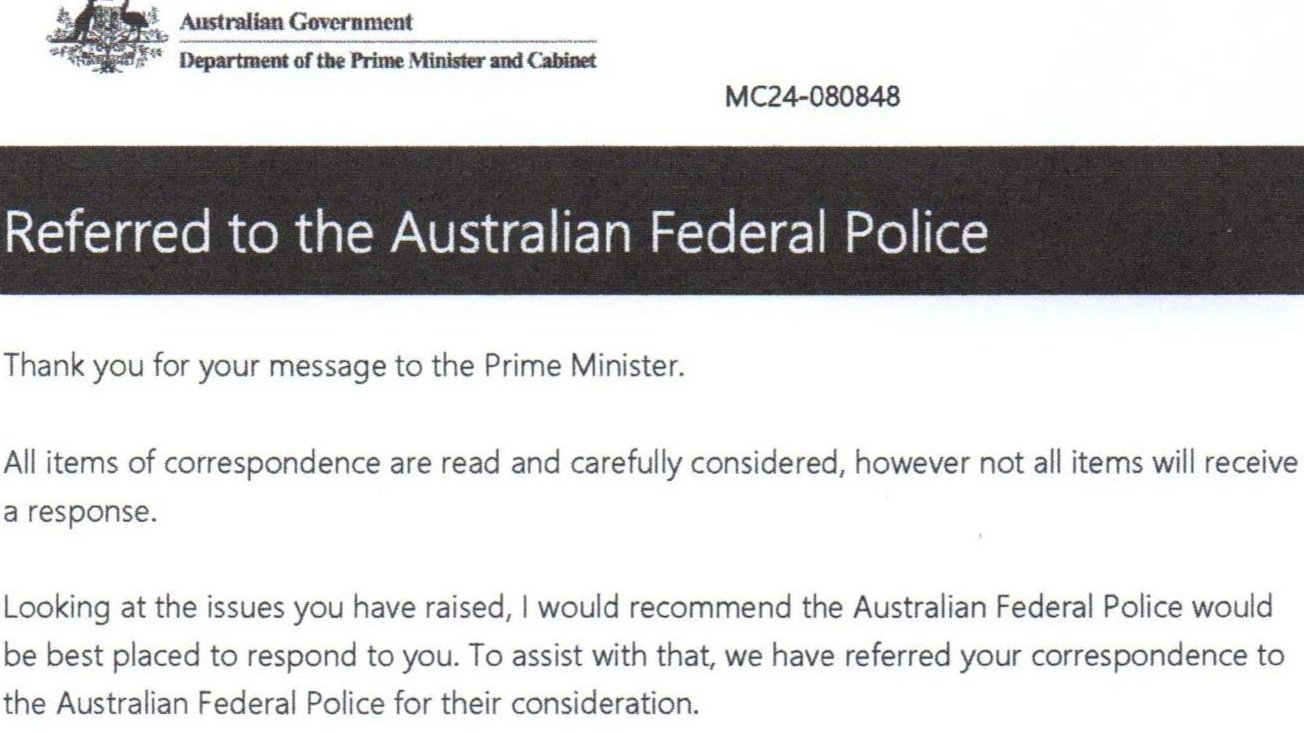
Family emails Prime Minister’s Cabinet requesting inquiry into the handling of Elly’s case by the AFP.
Outcome: Responsibility referred to AFP; no action taken on Four occasions same reply sent by the Australian government. However the AFP won’t reply to the Family!!
4 December 2024
Attorney-General Mark Dreyfus KC replies. He states the MAR process is not known to the Australian authorities and not relevant with this matter!! Family suspects the Australian attorney general has not been fully informed of all the facts on the Case by the AFP that Classification of homicide by SERNIC police reports and their Director general in 2017 & again in 2020 well before May 2023.
Outcome: Responsibility referred back to AFP; family frustrated with lack of accountability.
2025 Public Updates & Government Correspondence brick wall!
7 February 2025
Family posts on Facebook highlighting parallels with Laos tragedy.
Notes: Emphasizes AFP inaction and MAR failures. Homicide classification (CRIME) made years before May 2023!!
22 January 2025
I personally met with MP Jodie Belyea requesting response from the family’s complaint to the AFP commissioner 27th May 2024.
Elly’s Family also asked MP Jodie Belyea for immediate action for the Australian Attorney General to send the MAR for the Mozambique Case file as requested by the Deputy Attorney General by letter to the coroner on the 19th June 2023. (That they will only accept the official MAR for the realise of their case file). Basically the Australian Attorney General is not interested in the matter with a reply letter to the MP!
Outcome: No progress to date; family encounters bureaucratic “brick wall.”
16 June 2025
Blogs/Homepage Website added detailing AFP, DFAT, and Mozambique police cover-up from November 2016.
Verified Evidence: Letters, photos, official documents, transcripts and recordings all official records in support.
22 July 2025-2026
website updated My report on coroner’s findings in systematic order for clarity.
Even the Commonwealth Ombudsman appears to be avoiding the substantive issues raised by Elly’s family regarding the AFP, instead focusing on procedural technicalities in a way that gives the impression of avoiding accountability.
(Articial by Wayne Flower Fear of cover-up controlling watchdog ignores families complaint concerning AFP).
https://www.dailymail.com/news/article-16219687/elly-warren-father-ombudsman-afp-mozambique.html
There is a broader concern that when serious matters arise overseas involving Australian citizens, the current system does not always provide families with clear, timely and meaningful support. This raises questions about whether existing processes are sufficient, and whether improvements are needed to ensure families are better supported in crisis situations and that oversight mechanisms are genuinely responsive to substantive concerns.
Outcome: Highlights Melbourne pathologist and AFP misleading/failures, coroner transparency issues, relevant witnesses not called and MAR process mismanagement.
30th June 2026 book to be published (HUNTING ELLY’S KILLER)
It has just been confirmed May 2026 that the families launch for the book (HUNTING ELLY’S KILLER) will be held on the 10th July 2026 at Robinsons book store, Melbourne-Frankston central shopping Hub between 6-9pm.
Commonwealth Ombudsman decision 14/05 2026
The Commonwealth Ombudsman’s decision of 14th May 2026 has been devastating for Elly’s family. After years of engagement with Commonwealth agencies and the provision of extensive verified documentary evidence, official records, coronial material, AFP correspondence and supporting evidentiary material, serious concerns regarding AFP conduct, disclosure obligations, investigative integrity and accountability remain unresolved and unanswered.
This matter concerns the murder of a young Australian citizen overseas and raises exceptionally serious public interest issues regarding alleged misleading AFP representations, non-disclosure of critical evidence, failures of transparency and the handling of material evidence relevant to the coronial process and associated investigations.
The documentary record demonstrates that formal complaints and concerns were repeatedly raised directly with the AFP Commissioner acknowledged by the AFP referred by multiple Commonwealth agencies and pursued through parliamentary and oversight channels over many years.
The material provided includes evidence that the AFP received a clearer version of the crime scene photograph in November 2016 depicting Elly’s top ripped apart and exposing her upper torso, yet this clearer photograph and its evidentiary significance were never properly identified or disclosed within AFP reporting to the Coroner or Elly’s family.
The material further includes official SERNIC documentation supporting that Mozambique authorities had classified Elly Warren’s death as a homicide years prior to the position later advanced in AFP submissions to the Coroners Court.
I sent a new supplementary report requesting a review of the Commonwealth Ombudsman on 19th October 2026 to close my complaint which followed by Wayne Flower's article. I have attached the supplementary report at the bottom of this blog for anyone who wants to see how in my view they all cover each other's backs. The Coroner said that issues concerning the AFP were outside the scope of the inquest. Now after more than two years the Ombudsman has technically agreed with the AFP on a technicality that my report was not a complaint simply because I sent it directly to the AFP Commissioner.
However, the Ombudsman appears to have overlooked section 40SC of the Australian Federal Police Act 1979, under 40SA which provides for complaints about the conduct of the AFP to be made “directly” to the AFP Commissioner by letter or email!!
Despite the existence of substantial verified supporting material, no independent accountability process now appears willing to properly examine these matters.
In circumstances involving the murder of an Australian citizen overseas, allegations concerning misleading representations, evidentiary non-disclosure and failures of investigative transparency are exceptionally serious and warrant the highest level of independent scrutiny and public accountability.
The Australian public is therefore entitled to ask a serious and unavoidable question: who then holds the AFP accountable for misleading conduct the non-disclosure of critical evidence and failures of transparency in matters of such gravity?
Key Evidence
Clear Crime Scene Photo (Nov 2016): Shows T-shirt ripped from shoulder to torso, half-naked body. Not submitted or reported to the coroner by the AFP.
Autopsy reports Mozambique and South Africa both concur that aspirating an abundance of sand which had packed/ chockablock in Elly’s airways obstructing the airways causing death.
Radiogoly Report 2019
South african autopsy photographts clearly showing abreasions were never given to Melbourne pathologist before the release of his autopsy report
Elly’s Clothing: Retained at Maputo Central Hospital; AFP/SLO did not secure; DNA opportunity lost.
SERNIC Mozambique Police Reports (DIRECTOR GENERAL) (Apr 2017 & 2020): Confirms homicide classification.
Official letters to the coroner dated 16 &19th June 2023.
Official DFAT’s letter 22nd March 2019 sent to family and AFP.
Book Launch – 10th July 2026
The book launch was a huge success with around 80 people attending. We were honoured to have Mr Charlie Bezzina as our guest speaker.
A special thank you also goes to Robinsons Bookshop for hosting the event, and to Emily, who did such a wonderful job organising the evening and ensuring everything ran so smoothly. Your support was greatly appreciated.
The feedback I received afterwards was overwhelming. Charlie and I spoke together about Elly's case, along with several other cases Charlie has been involved in. Our discussion captivated the audience and after speaking for almost an hour many people told us they were so engrossed that they didn't want us to stop.
I was also delighted to sign around 50 copies of Hunting Elly's Killer. It was wonderful to see such incredible support from family, friends, and members of the community who came along to share the evening.
The entire book launch was video recorded by Emily. If anyone would like a copy of the recording please don't hesitate to ask.
Finally a heartfelt thank you to everyone who attended and helped make the launch such a memorable and special occasion. Your support, encouragement and friendship meant so much to me and my family.
The Website update was LAST UPDATED on o3/08/2026.
Critical Failures
AFP failed to send official MAR in 2016; only informal requests/personal letters. SERNIC confirmed Homicide with official revised police report in 2017 and again in 2020 by their Director general and reaffirmed again in May 2023 to the AFP. Note all SERNIC police reports were sent to DFAT and the AFP.
Vital crime scene photograph withheld from coroner and pathologist. No report no any trace evidence to coroner not even in official statements reported by the AFP to this day.
Radiology report by Dr O’Donnell 2019 taken from CT Scan just prior Melbourne autopsy clearly showing both lungs trees filled with foreign material (Sand) with other areas of very high density equivalent to bone and cement density levels measured by Hounsfield unit of measurement at 1290 HU and 947 HU. No sand found or recorded in the lungs in the Melbourne autopsy report concluding cause of death in 2016/17 as Undetermined!!
Elly’s clothing she was wearing at the time of her death was never collected for DNA testing.
Sand sample taken from crime scene by AFP. No sample taken from Elly’s body for comparison. (Body moved post- mortem AFP had prior Knowledge in 2016 and later confirmed by Mozambique chief inspector)
AFP prioritized appearances and diplomatic concerns over justice. Mozambique cover-up 6am ripped apart top tampering with crime scene by local police before main investigation police, chief and doctor turned up at 9am.
The family and Coroner kept largely in the dark from the onset; transparency and accountability lacking by AFP.
Mozambique case officially closed due to lack of evidence; missed opportunities for DNA evidence clothes for conviction if matched with any solid suspects. This was vital as a match in DNA with suspects places them at the crime scene. Drop of sweat any body fluids or skin cell from hand grip ripping apart Elly’s t-shirt!!!
Latest SERNIC Operation in Tofo Involving Independent Investigator Mr Roos
Recent developments in the investigation have further intensified concerns surrounding Elly Warren’s homicide case.
In 2025, during a SERNIC operation in Tofo connected to Elly Warren’s homicide investigation, accommodation used by investigating officers was reportedly raided at night in a brazen incident during which a laptop computer and mobile phone were stolen. The circumstances surrounding the raid raised further serious concerns regarding the sensitivity of the investigation and the possibility that individuals connected to the case believed critical evidence or intelligence was held on those devices.
Mozambique authorities have previously confirmed through official reports that Elly Warren’s death was classified as a homicide and that investigators had identified “solid suspects” connected to the case. Information received by Elly’s family indicates that SERNIC investigators are now increasingly confident regarding the identity of those responsible for Elly’s murder, however insufficient admissible evidence currently remains unavailable to secure criminal convictions.
This is why the failure to retrieve and preserve Elly’s clothing in November 2016 remains such a critical issue. The condition of Elly’s clothing, including her top being ripped apart and her underwear and bra or bathers displaced, represented potentially vital forensic evidence capable of DNA analysis and other forensic examination. A confirmed DNA match to any suspect could potentially identify the person responsible for Elly’s murder and provide critical evidentiary support capable of leading to criminal conviction.
Despite the obvious forensic significance of the clothing, the material was never formally retrieved or preserved by the AFP while officers were present in Maputo Mozambique twice three days after Elly’s autopsy was conducted in Maputo.
Some suspects have reportedly since left Tofo, while others remain. The “HUNT” still continues today even though the Mozambique Judge has closed the case in 2024.
Comwonwealth decision email below
On ,Thu May 14 2026 11:30:18 GMT+1000 (Australian Eastern Standard Time), Ombudsman <Ombudsman@ombudsman.gov.au> wrote:
---------- Original Message ----------
OFFICIAL: Sensitive
Our ref: 2024-705934
Dear Mr Warren
Thank you for your recent emails outlining your dissatisfaction with the decision I made regarding your complaint to our Office about the Australian Federal Police (AFP).
I have reviewed the additional information you have provided by email and made preliminary enquiries with the AFP, and my decision to close your complaint remains unchanged. I have explained the reasons for my decision below.
Complaint reconsideration
The AFP confirmed that you have sent multiple emails to the Office of the Commissioner, including the email sent on 27 May 2024. The AFP stated that these emails were not considered to be complaints, which is reflected in its response letter to you on 24 August 2024. Having reviewed your emails to the Office of the Commissioner, I am satisfied that the determination that the emails were not complaints is reasonable in the circumstance.
The AFP advised that the Professional Standards team, who investigate serious matters such as misconduct and corruption, has not received any complaints from you.
It remains open to you to lodge a formal complaint with the AFP. Information on how to submit a complaint is available on the AFP’s website: Complaints and feedback for the Australian Federal Police - AFP
If you disagree with my decision, you are welcome to request a review by completing our online form.
You should request a review within 3 months of being told about our decision. Your review request should clearly identify why you believe the decision was wrong and provide any additional supporting information or evidence. You can find information about our review process on our website under ‘Complaints about us’ and request a review of your complaint outcome.
Yours sincerely,
Teri
My final response email below to the Commonwealth Ombudsman email above 19th May 2026 sent to all:
Re: Commonwealth Ombudsman - 2024-705934 - Paul Warren CRM:0459003 [SEC=OFFICIAL:Sensitive]
pwww@bigpond.com
to
Ombudsman, attorney@ag.gov.au, foreign.minister@dfat.gov.au, DLO@pm.gov.au, commissioner@afp.gov.au, 60Minutes@nine.com.au, allylangdon@nine.com.au, mandy.squires@news.com.au, sarahmarinos@optusnet.com.au, Steven.jackson@mailonline.com, erugg222@nine.com, penelopeliersch@nine.com brodiempnews@gmail.com, daniellejcollis@gmail.com, scucchiara@nine.com.au, 4corners@your.abc.net.au, Producer@thebriefingpodcast.com.au, johnparrish@optusnet.com.au, Olivia
Tue, May 19, 2026 9:03 AM
Dear Teri,
I write to formally express my profound concern regarding the Commonwealth Ombudsman’s handling of my complaint concerning the conduct, integrity and complaint handling processes of the Australian Federal Police in relation to my daughter Elly Warren’s murder in Mozambique.
This matter concerns the death of a young Australian citizen overseas and raises exceptionally serious issues surrounding the AFP’s handling of critical evidence, disclosure obligations to the Coroner and Elly’s family, and the AFP’s subsequent failure to properly respond to a formal complaint lodged directly with the AFP Commissioner.
Given the gravity of the matters raised, including concerns regarding the AFP’s withholding of critical evidence in relation to the death of an Australian citizen overseas, the position now adopted by your Office is extraordinary, profoundly concerning and difficult to reconcile with the Commonwealth Ombudsman’s oversight responsibilities in matters of this seriousness.
After approximately two and a half years of engagement with the Commonwealth Ombudsman, Elly’s family is now being informed that no complaint had been made to the AFP prior to approaching your Office. That conclusion is plainly inconsistent with the documentary record already provided and cannot reasonably be reconciled with the evidence before you.
On 27th May 2024, I lodged a formal systems complaint directly with the AFP Commissioner concerning the AFP’s conduct, integrity and handling of my daughter’s case. This was not informal correspondence. It was a detailed complaint supported by official records, coronial material, AFP documentation, correspondence, forensic material and evidentiary records relating to the AFP’s involvement in the matter.
On 28th May 2024, the Office of the AFP Commissioner formally acknowledged receipt of that complaint and advised in writing that the “matters raised” would be considered and a response would be forthcoming.
I further note that correspondence from the Australian Attorney-General’s office also acknowledged that the concerns raised regarding the AFP’s handling of my daughter’s case fell outside its jurisdiction and were appropriate for the AFP to address directly.
Correspondence from the Department of the Prime Minister and Cabinet expressly advised that the AFP would be best placed to respond and confirmed that the correspondence had been referred to the AFP for consideration. Multiple Australian Government agencies provided similar responses, consistently directing the matters back to the AFP.
I also sought assistance through my local Federal Member of Parliament in an effort to obtain substantive responses from the AFP. These representations further demonstrate that the concerns were formally and repeatedly raised with Commonwealth authorities and that the AFP was aware of ongoing requests for accountability, transparency and response.
Elly’s family also sought independent Australian Government intervention and consideration of an inquiry into the AFP’s handling of the case. Despite the seriousness of the concerns, including disclosure obligations, investigative integrity and evidentiary handling, the consistent response was referred back to the AFP, leaving Elly’s family in a circular process where the agency subject to complaint remained responsible for assessing its own conduct.
Despite repeated referrals, follow up correspondence and formal acknowledgment by the AFP Commissioner’s Office, no substantive response addressing the core issues raised in the complaint was ever provided.
The factual position is therefore clear.
A formal complaint was lodged with the AFP Commissioner on 27th May 2024. It was acknowledged on 28th May 2024. The AFP advised a response would be provided. The Attorney-General’s office and other Australian Government agencies recognised the complaint and referred it to the AFP. My local Federal MP also raised the matter. No substantive response was ever provided. Elly’s family continued to seek responses without resolution.
This continuing failure is further evidenced by correspondence sent to Commander Raegan Stewart on 24th October 2024, in which I again referred to the 27th May 2024 complaint and requested a response, stating that the family needed answers and explanations to the issues raised.
In those circumstances, it is profoundly troubling that your Office has now determined that no complaint had been lodged with the AFP prior to Ombudsman involvement. That conclusion is inconsistent with the documentary record, the AFP’s own acknowledgment, the conduct of multiple Commonwealth agencies and your Office’s own extended engagement with this matter.
I must also address reliance upon AFP correspondence dated 23rd August 2024 referring to my latest correspondence. That letter does not identify the complaint of 27th May 2024 and does not engage with its substance.
It is also important to clarify the Mutual Assistance Request (MAR) process. At no stage did the Mozambique Attorney-General state that a Mutual Assistance Request could not have been initiated by the AFP from the outset. In fact, a Mozambique Government official had previously stated in 2021, within AFP submissions, that a joint operation between our two nations was always possible, and those submissions were provided to the then Coroner, Mr Bracken.
The issue raised instead concerned access to specific case file material prior to the lifting of Mozambique security restrictions, which is materially different from whether investigative cooperation or formal mutual assistance mechanisms could have been pursued between the two countries from the outset.
It must be strongly noted that, in the 19th June 2023 letter to Mr Cain, the Mozambique Deputy Attorney-General clearly stated that Mozambique would only accept the formal Mutual Assistance Request process with Australia in relation to access to the case file material. This demonstrates the importance and respect the Mozambique Government places upon the formal MAR process between our two nations.
The 19th June 2023 correspondence clearly supports this position and indicates that the appropriate official pathway for cooperation remained available through formal Mutual Assistance channels. The evidence therefore does not support any suggestion that the AFP was prevented from initiating or pursuing a Mutual Assistance Request process at any time. Rather, it demonstrates that Mozambique expected such engagement to occur through the proper official government-to-government mechanism.
Material later provided to the Coroners Court by the Australian Government Solicitor in June 2023 further demonstrates that formal cooperation mechanisms were in fact available and were used. That correspondence confirms AFP communication with Mozambique authorities in November 2016, sharing of evidentiary material, and ongoing interaction between Australian and Mozambique authorities.
The AFP acknowledged that Detective Superintendent Scruton, the AFP liaison officer based in Pretoria, received a blurred crime scene photograph from the Honorary Consul on 13th November 2016. Australian Government Solicitor correspondence later confirmed that the photograph obtained on 13th November 2016 was the blurred version provided by the Honorary Consul to the AFP/SLO on that date.
Although Detective Superintendent Scruton’s final statement was not made until 17th August 2017, he referenced the photograph obtained on 13th November 2016 without distinguishing between the blurred image originally received and the clearer version later supplied by DFAT. DFAT subsequently provided the AFP/SLO and AFP with a clearer version of the same photograph on 25th November 2016. The AFP/SLO then forwarded the clearer photograph to Mozambique authorities on 8th December 2016. However, neither the Coroner nor Elly’s family were informed that the AFP had provided Mozambique authorities with the clearer and explicit photograph depicting our daughter’s partially exposed body.
The Australian Government Solicitor correspondence confirms the clearer photograph was only provided to the AFP by DFAT on 25th November 2016. The image originated from the fisherman passed through the Honorary Consul after leaving Tofo, then to Embassy staff in Pretoria before reaching the AFP.
This distinction is critical. The clearer photograph clearly shows Elly’s top ripped from the shoulder, exposing her upper torso all the way down her right side. This evidentiary detail was capable of supporting the possibility that a violent physical struggle had taken place prior to her death. Despite this, the clearer photograph was not identified or explained in the AFP/SLO statement provided to the Coroner in 2017, nor in any AFP submissions, reports, or other statements issued to this day.
The AFP statement of Detective Superintendent Scruton refers generally to the photograph from the fisherman without clearly distinguishing between the blurred and clearer versions or acknowledging receipt of the clearer image.
The Coroner ultimately stated during my oral submissions at the inquest that there was no dispute that Elly’s top was ripped apart. However, the clearer photograph and its significance were not properly disclosed or addressed in AFP reporting to the Coroner.
This raises serious concerns regarding disclosure, evidentiary handling and investigative transparency. The AFP possessed the clearer image in November 2016, provided this material to Mozambique authorities, and was involved in supporting the coronial process, yet the clearer photograph was never provided to the Coroner by the AFP. No report concerning this vital evidence was provided to the Coroner indicating that, with Elly’s top so violently ripped apart, clear evidence existed of a violent altercation and probable third-party involvement prior to Elly’s highly suspicious death. No Mutual Assistance Request was ever sent, and the significance of the clearer photograph was never formally disclosed.
The clearer image showed Elly’s top ripped apart from the shoulder and exposing her upper torso, an evidentiary feature strongly capable of supporting the conclusion that a violent struggle had taken place prior to Elly’s death, which was later formally classified by Mozambique authorities as a homicide in two official police reports, including a comprehensive report issued by the Director-General of SERNIC well before May 2023.
The position previously advanced to Elly’s family that investigative limitations existed due to the absence of a Mutual Assistance Request is difficult to reconcile with documented AFP cooperation with Mozambique authorities.
After being advised the case had been closed, I wrote to Commander Raegan Stewart seeking clarification regarding whether a Mutual Assistance Request could still be pursued for the Mozambique file, reflecting ongoing efforts by Elly’s family to seek transparency and accountability.
The AFP correspondence of 23rd August 2024 does not address the substance of the complaint, including disclosure failures, evidentiary handling, integrity concerns or the handling of the crime scene photographs. These matters remain unanswered.
The AFP Commissioner’s submissions to Coroner Mr Cain dated 18th December are misleading in asserting that no Mozambique police authority had classified Ms Warren’s death as a crime or homicide prior to May 2023. This assertion is directly contradicted by two official reports issued by SERNIC, the Mozambique criminal investigation authority and their Director-General.
One report was issued in 2017, and a subsequent comprehensive report was later provided to both DFAT and the AFP by the Director-General of SERNIC August 2020 expressly confirming that Ms Warren’s death had been classified as a homicide and that they have solid suspects.
This is wholly unacceptable and significantly undermines the integrity of the AFP’s submissions and assistance provided to the Coroner.
It must also be strongly noted that the requirement for the AFP to issue a Mutual Assistance Request (MAR) and formally offer Australian assistance is dependent upon Mozambique authorities classifying the death of an Australian citizen as a crime. Once such a classification is made, it provides substantial weight and foundation for the MAR to be submitted through the Australian Attorney-General’s Department.
In this matter, despite the homicide classification having been formally communicated, no MAR was ever sent.
The contrast between the Mozambique Government’s respect for the formal MAR process and the AFP’s apparent failure to pursue that process raises further serious concerns regarding the adequacy of the AFP’s investigative efforts, international cooperation, and overall handling of this matter.
The seriousness of this matter cannot be overstated. It concerns the murder of a young Australian citizen overseas and allegations that critical evidence relevant to the coronial process was not properly disclosed to the Coroner or the family.
The material provided to your Office includes official records, coronial material, AFP correspondence, highly relevant clear photographic material and inquest evidence which collectively raise serious concerns regarding investigative integrity, accountability and disclosure obligations.
During the coronial proceedings, I raised concerns regarding AFP conduct. The Coroner advised that such matters were outside the jurisdiction of the Coroners Court and should be raised directly with the AFP. On that basis, Elly’s family lodged the formal complaint with the AFP Commissioner on 27th May 2024.
That sequence of events demonstrates that the family acted appropriately and in accordance with judicial direction. The inquest record is publicly available and supports this chronology.
At the time my complaint was made, the Commonwealth Ombudsman was actively examining systemic concerns relating to AFP complaint handling processes, including issues regarding effectiveness, consistency, responsiveness and public confidence in the handling of complaints against AFP members.
Those concerns were publicly acknowledged in public reporting regarding the Commonwealth Ombudsman’s examination of AFP
Region Canberra article regarding Ombudsman concerns about AFP complaint handling practices
The issues experienced in Elly’s case appear entirely consistent with those broader systemic concerns.
I further note that when I first approached your Office, I was advised that complainants were generally expected to raise matters with the relevant agency first. However, this was not presented as a jurisdictional bar preventing assessment of exceptionally serious public interest matters involving accountability and institutional integrity.
Your Office then engaged with this matter for approximately two and a half years, requesting material and progressing assessment stages. At no point was it clearly indicated that the matter would ultimately be rejected on the basis that no complaint had been made to the AFP, despite the documented evidence showing that it had.
A formal complaint was made. It was acknowledged. It was referred to by multiple agencies. It was raised through parliamentary channels. It was followed up repeatedly. It was never substantively answered.
To now conclude that no complaint existed is inconsistent with the documentary record and the AFP’s own written acknowledgment.
Accordingly, I request reconsideration of the decision that no further action is warranted, formal acknowledgment that the AFP complaint was lodged on 27th May 2024, clarification of how the contrary conclusion was reached, and a substantive explanation for the handling of this matter, including delay and assessment process.
Given the seriousness of the matters raised, the prolonged absence of substantive accountability, and the significant public interest issues concerning institutional transparency and oversight, I have copied this correspondence together with supporting material to the AFP Commissioner, Australian Attorney-General, DFAT, Australian Government representatives and multiple Australian media organisations.
This has not been done lightly. However, after approximately two and a half years of engagement with Commonwealth agencies without substantive resolution, Elly’s family believes there is now a clear public interest in ensuring independent public scrutiny of the matters raised.
This matter extends beyond Elly’s case alone. It raises broader concerns regarding whether Australian families confronting suspicious deaths overseas can have confidence that serious complaints involving Commonwealth law enforcement agencies will be properly assessed, independently scrutinised and transparently addressed.
In circumstances involving allegations concerning withheld evidence, disclosure failures and unresolved accountability issues, the continuing absence of substantive answers is deeply concerning.
The Australian public is entitled to expect that serious concerns involving Commonwealth agencies, particularly in matters involving the murder of an Australian citizen overseas, are properly examined and subject to independent review.
After years of unanswered questions, repeated referrals between agencies and the absence of meaningful accountability, Elly’s family believes other Australian families should not be placed in a position where they are left navigating prolonged institutional processes without transparency, resolution or confidence that critical concerns are being independently addressed.
If oversight mechanisms fail to properly respond to serious complaints involving evidentiary disclosure, investigative integrity and institutional accountability in matters of this gravity, it risks undermining public confidence not only for Elly’s family, but for other Australian families who may one day find themselves seeking answers and accountability following the death of a loved one overseas.
Yours sincerely,
Paul Warren
June 2026 Update – Outcome and Systemic Accountability Concerns Raised
If the Commonwealth Ombudsman maintains a position that no complaint was made to the Australian Federal Police (AFP) prior to its involvement in this matter, despite documentary evidence indicating that a formal complaint was lodged, acknowledged, referred between Commonwealth agencies, and repeatedly followed up over an extended period, then a serious question arises as to whether the oversight process is functioning effectively in relation to matters of significant public interest.
In practical terms, such a position has the effect of removing the matter from substantive independent review, notwithstanding that the underlying issues concern the death of an Australian citizen overseas, alleged failures in evidentiary disclosure, investigative handling, and complaint response by the AFP.
Where a complaint has been formally lodged with the AFP Commissioner, acknowledged in writing by the AFP, referenced and redirected by multiple Commonwealth agencies including the Attorney-General’s Department and the Department of the Prime Minister and Cabinet, and repeatedly followed up without substantive response, yet is later treated as if it did not exist for the purposes of oversight assessment, this creates a material accountability gap in the Commonwealth complaints framework.
The consequence of this gap is not procedural inconvenience. It is that serious allegations concerning law enforcement conduct may not receive independent examination on their merits, even where there is documented evidence of engagement with the agency concerned.
For members of the public, this raises a broader and more fundamental concern: whether there exists an effective and reliable pathway for independent scrutiny when complaints involve Commonwealth law enforcement agencies and complex overseas deaths, particularly where jurisdictional referral processes result in matters being returned to the very agency whose conduct is in question.
In circumstances of this nature, the absence of clear, transparent and final determination risks creating a system in which complaints are acknowledged but not substantively resolved, responsibility is repeatedly referred back to the subject agency, and oversight bodies are unable or unwilling to make findings on contested factual records.
If this outcome is correct, it would not only affect this case, but would also raise broader questions about public confidence in the effectiveness of Commonwealth oversight mechanisms in cases involving the deaths of Australian citizens overseas.
Accordingly, the central issue is not solely the factual dispute as to whether a complaint was made, but whether the oversight framework is capable of independently testing and determining serious allegations once raised, or whether procedural classification issues can prevent substantive review from occurring at all.
In matters of this gravity, the public interest lies in ensuring that serious complaints concerning investigative integrity, disclosure, and agency accountability are independently assessed and transparently resolved, rather than being left without definitive determination due to jurisdictional or procedural interpretation.
The question therefore remains:
Who holds the Australian Federal Police accountable for its actions?
Note: It is critically important that anyone reading this updated flow chart fully understands that I am in possession of all verified official documents and records that substantiate the matters outlined above. Accordingly, everything referred to in this updated flow chart is based entirely on factual information drawn directly from official sources, including material contained within the coronial brief of evidence, court transcripts and recordings. My above statements are not assumptions, opinion, or speculation, but are grounded in documented and verifiable evidence. It is essential that the seriousness and significance of these circumstances are fully understood in that context.
Paul Warren
SUPPLEMENTARY SUBMISSION TO THE COMMONWEALTH OMBUDSMAN REVIEW MANAGER
Date: 19 October 2026
Complaint reference: 2024-705934
CRM reference: 0459014
Complainant: Paul Warren
Subject: Review of the Ombudsman’s decision to close my complaint concerning the AFP’s handling of my report dated 27 May 2024.1. “Why I Am Making This Further Submission”
I make this further supplementary submission to the Review Manager in relation to Commonwealth Ombudsman complaint reference 2024-705934 (CRM reference 0459014). It follows my ongoing efforts to have the Commonwealth Ombudsman reconsider its decision dated 14th May 2026 to maintain closure of my complaint about the Australian Federal Police’s (AFP) handling of my report complaint to the AFP Commissioner dated 27th May 2024.
The main issue I am asking the Review Manager to reconsider is whether the Commonwealth Ombudsman properly examined the substance of my report, the circumstances in which I made it, the documentary evidence supporting my concerns and the applicable complaint handling framework before accepting the position that no complaint had been made to the AFP and maintaining closure. This is not a minor disagreement about procedure. It concerns whether the Ombudsman properly examined the matters I raised, whether its decision was adequately explained and whether the AFP’s handling of my serious concerns was properly scrutinised.
On 27th May 2024, I referred serious, evidence based concerns directly to the AFP Commissioner. I did so following the indication given by Coroner Cain during oral submissions on 11th December 2023 that concerns about AFP conduct could be pursued directly with the agency. At page 272 of the transcript, Coroner Cain stated that this “may be a matter that you deal with directly with the AFP by way of complaint about their conduct.” The following day, on 28th May 2024, the
Commissioner’s Office acknowledged my report and expressly stated: “The matters you have raised will be considered and a response will be forthcoming.”
These circumstances are important to understanding what I submitted, why I submitted it and how the AFP subsequently handled it. They should not be considered separately from the contents and purpose of my report or the circumstances in which it was made. Equally, the fact that the AFP subsequently sent me a response does not, by itself, establish that my actual concerns were properly examined or addressed.
For this reason, I believe the Ombudsman’s decision requires more than simply accepting the position that the AFP did not formally record or classify my correspondence as a complaint. The important question is whether the Ombudsman properly considered what I actually submitted, how the AFP received and dealt with that information, and whether the applicable complaint handling framework was correctly applied. The distinction between how the AFP administratively classified my correspondence and how it substantively handled the serious information I provided is central to this review. The AFP’s own characteisation of my correspondence should not, by itself, replace an independent and properly reasoned examination of my report and the way it was handled.
I have been dealing with the Commonwealth Ombudsman about these matters for more than two years. During that time, I have challenged the initial closure, provided further material when requested, responded to the Ombudsman’s enquiries and sought reconsideration of its position. The Ombudsman requested further material on several occasions, sought information from the AFP and advised me on 1th May 2026 that the matter was progressing and that further information would be sought from the AFP. Despite this, on 14th May 2026, the Ombudsman maintained closure. That decision did not resolve the substantive issues I had raised. I am making this further submission because those issues remain unresolved and I believe they require a proper, reasoned examination by the Review Manager.
My purpose in making this submission is to obtain a substantive, evidence based and properly reasoned review of the decision to maintain closure. I ask the Review Manager to examine whether the Ombudsman adequately considered the relevant evidence and correspondence, critically assessed the AFP’s position, correctly applied the appropriate complaint handling framework and gave sufficient reasons for its conclusion. I do not believe the review should treat the existence or absence of a formal complaint classification, or the fact that the AFP sent a response, as sufficient to settle the matter without examining the underlying circumstances and the substance of my concerns sent directly to the AFP commissioner.
The matters I have raised also have broader importance beyond my own family and the particular decision under review. The Commonwealth Ombudsman has an important responsibility to scrutinise the administrative conduct of Australian Government agencies, examine their explanations and ensure that concerns brought before it receive proper and meaningful consideration. Where serious concerns supported by documentary evidence have been raised, I believe the oversight process should examine the underlying evidence, the applicable requirements and the reasons for the agency’s actions, rather than relying on the agency’s own description of how it handled the matter. The adequacy of the Ombudsman’s own examination must also be open to scrutiny, particularly when a complainant maintains that important concerns remain unanswered.
Elly’s family should not have to experience these circumstances without meaningful answers. Other Australian families should not be left to face the same difficulties when seeking answers, support and accountability from government agencies. If shortcomings in complaint handling or oversight are identified, they should be properly examined and, where warranted, addressed. Otherwise, an opportunity to identify administrative shortcomings, improve accountability and prevent similar difficulties for other families may be lost. Families facing similarly distressing circumstances should be able to expect that serious concerns supported by documentary evidence will receive meaningful consideration, that agencies’ explanations will be critically examined and that any identified deficiencies will be addressed rather than left unresolved.
This is therefore not simply a disagreement about whether my correspondence was formally classified as a complaint. It raises a fundamental question about whether serious, documented concerns have been properly examined and whether the oversight process is fulfilling its purpose when families turn to it for independent scrutiny. I ask the Review Manager to consider whether the decision in my case was adequately reasoned and whether any shortcomings identified during the review warrant further scrutiny or corrective action in the interests of accountability and other Australian families who may face similarly distressing circumstances. The importance of this review lies not only in reaching a properly reasoned outcome in my case, but also in identifying and addressing any administrative deficiencies that could affect others.
I want to make clear that I am not asking the Review Manager to determine who was responsible for my daughter’s death, overturn the Coroner’s findings or undertake a criminal investigation. I am asking for a rigorous examination of how the AFP handled my report and whether the Ombudsman adequately examined those matters before deciding to maintain closure. The detailed evidence, chronology, statutory and procedural issues, and specific questions requiring determination are set out in the subsequent sections of this submission.
Accordingly, I ask the Review Manager to reconsider the decision to maintain closure of complaint 2024-705934, address the questions set out in Section 6, consider the material identified in Section 7 and provide a substantive written outcome. That outcome should explain the findings reached, the framework applied, the reasons for those findings and any further action considered appropriate. A further confirmation that my corespondence was received, processed or answered would not, by itself, resolve the issues I have raised. What I am seeking is a reasoned determination that directly addresses the substance of my concerns, the evidence and circumstances relevant to the handling of my report, and the basis on which the decision to maintain closure can or cannot be justified.
2. My Report to the AFP Commissioner on 27th May 2024
My report to the AFP Commissioner was not a general request for information or an expression of grief. It raised serious concerns about the AFP’s handling of evidence and information relevant to the investigation and coronial inquiry into Elly’s death. These concerns arose from official documents and records I had accumulated during my investigation.
The following matters show the nature and seriousness of the issues I brought to the Commissioner’s attention.
2.1 The Clear and Blurred Crime Scene Photographs: Failure to Examine, Report and Account for Significant Evidence.
One of my most significant concerns involves the handling and disclosure of the Clear Version of the Crime Scene Photograph taken by the fisherman who found Elly’s body at 5am on the 9th November 2016.
The documentary chronology records that:
On 13th November 2016, the Honorary Consul obtained a blurred version of the photograph.
On 20th November 2016, the AFP Senior Liaison Officer (AFP/SLO) passed the blurred version to Chief Inspector Cudzi.
On 25th November 2016, the AFP/SLO received a clear version from the Department of Foreign Affairs and Trade (DFAT).
On 8th December 2016, the AFP/SLO passed the clear version to Chief Inspector Cudzi.
The AFP/SLO Action Sheet dated 7th November 2018 records further analysis of the clear photograph obtained in connection with material associated with the 60 Minutes investigation.
The clear crime scene photograph shows Elly’s top ripped from her right shoulder all the way down the right side of her torso. This damage cannot be seen in the blurred version. The difference between the two photographs is material because the clear version depicts the condition of Elly’s clothing in a way that the blurred version does not. This raises serious questions about whether the clear photograph was properly examined, assessed and reported during the coronial investigation, and whether the significance of the evidence it depicted was adequately brought to the Coroner’s attention.
DFAT Assistant Secretary Claire McComish’s letter dated 22nd March 2019 confirms the existence of the clear photograph and its forwarding to the Mozambique police by Mr Scruton, the AFP/SLO based in South Africa at the time.
The documentary record also confirms that DFAT emailed the clear photograph to the Victorian Police Coronial Support Unit on 25th November 2016 and shared it with the Victorian Institute of Forensic Medicine (VIFM). In addition, Ms McComish’s letter confirms that Mr Scruton had received the clear photograph and that it was handed over to the Mozambique authorities on 8th December 2016. The clear photograph had therefore reached relevant Australian authorities in 2016, and the record confirms that it had also been provided to the Mozambique police authorities.
However, the Australian Government Solicitor’s letter dated 16th June 2023 confirmed that the photograph accompanying the AFP/SLO statement to the Coroner was the blurred version only dated the 13th November 2016, not the clear version. This creates a significant documentary discrepancy that demands a clear and substantive explanation. Mr Scruton, the AFP/SLO, had received the clear photograph on the 25th November 2016 from DFAT, and the documentary record confirms that it was handed over to the Mozambique police authorities on 8th December 2016. Why, then, was only the blurred version provided with the AFP/SLO statement to the Coroner? What happened to the clear version within the investigative and coronial processes? Why was the clear photograph not included with that statement? Why was the transfer of the clear photograph to the Mozambique police authorities not clearly disclosed and explained to the Coroner, and why was the Coroner not properly informed of the handling and transfer of this potentially significant evidence?
Equally serious is why the Coroner and the family were not informed that the clear photograph was being handed over to the Mozambque authorities, and why the family’s permission was not sought before this transfer took place. This concern is particularly significant because, during my oral submissions, the AFP lawyer acknowledged that permission should have been sought. The lawyer also stated during those same oral submissions that the photograph was critical evidence that the AFP had an obligation to share with the investigating authority.
These statements raise serious questions. If the AFP lawyer acknowledged that permission should have been sought, why was the family not consulted and its permission not obtained before the photograph was handed over to the Mozambique authorities? If the photograph was acknowledged to be critical evidence that the AFP needed to share with the investigating authority, why was the clear version not included with the AFP/SLO statement to the Coroner? Why was the Coroner not properly informed of the transfer and handling of this critical significant evidence? Why was the family not informed of the transfer, and why was the clear photograph and its significance not properly disclosed and addressed in the coronial material? What records exist of any notification, consultation or request for permission?
I reiterate that the clear photograph shows Elly’s top ripped from her right shoulder all the way down the right side of her torso, damage that cannot be seen in the blurred version. The AFP/SLO Action Sheet dated 7th November 2018 records that the clear crime scene photograph was analysed by the Senior Superintendent based with the South African AFP/SLO. The clear crime scene photograph was the only photograph I brought back from Tofo in October 2018. Accordingly, the photograph recorded as having been analysed by the AFP/SLO on 7th November 2018 was the same clear crime scene photograph I had brought back from Tofo.
The seniority and experience of the officer who analysed this photograph make it particularly important to establish what examination and analysis were undertaken, what conclusions were reached, and why the damage to Elly’s ripped top, clearly visible in the photograph, was not properly assessed and reported to the Coroner at that time, almost two years after Elly’s death. This is especially concerning because the clear photograph had already reached relevant authorities in 2016, yet I had to obtain it myself and bring it to the Coroners Court’s attention. Why was this significant damage to Elly’s clothing not properly examined, assessed and reported to the Coroner when the clear photograph was initially received in 2016 and again when it was analysed in November 2018, in light of the AFP’s sworn obligations and its role in supporting Australian policing matters overseas? The circumstances surrounding the receipt, handling, analysis and transfer of the clear photograph, the failure to inform the Coroner and the family, the failure to seek the family’s permission, and the failure to properly account for this critical evidence in the coronial process demand a clear and substantive explanation.
The concern is not simply that two versions of the photograph existed. The clear version showed damage to Elly’s clothing that could not be seen in the blurred version. The issue is whether this potentially significant evidence was properly examined and assessed, whether its significance was communicated to the relevant forensic personnel and the Coroner, and whether the available photographic evidence was adequately accounted for in the coronial investigation.
A further serious concern arises from a recorded meeting on 7ht September 2017, attended by three AFP officers or representatives. At that meeting, approximately one year after Elly’s death, Melbourne pathologist Dr Lynch had not been provided with the clear crime scene photograph or the South African autopsy photographs showing facial injuries and abrasions to Elly’s face. The AFP action sheet dated 22nd November 2016 records that the Melbourne AFP/SLO had obtained these critical autopsy photographs on this date. The Melbourne AFP/SLO was also present at the recorded meeting with Dr Lynch and the family and still on mention at this recorded meeting of these critical autopsy photographs by the AFP/SLO. This raises serious questions about why photographic evidence already obtained by the AFP had not been made available to Dr Lynch, and whether he had been given the material necessary to properly consider the available photographic evidence. An explanation is required of why these critical photographs, clearly showing marks and abrasions to Elly’s face and head, had not been provided to him by that stage by the AFP, what photographic evidence he had available for consideration, and what steps the AFP took to ensure that this material was brought to the attention of the appropriate forensic personnel.
The AFP’s role in supporting the coronial investigation, particularly in relation to evidence concerning a death overseas, requires proper scrutiny. My position is that DFAT was not responsible for reporting on Serious Crime Scene Evidence and that this responsibility rested with the AFP in its supporting role in the coronial investigation. The documentary record therefore raises questions about what the AFP did after the clear photograph was received, what assessment was undertaken, what information was communicated to the Coroner and relevant forensic personnel, and why the clear version and the evidence it depicted were not properly accounted for in the coronial material.
The Review Manager should establish what procedures and protocols applied to the receipt, handling, assessment, preservation and reporting of this photographic evidence by the AFP. What steps did the AFP take after Mr Scruton received the clear photograph? What records exist of its receipt, handling, distribution and assessment? What steps were taken to ensure that the clear photograph was provided to the Coroner and relevant forensic personnel? Why was the blurred version used in the photograph accompaning the AFP/SLO statement when the clear version had been received? What steps were taken to ensure that the South African autopsy photographs showing facial injuries and abrasions to Elly’s face were made available to Dr Lynch? These questions remain important because the documentary record establishes the existence and circulation of the clear photograph, while leaving significant questions and gaps about how it was handled and reported during the coronial process.
Despite the clear photograph having reached relevant authorities in 2016, I did not become aware of and obtain the clear version until my trip to Tofo in October 2018. I then emailed the photograph to the Coroners Court myself. This is a particularly concerning aspect of the chronology. The clear photograph had already been received and circulated within relevant official channels, yet I ultimately had to obtain it during my own efforts in Tofo and send it to the Court.
Upon my return, I asked Mr King Taylor, Coroner Bracken’s assistant responsible for the coronial investigation, why the family had not been given the clear version. Mr King Taylor told me that even the Coroner had not received the clear photograph until I sent it from Tofo and that he would investigate why. Approximately two weeks later, when I contacted him again, he told me that the clear photograph had simply been filed away.
These statements raise serious questions about how the photograph was handled and why it had not been brought to the Coroner’s attention earlier. They also require reconciliation with the documentary record confirming that the clear photograph had reached relevant Australian authorities in 2016. The explanation that the photograph had simply been filed away does not resolve why the clear version was not properly examined by the AFP, why the significance of the damage visible in the photograph was not reported to the Coroner by the AFP, or why I had to obtain and forward the photograph myself in October 2018, thereby bringing its existence to the attention of Coroner Bracken for the first time, almost two years after Elly’s murder.
I raised this matter directly during the inquest, specifically questioning why the clear photograph showing Elly’s top ripped from her right shoulder all the way down the right side of her torso had not been examined and reported to the Coroner. I raised the issue again in my oral submissions with Mr Cain on 11 December 2023. Despite raising these concerns during the coronial proceedings and again in my oral submissions, I received no satisfactory answer explaining why the clear photograph had not been properly examined and its significance reported to the Coroner by the AFP, as the Coroner had informed me that the matter was outside the scope of the inquest.
The failure to provide a satisfactory explanation is significant. These were not merely concerns about the quality of an image or the administrative handling of a document. They concerned the availability, assessment and reporting of photographic trace evidence depicting the condition of Elly’s clothing, together with the separate issue that Dr Lynch had not been provided with the clear crime scene photograph or the South African autopsy photographs showing facial injuries and abrasions at the recorded meeting on 7th September 2017. The relationship between these facts and the documentary discrepancy concerning the photograph accompanying the AFP/SLO statement requires proper examination.
My evidence based report raised these matters as serious evidence handling and disclosure concerns. They required a substanive response explaining what the AFP knew, what it received, what it communicated, what photographic trace evidence it provided to the relevant authorities and forensic personnel, and why the clear photograph and the evidence it depicted were not properly accounted for in the coronial material. They also required an explanation of the circumstances in which the blurred photograph accompanied the AFP/SLO statement, despite the clear version having been received, and why the relevant photographs had not been made available to Dr Lynch by the time of the recorded meeting in September 2017.
Taken together, the chronology raises serious and unresolved questions. The clear photograph existed and had reached relevant Australian authorities in 2016. The documentary record confirms that it was handed over to Mozambque authorities on 8th December 2016 by AFP/SLO Mr Scruton. This is also documented in his action sheet on this date. Yet the photograph accompanying the AFP/SLO statement to the Coroner was the blurred version. At the recorded meeting on 7th September 2017, Dr Lynch had not been provided with the clear crime scene photograph or the South African autopsy photographs. I subsequently had to obtain and email the clear photograph to the Coroners Court myself in October 2018. When I asked Mr King Taylor why the family had not received it, he told me that even the Coroner had not received it until I sent it and later told me that it had simply been filed away. I raised the issue during the inquest and again in my oral submissions with Mr Cain on 11th December 2023, but received no satisfactory answer.
The Review Manager is therefore asked to examine these unresolved discrepancies and obtain a substantive explanation of how this photographic evidence was handled. In particular, the review should establish why the blurred version accompanied the AFP/SLO statement when the clear version had been received; what procedures and protocols the AFP followed in receiving, handling, reviewing and reporting this evidence; why Dr Lynch had not been provided with the clear crime scene photograph or the South African autopsy photographs at the recorded meeting on 7 September 2017; what communications and transfers occurred between the relevant Australian and Mozambican authorities; why the significance of the clear photograph was not properly addressed in the material provided during the coronial investigation; and what steps the AFP took in fulfilling its responsibilities in support of the coronial process.
Elly’s death overseas warranted a thorough and accountable investigation, including proper consideration of potentially significant evidence. The documented discrepancy between the clear and blurred photographs, the failure to provide the relevant photographs to Dr Lynch by September 2017, the circumstances in which I obtained and forwarded the clear photograph in October 2018, and the absence of a satisfactory explanation despite my repeated efforts to obtain one raise serious questions that should not remain unresolved.
These matters require more than a general response. The Review Manager should obtain a clear account of what happened to the photographic evidence, what steps were taken to assess and report its significance, why the clear version was not properly accounted for in the coronial material, and whether the AFP fulfilled its responsibilities in supporting the coronial investigation. The central issue is the proper handling, assessment and reporting of potentially significant evidence in the investigation into the death of a young Australian overseas.
2.2 The AFP Action Sheet and Information Disclosed Years Later
The AFP/SLO Action Sheet is another important documentary record.
It was produced to the Coroner in 2021, approximately five years after Elly’s death, after Coroner Bracken specifically asked whether the AFP retained notes.
The Action Sheet records investigative activity, including analysis of the clear crime scene photograph. It also records information concerning a sand sample taken at the location where Elly’s body was found and information from Chief Inspector Cudzi raising the possibility with the AFP/SLO that the body had been moved after death.
The chronology in the records identifies a sand sample collected by AFP/SLO Scruton on 17 and 18ht November 2016, as well as information from Chief Inspector Cudzi on 18th November 2016 concerning his views on the movement of the body. These are significant evidentiary matters, yet they were not included in Scruton’s 2017 statement in the same way they were subsequently recorded in the Action Sheet. This discrepancy raises questions about why these matters were not adequately reflected in his statement and whether the statement accurately accounted for the investigative activities and information recorded at the time.
The sand sample was potentially relevant because sand had been recorded in Elly’s airways or lungs during overseas forensic examinations, and the presence of a large amount of sand was later identified as the cause of death. A comparison between a sand sample recovered from Elly and sand collected from the location where her body was found could have assisted in examining the circumstances surrounding her death. However, no sand sample was taken from Elly’s body for comparison. This was a missed forensic opportunity to investigate whether Elly’s body had been moved after death.
The late disclosure of the Action Sheet matters because it contained information relevant to the investigation and the circumstances of Elly’s death. It was only provided to all parties after Coroner Bracken specifically asked whether the AFP had taken any investigation notes. This raises a legitimate question about whether the Coroner and the family had been provided with a complete account of the AFP’s investigative activities from the outset, or whether relevant information remained undisclosed until the Coroner specifically sought it.
I raised these concerns because the handling, recording and disclosure of such material were matters that the AFP needed to explain.
2.3 The Different Forensic Findings About Sand and Elly’s Cause of Death
The medical and forensic records contain significant differences concerning sand in Elly’s airways and lungs and the cause of death.
The relevant chronology includes:
The Mozambique autopsy on 14th November 2016, which recorded violent homicide and abundance of sand in the airways.
The South African autopsy conducted by forensic pathologist Dr Patricia Klepp on 16th November 2016 described Elly’s airways as packed with sand, using the expression “chockablock”. In her evidence at the inquest, Dr Klepp stated that she had “never, ever in her 44 years” as the practicing forensic pathologist encountered such a finding. She also stated that she had seen plenty of cases of people being buried alive, emphasising the extraordinary nature of the finding of packed sand in Elly’s airways.
Elly’s body was transported over approximately 700 kilometres on wet roads over several days before the Melbourne examination.
The Melbourne/VIFM examination on 22nd November 2016, which recorded an undetermined cause of death and no significant sand.
A recorded family meeting on 7th September 2017, at which the Melbourne pathologist stated that he found “no sand whatsoever in Elly’s airways” when speaking to the family and AFP representatives. The Melbourne pathologist consented to the meeting being recorded, and King Taylor, the Coroner’s Assistant, was also present.
A subsequent CT scan, taken before the Melbourne autopsy on 22nd November 2016 and reviewed in a radiology report, showed high density sand and foreign material filling both lungs.
Dr Christopher O’Donnell’s 2023 assessment identified foreign material filling both lungs consistent with sand, with reported density measurements of 1290 HU and 947 HU equivalent to bone density.
A change in the cause of death determination after approximately seven years to “aspiration of a large amount of sand”.
The final coronial finding included the possibility that an unknown person or persons caused or contributed to Elly’s death.
These records raise substantial questions about the interpretation of the original overseas findings, the later Australian examination, the significance of the CT findings, and the basis for the eventual change in the cause of death determination.
I recognise that different pathologists may reach different conclusions and that a later review can legitimately alter an earlier opinion. My concern is that the documented differences were serious and material, and required a clear account of how they were assessed, reconciled and communicated during the coronial process. I find these contradictions stark and believe they require a full and substantive explanation.
The significance of this material to my report was that the AFP had been involved in supporting the coronial process and had access to information relevant to the investigation. I sought an explanation of the handling of that information, not an assumption that any one medical opinion must automatically prevail.
2.4 The Mozambique Records Showing a Homicide Investigation and the Non-Disclosure of the Prosecutor’s Report
The official records from Mozambique also raised concerns requiring explanation.
The material I rely on includes:
A SERNIC record dated 10th April 2017 classifying the matter as homicide.
A recorded AFP meeting on 7th September 2017 confirming that a homicide investigation was being conducted in Mozambique.
A SERNIC Director General report dated 11th August 2020 describing the case as “FIRST DEGREE MURDER”, which was provided to the AFP and DFAT on 20th August 2020.
Correspondence from AFP Commander A.P. Smith dated 19th June 2023 concerning discussions with the Deputy Attorney General and the confirmation of the case as a homicide, consistent with the earlier records.
These records must be considered alongside the AFP Commissioner’s December 2023 position, which I understood to claim that no Mozambique law enforcement homicide classification existed before the meeting with the Deputy Attorney General on 19th May 2023.
The existence of the earlier SERNIC and AFP records raises an obvious question about the basis for that position and whether the relevant information was properly identified and considered. In my view, the position was misleading to the Coroner because it did not appear to account for the earlier records documenting the homicide investigation in Mozambique.
The issue is not whether the Australian authorities were required to adopt every statement made by a foreign authority without scrutiny. It is whether the AFP’s account accurately reflected the official records available to it and whether those records were properly considered when responding to concerns about the investigation and coronial process.
The Mozambique Prosecutor’s Report Obtained by the AFP but Not Identified in the Coronial Brief
A further and particularly serious issue concerns the Mozambique prosecutor’s report, which the AFP’s own Summary of Circumstances in the coronial brief indicates was obtained by the AFP in 2016, together with the Mozambique autopsy report.
The report from the head prosecutor, Morais Baúbo Nhanala, does not appear in the table of contents of the coronial brief. To my knowledge, the report itself was not provided to Elly’s family or to the Coroner. This raises a critical question about what happened to an official document obtained by the AFP concerning the investigation into Elly’s death, and why it does not appear to have been identified in the coronial brief.
The AFP/SLO Action Sheet records that, during a meeting with the Mozambique prosecutor, Mr Morais, on 18 November 2016, the prosecutor had been advised that the cause of death was due to sand in the mouth, consistent with the preliminary South African autopsy findings. However, this Action Sheet entry is not the prosecutor’s actual report. I cannot state what the report itself contained because neither the Coroner nor the family has been provided with it, and it is not listed in the brief of evidence. Given the circumstances of Elly’s death, this report is a vital document that requires an explanation of its whereabouts, its handling by the AFP, and why it was not identified in the coronial material.
The existence of the report, as recorded in the AFP’s Summary of Circumstances, therefore raises questions that cannot be answered merely by referring to the Action Sheet. It is necessary to establish when and from whom the AFP obtained the prosecutor’s report, how it was recorded and retained, whether it was provided to the Coroner or otherwise considered during the coronial process, and why it was not identified in the coronial brief.
This is not a minor administrative question. The report concerned the investigation into Elly’s death in Mozambique and was apparently in the AFP’s possession in 2016. If it was not provided to the Coroner or made available during the coronial process, it is important to establish why. The family should not have to speculate about the contents of an official report that the AFP’s own records indicate it obtained.
I am not claiming to know what the prosecutor’s report said beyond what the available records establish. My concern is that the report appears to have existed, yet its contents and treatment remain unexplained. The fact that the AFP/SLO Action Sheet records information conveyed to the prosecutor does not resolve whether the actual report was disclosed, considered or properly accounted for.
I ask the Review Manager to examine this apparent non-disclosure and require a clear explanation of the report’s history and treatment. This should include whether it was provided to the Coroner, whether it formed part of the material considered during the coronial inquiry, and why it was not listed in the coronial brief. The question is especially important given the other discrepancies between the official records, the overseas forensic findings and the information presented during the coronial process.
Taken together, the earlier homicide records and the unexplained treatment of the prosecutor’s report raise serious questions about the completeness of the information available to Australian authorities and the Coroner. These issues required a substantive response to my report to the AFP Commissioner and should not remain unresolved.
2.5 Why Further Assistance from Mozambique Was Not Pursued and Important Evidence Was Lost
The concerns raised in my report to the AFP Commissioner also included whether the AFP adequately pursued available opportunities to obtain evidence, secure international cooperation and preserve potentially critical forensic material in Mozambique.
These matters are closely connected, but each raises a distinct issue requiring proper examination. They include the failure to pursue a formal government to government Mutual Assistance Request (MAR), the information available about Mozambique’s position on the formal MAR process, the earlier official classification of Elly’s death as homicide, the possibility of a joint operation with Mozambique authorities, the advice provided to Australian authorities concerning the MAR process, and the failure to retrieve Elly’s clothing from Maputo Central Hospital while it was still available.
These were not simply requests that failed to produce the outcome I wanted. They concerned identifiable opportunities, official records and correspondence, and potentially important evidence that may have been obtained or preserved had appropriate steps been taken.
The central question is whether those opportunities were properly explored and whether the decisions made were based on a complete and accurate understanding of the available information. I ask the Commonwealth Ombudsman to examine whether these matters were adequately investigated and addressed when considering my original report to the AFP Commissioner.
Why a Formal Request to Mozambique Was Not Pursued
Before the hearing before Coroner Bracken in December 2020, the AFP made submissions concerning the investigation and the information available from Mozambique. Following that hearing, Coroner Bracken asked the AFP to send an official request for “direct” assistance from Mozambique. Instead of pursuing the formal government-to-government process, the AFP sent a personal letter.
A personal letter is not the same as a formal Mutual Assistance Request (MAR) between governments. The sending of a letter does not establish that the formal process requested by the Coroner was pursued, or that the Mozambique authorities were given the opportunity to consider an official Australian request through the appropriate channels.
The question is why the formal process was not pursued when the Coroner had asked for an official request and the possibility of formal international assistance remained to be explored.
A formal MAR provides an established government-to-government process for seeking assistance and determining whether a request can be approved. It can provide a proper basis for cooperation between the two countries’ authorities, including consideration of a joint operation to ensure that all avenues for obtaining answers for families whose loved ones have died in suspicious circumstances overseas are pursued with due diligence.
This method of assistance between countries is applied and respected internationally. The Mozambique Deputy Attorney General and a Mozambique Government official had indicated that the formal process was respected, including before the AFP made its submissions to Coroner Bracken in 2020/21.
The AFP is Australia’s national police agency, with responsibilities in relation to investigations and international law-enforcement cooperation. Given the nature of the evidence sought and the importance of obtaining cooperation from Mozambique, I consider it necessary to examine why the formal process was not pursued and what steps, if any, were taken to determine whether it could be used.
This is particularly important because the AFP had been provided by DFAT with official records indicating that Elly’s death was a crime well before May 2023. These records raise a serious question about how the AFP assessed its responsibilities in relation to the investigation and why a formal process for seeking assistance from Mozambique was not pursued. The Review Manager should examine the basis for that decision in light of the information already available to the AFP.
The AFP was dealing with a suspicious death in which potentially important forensic evidence was located overseas. My concern is that the available technical forensic capacity in Mozambique may have been limited and that the AFP should have properly considered the formal process for transferring evidence between countries, including clothing and other material that might have been suitable for DNA or trace-evidence examination. The MAR process could have provided a recognised avenue for seeking assistance across the different aspects of the investigation.
The correspondence dated 19 June 2023 concerning AFP Commander A.P. Smith’s engagement with Mozambique and the classification of Elly’s death is particularly relevant. That correspondence recorded information about the position of the Mozambique Deputy Attorney General and identified the formal MAR process as the means by which the Mozambique investigation file could be obtained once the relevant instruction phase had been completed and the applicable security restrictions had been lifted. It also recorded that the Mozambique Government “respected” the formal MAR process between our two countries.
This information is significant. It indicates that there was a recognised formal process for seeking the investigation file and that the Mozambique Government respected that process for assistance.
The issue is therefore not simply whether an informal request had been made or whether the file could be released immediately. It is whether the formal process was properly explored, particularly given the earlier homicide classification in 2017, the further classification in 2020 and the later discussions in May 2023. The formal MAR could have been considered for the purpose of offering assistance and establishing the appropriate process for obtaining the file when the relevant restrictions permitted its release.
The restrictions concerning the eventual release of the Mozambique investigation file should not automatically be treated as resolving the separate question of whether Australia could have initiated the formal process earlier to offer investigative assistance. A restriction on the immediate release of a file is not necessarily the same as a restriction on submitting a request to offer assistance. These are different issues and should not be conflated.
The correspondence published on EllyWarren.net records my concern that an official MAR was never sent through the appropriate Australian government channels to the Mozambique Attorney General. I had asked Australian authorities to consider submitting an MAR to offer assistance and to establish the formal process for obtaining the file once the applicable requirements permitted its release.
My concern was not based on an assumption that Mozambique was required to approve the request. It was that the formal process should have been properly explored much earlier and that Mozambique should have been given the opportunity to consider the request through the recognised government-to-government channel.
I acknowledge that Mozambique was not obliged to approve an MAR and that a request would not have guaranteed access to the investigation file, a joint operation, or any particular investigative outcome. However, the possibility that a request might be refused does not, by itself, explain why the available formal process was apparently not pursued from the outset.
The AFP was already aware of the homicide investigation through the recorded meeting on 7 September 2017, which confirms that a homicide investigation was being conducted in Mozambique. The matter was subsequently described as “FIRST DEGREE MURDER” in a report issued by the SERNIC Director General on 11 August 2020, which was provided to the AFP and DFAT on 20th August 2020. These official records existed well before May 2023 and raise a serious question about how the AFP assessed its responsibilities in relation to the investigation and why the formal process for seeking assistance from Mozambique was not pursued.
The question remains whether the formal process was properly considered, whether the relevant authorities in Mozambique were given the opportunity to respond to an official request, and whether the reasons for not pursuing it were adequately examined. Given the Coroner’s request, the recorded evidence of the homicide investigation in 2017, the SERNIC Director General’s “FIRST DEGREE MURDER” classification in 2020, and the later correspondence concerning the formal MAR process, the Review Manager should examine what consideration the AFP gave to these records, whether the formal process was properly explored, and the basis for its decision to send a personal letter instead of pursuing the formal process. The reasons for that decision should be clearly explained.
Whether a Joint Investigation with Mozambique Was Considered
The possibility of a joint operation is a separate but related issue.
Paragraph 40 of the AFP submissions made before Coroner Bracken recorded that a Mozambique Government official had indicated that a joint operation with the AFP was possible. This is important because it raises a question about whether opportunities for direct investigative cooperation were properly explored, rather than treating the matter solely as a request to obtain an existing investigation file.
Although Mr Bracken asked the AFP to send an official request, the request sent was not the formal MAR. My concern is that the distinction was important to the Mozambique authorities. The failure to send the formal request raises the question of whether the Mozambique Director General was left with the impression that the Australian authorities were not serious about pursuing the matter, given the greater diplomatic weight of an official government to government request.
During oral submissions before Coroner Cain on 11th December 2023, I raised the importance of international cooperation and the need to obtain relevant forensic evidence, including DNA and trace evidence. At page 283 of the transcript, Coroner Cain questioned what an earlier MAR would have changed and emphasised that Mozambique would have had to agree. I responded: “We never gave them the opportunity to agree.”
That statement captures the central concern. Without an appropriate formal request, Mozambique had not been given the opportunity to consider the proposed assistance through that process.
The question is not whether Mozambique would necessarily have agreed, but whether the AFP properly pursued the available opportunity and whether the possibility of a joint operation was adequately explored.
I also fully explained to Mr Cain that the possibility of a joint operation should be considered separately from the eventual release of the Mozambique investigation file. Even if restrictions prevented the file from being released at a particular time, that does not, by itself, resolve whether a request to offer investigative assistance could have been submitted earlier.
The possibility of cooperation had been recorded in the AFP’s own submissions before Coroner Bracken, and the Coroner had asked for an official request for the file and direct assistance. These circumstances make it important to establish why the formal government to government process was not pursued and whether the possibility of a joint operation was properly considered.
I am not suggesting that a joint operation would necessarily have been approved, that it would have produced a particular result, or that it would inevitably have led to a successful prosecution. My concern is that a recorded opportunity for international cooperation appears not to have been pursued through the formal process, and that the Mozambique authorities may not have been given the opportunity to consider the proposed assistance.
This argument also concerns other Australian families who may find themselves in the same diabolical circumstances as Elly’s family when a loved one dies in suspicious circumstances overseas. The proper pursuit of available international cooperation is an important issue beyond my own family’s circumstances.
This is a substantive issue requiring an explanation, not an assumption about what the outcome would have been.
The Earlier Homicide Records and the Advice Given to Australian Authorities
A further issue is whether the advice provided to Australian authorities about pursuing an MAR was based on a complete and accurate account of the official records concerning Mozambique’s homicide investigation.
I acknowledge that Australian authorities received advice that an MAR could not be used in the circumstances. However, I am concerned about whether that advice was informed by the earlier official records showing that Mozambique had classified Elly’s death as homicide well before May 2023, and whether the full chronology was provided to and considered by the relevant Australian authorities.
The records include the following:
10th April 2017: A SERNIC record classified the matter as homicide.
7th September 2017: During a recorded meeting attended by three AFP officers or representatives, I asked whether Mozambique police were conducting an active homicide investigation. The AFP representatives confirmed that a homicide investigation was being conducted in Mozambique.
11th August 2020: A SERNIC Director General report described the matter as “FIRST DEGREE MURDER”. This report was provided to the AFP and DFAT on 20th August 2020.
19th June 2023: Correspondence from AFP Commander A.P. Smith addressed discussions with Mozambique and the classification of Elly’s death.
December 2023: The AFP Commissioner made submissions which, in my view, were misleading to the Coroner. As I understood them, those submissions indicated that no Mozambique law-enforcement authority had classified Elly’s death as homicide before the meeting with the Deputy Attorney General on 19 May 2023.
These records raise a serious question about the basis for the position communicated in the AFP Commissioner’s submissions. The 2017 and 2020 records existed well before May 2023, and the AFP had received factual information concerning the homicide investigation.
It is therefore necessary to establish why these earlier records were not properly considered and whether the Australian authorities were given a complete account of the chronology when advice was provided about the availability or appropriateness of an MAR.
My concern is not that Australia was automatically required to accept every statement or classification made by a foreign authority without scrutiny. Rather, the question is whether the AFP’s account accurately reflected the official records available to it and why those records were not properly considered when responding to concerns about the investigation, international cooperation and the coronial process.
The Mutual Assistance in Criminal Matters Act 1987 provides the statutory framework relevant to mutual assistance, subject to its requirements and applicable circumstances. I ask the Review Manager to consider whether that framework, the earlier SERNIC records, the AFP’s own confirmation in September 2017 that Mozambique was conducting a homicide investigation, and the information provided by Mozambique concerning the formal MAR process were properly considered before the conclusion was reached that an MAR could not be pursued because the relevant crime classification needed to be concluded by the investigating police authorities before an official MAR was sent.
I am not asserting that the existence of an earlier homicide classification automatically meant that an MAR had to be approved or that the Mozambique investigation file had to be released. The issue is whether the advice and decisions were based on the complete available record and whether the distinction between offering investigative assistance through a formal MAR and obtaining the investigation file after restrictions were lifted was properly addressed.
If the Australian authorities were provided with the earlier records by DFAT, why were those records not considered? That raises a further question about the completeness of the information on which the advice was based. I ask that the Review Manager examine what information was provided to the relevant Australian authorities, what material was considered, and whether the advice adequately addressed the earlier homicide classifications and the separate purposes for which the formal MAR process could potentially have been used.
This is very important because the Coroner referred to the Attorney General’s statement in his findings. If that statement was based on incomplete information because the earlier homicide records were not properly provided or considered, the Coroner may have been materially misled about the chronology of Mozambique’s homicide investigation and the basis for the advice given to Australian authorities. This concern requires proper examination rather than being left unresolved, because it goes to the heart of integrity for the Australian people and the AFP’s sworn duty.
Why Elly’s Clothing Was Not Collected from the Hospital
The failure to pursue a formal MAR and the questions about international cooperation must also be considered alongside the failure to retrieve and preserve Elly’s clothing from Maputo Central Hospital. This is a separate concern about whether reasonable opportunities to secure potentially important forensic evidence were pursued while that evidence was still available.
Elly underwent an autopsy at Maputo Central Hospital on 14th November 2016. The clothing she was wearing was retained at the hospital and was available for collection for a period after the autopsy. My later enquiries, including enquiries made by private investigator François Roos, established that the hospital director confirmed the clothing had been retained and was available some time afterwards, waiting for the family or authorities to retrieve it before it was eventually destroyed by incineration because nobody had come to collect it.
The AFP/SLO was in Mozambique only three days after Elly’s autopsy. The AFP/SLO travelled from Johannesburg to Maputo, Inhambane and Tofo on 17th and 18th November 2016 in connection with the coronial inquiry, met with Mozambique officials, attended the crime scene, obtained information and collected a sand trace evidence sample directly from the crime scene. The AFP/SLO also travelled through Maputo while changing flights.
The clothing at Maputo Central Hospital was therefore potentially available while AFP personnel were in Mozambique and taking steps to obtain other information and evidence relevant to the coronial process.
There is also a relevant distinction between the clothing that was collected and the clothing that remained at the hospital. When the AFP/SLO returned through Tofo, the Mozambique Chief Inspector was helpful in approving their attendance at the crime scene and cooperated in handing over Elly’s other clothing on 18th November 2016, before the AFP/SLO continued to Maputo and then Johannesburg. That cooperation appears to have occurred without difficulty. However, the critical evidence, the clothing Elly had been wearing at the time of her death, remained at Maputo Central Hospital and was not retrieved.
This raises a direct question: why was the clothing retained at Maputo Central Hospital, which the hospital director later confirmed to me and Mr Roos, not collected while it remained available, particularly when the AFP/SLO was in Mozambique and Mozambique authorities had demonstrated clear cooperation by providing Elly’s other clothing? What steps, if any, were taken to secure the hospital clothing, and why was it not retrieved or otherwise preserved? The AFP/SLO also had the opportunity to ask the Chief Inspector whether this vital clothing could be collected on the return trip from the hospital.
Both François Roos and I subsequently contacted the hospital director. On both occasions, the director advised that the clothing worn by Elly at the time of her death had been retained and remained available for some time after the autopsy. The director also indicated that they understood the importance of the clothing because the death had been established as a homicide by the doctor who conducted the autopsy and the doctor in charge of that department. The director stated that, as nobody came to collect it after some time, the clothes were eventually incinerated.
These accounts raise a serious concern about whether reasonable steps were taken to secure critical evidence for DNA testing before it was destroyed. This evidence might have provided an opportunity to achieve justice for the family, particularly as the letter provided to Mr Cain in June 2023 clearly stated that the Mozambique authorities had solid suspects but insufficient evidence to convict.
The roles of the AFP, DFAT and the Mozambique authorities may all be relevant to understanding what occurred. The important point is that the clothing remained at the hospital, the AFP/SLO was in Maputo, and cooperation had been obtained from the Mozambique Chief Inspector in relation to other clothing. I ask the Review Manager to examine whether reasonable steps were taken to retrieve and preserve the clothing from the hospital, who was responsible for considering that opportunity, and why the clothing was ultimately left behind.
In any suspicious death, trace evidence is critical, both from the crime scene and from items that may contain evidence relevant to DNA testing. It must also be noted that the Chief Inspector informed the AFP/SLO that it was possible the body had been moved after death, raising further suspicions and making the preservation of potentially relevant evidence particularly important.
The clothing may have contained DNA or other trace evidence relevant to the investigation. In correspondence to Coroner Cain in June 2023, the Mozambique authorities indicated that they had solid suspects but insufficient evidence to secure a conviction. In those circumstances, the potential value of preserving and examining available forensic material is particularly important. Evidence from the clothing might have assisted in identifying or assessing the involvement of a person or persons connected with Elly’s death.
I acknowledge that forensic testing would not necessarily have produced a DNA match, identified a perpetrator, or resulted in a prosecution. However, the fact that testing might not have produced a conclusive result does not remove the need to examine why the opportunity to preserve and assess the clothing was not taken when it was possible to do so. Once the clothing was destroyed, the opportunity to conduct any further examination of that material was irreversibly lost.
This concern also needs to be considered independently of the restrictions affecting access to the Mozambique investigation file. Even if the file could not be released at the relevant time, the separate question remains whether the clothing could have been retrieved through the cooperation demonstrated by the Mozambique Chief Inspector and the other authorities.
The availability of the clothing, the AFP/SLO’s presence in Mozambique, and the collection of other clothing and evidence make this an issue that warrants a clear explanation.
Why These Issues Need to Be Considered Together
The issues described above are distinct, but they are also connected by the question of whether reasonable opportunities to obtain overseas evidence, secure international cooperation and preserve potentially important forensic material were properly pursued.
First, the formal MAR issue concerns why the government to government process was apparently not pursued after Coroner Bracken requested an official request for the Mozambique case file and direct assistance, despite information that Mozambique respected the formal process and that it provided a means of seeking the file once applicable restrictions were lifted. It also concerns whether the possibility of offering investigative assistance earlier was properly considered.
Second, the homicide classification issue concerns whether the advice provided to Australian authorities was based on the complete chronology, including the SERNIC record of 10th April 2017, the AFP’s confirmation on 7th September 2017 that Mozambique was conducting a homicide investigation, and the SERNIC Director General report of 11th August 2020, which was provided to the AFP and DFAT on 20th August 2020. These records raise questions about the accuracy and completeness of the account that no Mozambican law-enforcement authority had classified the death as homicide before May 2023.
Third, the possibility of a joint operation concerns whether the opportunity recorded in paragraph 40 of the AFP submissions was properly explored through appropriate channels, rather than being treated as an outcome that could not be pursued or considered without first establishing whether Mozambique would agree.
Fourth, the failure to retrieve Elly’s clothing concerns the loss of potentially important forensic material that was retained at Maputo Central Hospital and was reportedly available for collection while the AFP/SLO was in Mozambique. That material was eventually destroyed, removing the opportunity to assess it through later forensic examination.
Fifth, the Mozambique prosecutor’s report raises a separate but related concern about the completeness of the documentary material available during the coronial process. The AFP’s Summary of Circumstances indicates that the AFP obtained the report in 2016, yet it does not appear in the table of contents of the coronial brief and, to my knowledge, was not provided to me or the Coroner. The report’s contents, handling and disclosure remain unexplained. This must be examined alongside the other questions about the accuracy and completeness of information provided to Australian authorities and the Coroner.
I do not suggest that a formal MAR would necessarily have resulted in the release of the investigation file, that Mozambique would necessarily have agreed to a joint operation, or that forensic testing of the clothing would necessarily have identified a perpetrator or secured a conviction.
My concern is more fundamental. These were identifiable opportunities to seek cooperation, obtain information and preserve potentially important evidence. The question is whether those opportunities were reasonably pursued, whether the available information was accurately considered, and whether the reasons for the decisions made were adequately examined.
The cumulative significance is important. These matters should not be assessed only by asking whether a request would certainly have succeeded or whether a particular item of evidence would certainly have changed the outcome. They require consideration of whether the available processes were properly explored, whether relevant information was provided to and considered by the appropriate decision makers, and whether reasonable steps were taken to preserve evidence before it was lost.
I ask the Commonwealth Ombudsman to examine whether its handling of my original report adequately addressed these issues. In particular, I ask whether it properly considered why the formal MAR process was not pursued, whether the earlier homicide classifications were accurately reflected and considered when advice was provided to Australian authorities, whether the possibility of a joint operation was explored, whether the advice concerning mutual assistance was based on the complete available chronology, whether the failure to retrieve Elly’s clothing from Maputo Central Hospital was adequately pursued or examined, and whether the existence and apparent non-disclosure of the Mozambique prosecutor’s report were properly investigated.
The central issue is whether reasonable opportunities to obtain overseas evidence, secure international cooperation and preserve potentially critical forensic material were pursued, and whether the Commonwealth Ombudsman adequately examined those matters before maintaining closure of my complaint.
These are substantive questions concerning the handling of evidence and the adequacy of the investigation and oversight processes. They should not be left unresolved merely because the outcome of any request or forensic examination cannot now be known with certainty.
I ask that these issues be considered both individually and cumulatively, with proper regard to the contemporaneous records, the correspondence concerning Mozambique’s position, the information available to the AFP and other Australian authorities, the unexplained treatment of the prosecutor’s report, and the irreversible loss of the clothing. The review should establish whether these matters were adequately examined and whether the decision to maintain closure can be justified in light of the evidence and the questions raised by such a suspicious death.
2.6 Why My Report Needed a Proper Response
The matters set out in Section 2.5 were not isolated requests for information. They concerned the handling and potential loss of significant evidence, discrepancies between official records, the pursuit of investigative cooperation with Mozambique authorities, and the steps taken to obtain information relevant to the Australian coronial process.
These concerns also formed part of a wider pattern of unresolved evidentiary and procedural issues raised during the coronial inquiry. These included the failure to recover and test a sanitary item despite advice from Dr Byron Collins that DNA testing was relevant given the circumstances of Elly’s death, and the substitution of a VIFM/Noel Woodford peer review for the independent medical review by Dr Collins that had been requested by the family. The significant discrepancies between the Melbourne and African forensic conclusions, and how findings that differed to such a degree could be reconciled, were never adequately explained.
Of particular concern, Mr Cain had acknowledged gaps in the evidence at an earlier hearing in February 2023. Yet relevant witnesses whose evidence could have helped address those gaps, including independent forensic pathologist Dr Byron Collins and investigator François Roos, were not called to give evidence. Dr Christopher O’Donnell, whose radiological evidence was also directly relevant to the unresolved medical findings, was initially excluded and was called only after the family challenged that decision. These decisions restricted the opportunity to examine important evidence and to subject the Melbourne VIFM pathologist’s findings to proper independent scrutiny. Given that the unresolved discrepancies concerned findings made by a pathologist within the same institution subsequently entrusted with the peer review, this raises a serious concern about the adequacy and independence of the process and whether the Melbourne pathologist’s findings were subjected to the scrutiny the circumstances required. When Mr Cain was questioned about replacing the independent review requested by the family with the VIFM/Noel Woodford peer review, he responded, “that is not how it works.”
I do not present these matters as proof of misconduct in themselves. They are relevant because they demonstrate the nature, seriousness and cumulative context of the concerns I raised with the AFP Commissioner. Taken together, they called for proper consideration of the underlying issues and a reasoned response addressing the substance of my report.
The Commissioner’s Office acknowledged my report on 28th May 2024 and advised that the matters raised would be considered and a response would be forthcoming.
The subsequent classification of my correspondence as not constituting a complaint, and the Ombudsman’s acceptance of that classification, must be assessed against the actual content and seriousness of the report, the matters it raised, and the assurance that those matters would be considered and answered.
My report contained specific concerns supported by official records, correspondence, dates and identifiable events. It raised questions about evidence that had been disclosed or not disclosed, including the clear crime scene photograph and the Mozambique prosecutor’s report; differences between forensic findings; the accuracy and completeness of information provided to Australian authorities; opportunities for international cooperation; and the loss of potentially important forensic material.
I was asking for these matters to be examined and explained. I was not simply seeking a general response or expressing dissatisfaction because I had not received the answers I wanted.
For me, these were serious questions about the handling of information and evidence relating to Elly’s death. They deserved to be considered on their merits. The fact that the AFP subsequently characterised the correspondence as not constituting a complaint does not, by itself, answer whether the concerns were substantively examined or whether the assurance given on 28th May 2024 was fulfilled.
This is why I ask the Review Manager to look beyond the administrative classification of my correspondence and examine what was actually reported, what consideration was given to the evidence and issues raised, and what reasons support the decision to maintain closure.
The central question remains whether the substance of my evidence based report was properly addressed. I ask that this be determined through a reasoned examination of the records, the circumstances in which I made the report, the AFP’s handling of the matters raised, and the basis on which the Commonwealth Ombudsman accepted that the correspondence did not constitute a complaint.
3. The Ombudsman’s Handling of My Complaint and Reasons for Closure
The chronology is important because it shows that my concerns have remained before the Commonwealth Ombudsman for more than two years, with no further response following the confirmation on 17th June 2026 that my supplementary information had been referred to the Review Manager. It also records the progression of the complaint, the communications I received, and the steps I took to seek a substantive response from the AFP.
3.1 Initial Acknowledgement and Progression
On 3rd June 2024, the Ombudsman acknowledged my complaint and advised that complainants would “generally” be expected to approach the relevant agency first.
On 21st August 2024, I was advised that my complaint was progressing to the next stage.
Meanwhile, the AFP Commissioner’s Office had acknowledged my report of 27th May 2024 on 28th May 2024 and advised that the matters raised would be considered and a response would be forthcoming. As discussed in Section 2.6, this assurance is relevant to the question of whether the substance of my report was subsequently addressed.
On 24th October 2024, I wrote to Commander Raegan Stewart, referring to my report to the Commissioner and the absence of a substantive response. I asked the AFP to address the concerns I had raised.
The Ombudsman continued to request further information and provide progress updates, including on 11th March 2025 and 15th July 2025. On 6th January 2025, I was advised that the matter had not yet been allocated. Given that my report concerned serious unresolved questions about the investigation into the murder of a young Australian overseas, this raises a significant question about the priority given to my complaint and the time taken to progress the matter.
3.2 The Initial Closure Decision of 10th April 2026
On 10th April 2026, the Ombudsman advised that my complaint was being closed because I had not submitted a complaint to the AFP that had been finalised by the agency.
I challenged that conclusion on 13th April 2026. I referred to the Coroner’s direction that concerns about AFP conduct should be raised with the AFP and disputed the proposition that no formal complaint had been lodged.
I also referred to the AFP’s published information about complaints and the fact that I had written directly to the Commissioner about the handling of Elly’s case.
3.3 The Ombudsman’s Request for Further Material
On 16th April 2026, Teri wrote to me acknowledging that I had advised the Ombudsman that I had made a complaint to the AFP. She stated that, after reviewing the volume of documents supplied, she had been unable to locate a copy of the complaint to the AFP.
Teri requested:
A copy of the report submitted to the AFP on 27th May 2024.
Copies of any responses received from the AFP about that report.
A link to information on the AFP website relevant to my position that an email to the Commissioner could constitute an official complaint.
I provided the requested material on 23rd April 2026.
3.4 The Ombudsman Confirmed That Further AFP Information Would Be Sought
On 1st May 2026, Teri advised that my complaint was being progressed and that further information would be requested from the AFP concerning its handling of my 27th May 2024 email.
On 4th May 2026, I clarified that my complaint concerned the AFP’s handling of my report and the absence of a substantive response. I emphasised that the complaint-handling issue could not reasonably be separated from the seriousness of the evidence-based concerns that I had raised.
I explained that the report to the Commissioner was a formal systems complaint following the Coroner’s indication that concerns about AFP conduct fell outside the coronial jurisdiction and should be directed to the AFP.
3.5 The Decision of 14 May 2026
On 14 May 2026, Teri advised that she had reviewed the additional information and made preliminary inquiries with the AFP, but that her decision to close my complaint remained unchanged.
The decision stated that the AFP had confirmed that I sent multiple emails to the Office of the Commissioner, including the email of 27th May 2024. It then stated:
“The AFP stated that these emails were not considered to be complaints, which is reflected in its response letter to you on 24th August 2024.”
Teri continued:
“Having reviewed your emails to the Office of the Commissioner, I am satisfied that the determination that the emails were not complaints is reasonable in the circumstance.”
The decision also recorded that the AFP’s Professional Standards team had not received any complaints from me and advised that it remained open to me to lodge a formal complaint with the AFP.
This reasoning is the central subject of my review request.
The fact that the Professional Standards team had not received a complaint does not, by itself, resolve whether my 27 May 2024 report to the Commissioner should have been treated as information raising an AFP conduct or practices issue under section 40SA of the Australian Federal Police Act 1979, or whether the statutory requirements for recording and dealing with such information were followed.
The decision acknowledges that the Commissioner received my emails. It does not adequately explain why the substance and circumstances of the 27 May report did not meet the relevant test, how the applicable statutory provisions were considered, or why the Commissioner’s Office acknowledgement did not warrant closer examination.
I recognise that the Ombudsman made preliminary inquiries with the AFP and reviewed additional information. My concern is that the conclusion appears to have accepted the AFP’s classification without adequately addressing the legal and factual issues raised by the material I supplied.
3.6 Subsequent Review and Supplementary Information
On 17th June 2026, Teri confirmed that my supplementary information had been linked to the complaint and review file for consideration by the Review Manager.
As of 16th October 2026, I have received no further response since that confirmation.
My request for review is therefore directed at the reasoning behind the decision to maintain closure, the adequacy of the consideration given to the original report and supporting records, and whether the decision properly applied the relevant statutory framework.
I ask the Review Manager to consider the complete chronology rather than treating the absence of a complaint received by Professional Standards as conclusive.
4. Relevant AFP Complaint-Handling Framework and Systemic Context
The Australian Federal Police Act 1979 provides a statutory framework for raising AFP conduct and practices issues and for dealing with information supplied to the AFP.
Section 40SA allows a person to give information raising an AFP conduct or practices issue to the Commissioner or an AFP appointee, orally or in writing. Under subsection 40SA(3), the person is a complainant in relation to the issue if they expressly indicate, or the manner in which they give the information necessarily implies, that they wish to be kept informed of the action taken.
Section 40SC generally requires the recipient of information provided under section 40SA to record the details and deal with the information in accordance with the Commissioner’s orders, subject to the exceptions in the legislation.
These provisions are relevant to the assessment of my 27th May 2024 report. The question is not simply whether the AFP subsequently labelled the email a complaint. The question is whether the report raised an AFP conduct or practices issue, whether its content and circumstances met the statutory test concerning the person’s wish to be kept informed, and whether the information was recorded and dealt with as required.
I do not suggest that every email to the Commissioner automatically becomes a complaint under the Act. My position is that the content and circumstances of this particular report needed to be assessed against the legislation, rather than its status being determined solely by the AFP’s later description of it.
The Commissioner’s Office acknowledged the report on 28th May 2024 and stated that the matters raised would be considered and a response would be forthcoming. That acknowledgement is relevant evidence of how the communication was received and understood at the time. It does not, on its own, settle the statutory question, but it warranted consideration alongside the report itself.
There is also relevant systemic context in the Commonwealth Ombudsman’s published oversight findings. The Ombudsman’s report on AFP complaint handling for 2023/24 identified recurring concerns involving the identification and categorisation of complaints, communication with complainants, and the quality of investigations and reports. The Ombudsman concluded that the findings, together with the failure to adequately address earlier recommendations, indicated that the AFP complaint-handling system was not meeting legislative requirements. The report made 19 recommendations and 9 suggestions.
Those findings do not prove that the AFP mishandled my report. They do, however, demonstrate that classification and complaint-handling decisions are recognised areas of concern requiring effective oversight. This makes it particularly important that the Review Manager examine whether the reasoning applied to my case was adequate and consistent with the statutory framework.
I ask the Review Manager to consider the current and applicable statutory provisions, the AFP’s relevant complaint handling procedures and orders, the Commissioner’s acknowledgement, the content of my 27th May report, and the Ombudsman’s own published findings when determining whether the decision to close my complaint was properly reasoned.
5. Seriousness and Evidentiary Basis of My Original Complaint
The seriousness of my original report is central to the question of whether its handling was adequately assessed.
The evidence set out in Section 2 includes a clear crime-scene photograph held by Australian authorities, an AFP/SLO Action Sheet produced to the Coroner only years later, contradictory forensic findings concerning sand in Elly’s airways and lungs, official Mozambican records classifying the death as homicide, the failure to pursue the formal process described for obtaining the Mozambican case file, and the destruction of potentially relevant clothing.
These are matters supported by identifiable documents and records. They concern the completeness and accuracy of information available during the investigation and coronial process. They also raise questions about what the AFP knew, what it recorded, what it disclosed, and what steps it took to assist the Coroner and respond to the family’s concerns.
The significance of the evidence is cumulative. The clear photograph, delayed Action Sheet and missing overseas case file cannot sensibly be considered as unrelated administrative details when each bears on whether relevant information was available and properly considered. Similarly, the differences between the overseas autopsies, the Melbourne findings and the later CT review required a reasoned account of how the evidence was assessed and reconciled.
The concerns about Elly’s clothing, the untested sanitary item, the requested independent review by Dr Collins, and the handling of the Mozambican investigation further demonstrate that the report was directed at specific evidentiary and procedural questions. I do not ask the Review Manager to decide those underlying forensic questions. I ask the Review Manager to recognise that they formed the substantive basis of my report and that the AFP’s response to them was the subject of my complaint.
My concern is that, after I provided the original report and further supporting information at Teri’s request, the decision of 14th May 2026 remained focused on the AFP’s classification of my emails and the fact that Professional Standards had not received a complaint. The decision did not adequately explain how the statutory test had been applied to the actual report, or why the Commissioner’s acknowledgement and the subsequent correspondence did not require further examination.
A complaint handling review does not have to determine the truth of every underlying allegation. It must, however, properly identify the issue being reviewed, apply the relevant framework, consider material information, and explain the basis for its conclusion.
In this case, the central question is whether the Ombudsman had a sufficient and properly reasoned basis to accept that my 27th May 2024 report was not a complaint and to maintain closure on that basis.
The systemic findings published by the Ombudsman reinforce the importance of examining this question carefully. They do not establish that my case was mishandled, but they provide a legitimate context for asking whether the classification, communication and decision-making processes in my case were adequate.
I therefore ask the Review Manager to consider the report as a whole, the records that accompanied it, the statutory framework, and the actual sequence of communications between the AFP and the Ombudsman before determining whether the closure decision should stand.
6. Specific Matters Requiring Determination by the Review Manager
I respectfully request that the Review Manager address the following questions expressly in the review outcome. They arise from the chronology in Section 3, the statutory framework in Section 4, and the documentary evidence and analysis in Sections 2 and 5.
A. My Original Report to the AFP Commissioner
1. Did the Review Manager consider the full content of my 27th May 2024 report to the AFP Commissioner, rather than relying primarily on the AFP’s subsequent description of it as an email that was not a complaint?
2. Was the report assessed against section 40SA of the Australian Federal Police Act 1979, including whether it raised an AFP conduct or practices issue and whether its content or the circumstances in which it was provided necessarily implied that I wished to be kept informed of the action taken?
3. What consideration was given to the Commissioner’s Office acknowledgement dated 28th May 2024, which stated that the matters raised would be considered and a response would be forthcoming?
4. Was the significance of the evidence-based nature and seriousness of the concerns in the report properly considered when assessing how the AFP should have recorded, classified and dealt with the information?
B. The AFP’s Subsequent Handling of the Report
5. What records did the AFP provide to the Ombudsman to support its position that my emails to the Commissioner were not complaints, and were those records sufficient to justify that conclusion?
6. Was the AFP’s handling assessed against section 40SC and the applicable Commissioner’s orders and procedures for recording and dealing with information supplied under section 40SA, subject to any relevant statutory exceptions?
7. What consideration was given to the AFP Commissioner’s Office acknowledgement, my correspondence to Commander Raegan Stewart dated 24th October 2024, and the absence of a substantive response addressing the concerns in my original report?
8. Did the Ombudsman sufficiently distinguish between the fact that the Professional Standards team had not received a complaint and the separate question of whether the AFP had properly recorded, classified and dealt with the information I provided to the Commissioner?
C. The Ombudsman’s Decision-Making
9. What was the basis for the Ombudsman’s conclusion on 14th May 2026 that the AFP’s determination that my emails were not complaints was “reasonable in the circumstance”?
10. Did the Ombudsman apply the relevant statutory test to the content and circumstances of my 27th May 2024 report, and if so, what reasoning supported the conclusion that the report did not qualify for treatment as a complaint?
11. How did the Ombudsman reconcile that conclusion with the Commissioner’s Office acknowledgement of 28 May 2024 and its statement that the matters raised would be considered and a response would be forthcoming?
12. After requesting and receiving the original report and AFP correspondence in April 2026, did the Ombudsman adequately assess those documents before maintaining closure, and were any material matters left unanswered?
13. What consideration, if any, was given to the Ombudsman’s published findings concerning recurring problems with AFP complaint identification, categorisation, communication and decision-making, and was the reasoning in my case sufficiently robust in that context?
14. Was the decision to close my complaint based on a sufficiently complete and accurate understanding of the relevant facts, statutory framework and correspondence, rather than simply accepting the AFP’s classification?
D. The Review Outcome and Reasons
15. Should the decision to maintain closure be reconsidered in light of the original report, the Commissioner’s acknowledgement, the subsequent correspondence and the applicable statutory framework?
16. If the Review Manager concludes that closure was justified, will the review outcome explain how section 40SA and section 40SC, the Commissioner’s acknowledgement and the material supplied in April 2026 were considered, and why they did not alter the conclusion?
17. If deficiencies are identified in the reasoning or handling of the complaint, what further action is available within the Ombudsman’s remit to address those deficiencies and ensure that my concerns have been properly considered?
I request a substantive response to these questions. A general statement that the AFP considered the correspondence not to be a complaint would not adequately address the issues raised in this submission.
7. Documents Requiring Express Consideration
I request that the Review Manager consider the following documents, together with the other material already provided in connection with complaint 2024-705934:
My report to the AFP Commissioner dated 27th May 2024, including the evidence based concerns raised about the investigation and coronial process following Elly’s death.
The AFP Commissioner’s Office acknowledgement dated 28 May 2024, stating that the matters raised would be considered and a response would be forthcoming. Although a response was subsequently provided, it did not address the substantive issues raised in my report.
The Commonwealth Ombudsman acknowledgement dated 3rd June 2024 and the subsequent correspondence advising that the complaint was progressing.
My correspondence to Commander Raegan Stewart dated 24th October 2024, referring to the report to the Commissioner and the lack of a substantive response.
The Commonwealth Ombudsman’s initial closure decision dated 10th April 2026, including the stated basis that no complaint had been submitted to and finalised by the AFP.
My response dated 13th April 2026, challenging the closure decision and explaining why I considered that a complaint had been made.
Teri’s request for further material dated 16th April 2026, and my detailed response dated 23 April 2026, including the original report and relevant AFP correspondence.
Teri’s email dated 1st May 2026 confirming that the complaint was being progressed and that further information would be sought from the AFP, together with my clarification dated 4th May 2026.
The Commonwealth Ombudsman’s decision dated 14ht May 2026, particularly its reasoning that the AFP’s determination that my emails were not complaints was reasonable in the circumstances.
The AFP correspondence referred to in the 14th May 2026 decision as dated 24th August 2024, which the Ombudsman relied on when describing the AFP’s position that the emails were not complaints.
Teri’s email dated 17th June 2026, confirming that my supplementary information had been linked to the complaint and Review Manager’s review file, together with the supplementary information itself.
The relevant statutory and oversight material, including sections 40SA and 40SC of the Australian Federal Police Act 1979, the applicable AFP complaint handling procedures and Commissioner’s orders, and the Commonwealth Ombudsman’s published report on AFP complaint handling for 2023/24.
These documents are important because they establish the chronology, the nature of the original report, the AFP’s acknowledgement, the basis for the Ombudsman’s decision and the statutory and systemic context in which that decision should be reviewed.
I ask that the Review Manager consider them collectively and identify the material relied upon in reaching the review outcome.
8. Conclusion
My complaint concerns the handling of a serious, evidence based report to the AFP Commissioner about evidentiary and procedural concerns arising from the investigation and coronial process following my daughter Elly’s death in Mozambique.
As set out in this submission, my original report was supported by identifiable documentary evidence and raised specific questions about the handling and disclosure of crime scene photographs, the delayed production of investigative notes, contradictory forensic findings, official Mozambique records classifying Elly’s death as a homicide, the failure to pursue the formal process for seeking the Mozambique case file and investigative cooperation, and the loss of potentially relevant forensic evidence.
These were substantive concerns requiring proper consideration. They were not simply expressions of dissatisfaction with the coronial outcome.
The AFP Commissioner’s Office acknowledged my report on 28th May 2024 and stated that the matters raised would be considered and a response would be forthcoming. However, the Ombudsman’s decision of 14th May 2026 maintained closure after accepting the AFP’s determination that my emails were not complaints and noting that the Professional Standards team had not received a complaint.
The central issue for this review is whether that conclusion was reached after proper consideration of the actual content and circumstances of my 27th May 2024 report, the applicable statutory framework, the Commissioner’s acknowledgement and the subsequent correspondence. I respectfully submit that the decision requires further examination because it does not adequately explain how these matters were assessed or why the AFP’s classification was considered reasonable in the circumstances.
My concern is not merely that my report was classified as something other than a formal complaint. It is that, after more than two years of pursuing this matter and providing supporting documentary material, the absence of a complaint recognised by the AFP appears to have become the basis for maintaining closure, without adequately addressing the serious issues raised in my original report. I respectfully submit that effective oversight requires consideration of the substance of the concerns raised, as well as their formal classification, particularly where the information concerns the handling of evidence in the investigation and coronial process following the death of an Australian citizen overseas.
I recognise that the Ombdsman’s role is not to reinvestigate Elly’s death, determine criminal responsibility or substitute its judgment for that of the Coroner. My request is for a fair, independent and properly reasoned review of the complaint-handling decision within the Ombudsman’s remit.
More than two years have passed since the Ombudsman acknowledged my complaint on 3rd June 2024. I provided further material when requested, and on 17th June 2026 I was advised that my supplementary information had been linked to the complaint and review file for consideration by the Review Manager. As of 16th October 2026, I have received no further response.
This matter is of profound personal importance to my family, but its significance extends beyond our circumstances. Australian families whose loved ones die in suspicious circumstances overseas must be able to raise evidence-based concerns about the conduct and practices of Australian authorities and have those concerns properly considered. The way such reports are received, classified and handled has implications for accountability, public confidence and the ability of families to obtain meaningful answers when serious questions remain unresolved.
My investigation has been guided by the commitment expressed on my website: “Every statement on this website is supported by VERIFIED Evidence.” I ask that the same commitment to documentary accuracy, careful consideration and transparent reasoning underpin the review of my complaint.
I respectfully request that the Review Manager:
Reconsider the decision to maintain closure of complaint 2024-705934.
Address the 17 questions set out in Section 6 and expressly consider the documents identified in Section 7.
Explain how the applicable statutory framework was applied to my report of 27th May 2024 and the subsequent correspondence.
Identify any deficiencies in the AFP’s handling of the report or in the reasoning supporting the Ombudsman’s closure decision, and determine what further action is available within the Ombudsman’s remit.
Provide a clear, substantive and properly reasoned written outcome that addresses the material issues raised in this submission.
I make this request in the interests of accountability, procedural fairness and the proper consideration of serious, evidence based concerns. It is also consistent with the wider purpose of my proposed Elly Warren Protocol: to help ensure that Australian families confronting suspicious deaths overseas receive better support, greater transparency and a meaningful opportunity to have their concerns examined.
Elly’s death and the unanswered questions surrounding the investigation have had a lasting impact on our family. I hope that a proper examination of the issues raised in this review will not only ensure that my complaint receives the consideration it warrants, but also contribute to better practices for other Australian families facing similar circumstances.
I respectfully ask the Review Manager to assess this complaint on the substance of the report, the documentary record and the applicable statutory framework, and to provide a reasoned outcome that addresses the issues raised.
Yours sincerely,
Paul Warren
Additional correspondence for Nick’s consideration | Complaint 2024-705934
pwww@bigpond.com
to
Ombudsman@ombudsman.gov.au
Thu, Oct 29, 2026 10:35 AM
My apologies the first email I sent went into Drafts and dropped the attachments. The attachments are attachments here below for your consideration.
Dear Nick,
Further to your email of 20th October 2026 I am providing two additional emails in response to two AFP letters together with the acknowledgement from the Prime Minister’s Ministerial Correspondence Unit for your consideration when deciding whether my request should proceed to a Review Manager review. The two emails are my response to the AFP letter dated 23rd August 2024 and my follow up email to Commander Raegan Stewart dated 24th October 2024.
These emails relate directly to my report to the AFP Commissioner dated 27th May 2024 concerning specific aspects of the AFP’s handling of our daughter’s case and the support the AFP provided for the Victorian coronial investgation. They also demonstrate my attempts to clarify the AFP’s position regarding the Mutual Assistance Request (MAR) and obtain answers to the concerns I had raised.
After receiving the AFP letter dated 23rd August 2024, I wrote to the AFP Commissioner that same day to challenge the explanation provided about the MAR. I explained my understanding that the instruction phase needed to be completed before the Mozambique case file could be released to the Coroner for the Victorian coronial investigation. I questioned why this prevented the AFP from sending a MAR to offer assistance with the investigation and matters concerning suspects from the outset, particularly given that in 2021 a Mozambique government official had indicated that a joint investigation involving Mozambican authorities and the AFP was possible, as referred to in AFP submissions to Coroner Bracken. My email sought clarification on why the MAR had not been sent but I received no response.
On 24th October 2024, I wrote again to Commander Raegan Stewart. I raised the MAR and asked whether the Judge having closed the Mozambique case meant the Mutual Assistance Request could now be sent to the Mozambique Attorney General to obtain the case file. In the same email I expressly reminded the AFP that I had submitted my report to the AFP Commissioner on 27th May 2024 and had not received an adequate response to the concerns Elly’s family had raised in that report. I asked the AFP to address those concerns and provide the answers and explanations our family needed. The AFP did not respond to this follow up correspondence.
On 20th November 2024, having received no response from the AFP I then raised my concerns with the Prime Minister’s office. The Prime Minister’s Ministerial Correspondence Unit acknowledged my correspondence and referred it back to the AFP stating that the AFP was best placed to respond. Despite this further attempt to obtain answers my concerns remained unresolved. The referral did not provide the substantive response I had been seeking from the AFP.
I respectfully ask that you consider these two emails and the acknowledgement from the Prime Minister’s Ministerial Correspondence Unit alongside my Further Supplementary Information for Review Manager report when deciding whether my matter should proceed to a Review Manager review.
These documents demonstrate my repeated attempts to obtain clarification from the AFP about the MAR and, importantly, to obtain a substantive response to the concerns I raised in my report to the AFP Commissioner on 27th May 2024. The correspondence with the Prime Minister's office further demonstrates that I sought assistance after failing to obtain answers from the AFP. Despite these efforts, the substance of my concerns remains unanswered.
In making your decision I respectfully ask that you consider the substance of the concerns raised and the history of my attempts to obtain a substantive response, rather than allowing the outcome to turn on how the AFP categorised or labelled my correspondence. The AFP’s failure to respond has left the concerns Elly’s family raised about the AFP’s own conduct unaddressed. This matter is important not only for Elly’s family but also for other Australian families who may find themselves relying on the AFP in similarly difficult circumstances. I believe these circumstances warrant careful consideration when deciding whether my request for a Review Manager review should be accepted.
Thank you for your consideration.
Kind regards,
Paul Warren
Re_ Reply email to the AFP - 23 August 2024 letter [SEC=OFFICIAL] (1).pdf
33.37 KB
Download
Fwd_ Reply email to AFP letter 24 October 2024 (1).pdf
34.37 KB
Download
AFP Letter to Paul Warren - 23 August 2024 (1) (9) (1).pdf
158.98 KB
Download
AFP Letter to Paul Warren - 24 October 2024 (9) (1).pdf
319.46 KB
Download
Acknowledgement Letter.pdf
33.39 KB
My two replied emails below to the AFP in 2024:
Re: Letter from AFP - 23 August 2024 [SEC=OFFICIAL]pwww@bigpond.com
to
commissioner@afp.gov.au, Kylie.Hemiak@afp.gov.au, DLO@pm.gov.au, mark.dreyfus.mp@aph.gov.au, shane.patton@police.vic.gov.au, foreign.minister@dfat.gov.au
Fri, Aug 23, 2024 5:27 PM
Dear Commissioner AFP,
Just as a matter of clarity with the below correspondence just sent to me. The Mozambique deputy Attorney General clearly states that was only for their case file to be released as their instruction phase needed to be completed first so they can release their case file to the Australian authorities. This was explained in my email as it does not hinder the AFP to send the Mutual Assistance Request to become involved to help with the investigation and with suspects. In 2021 it states it is possible for a joint investigation by a Mozambique government official. The AFP know it's a crime established by the Mozambique authorities so what is the hold up in sending the Mutual Assistance Request now to the Mozambique Authorities to offer our assistance.
sincerely yours,
Paul Warren
AFP Letter to Paul Warren - 23 August 2024 (1).pdf
158.98 KB
Fwd: Letter for Mr. Paul Warren [SEC=OFFICIAL]
pwww@bigpond.com
to
FILO-Coordination@afp.gov.au, commissioner@afp.gov.au, DLO@pm.gov.au
Thu, Oct 24, 2024 4:01 PM
Dear, Commander Raegan Stewart,
Thank you for your letter with the update from the Mozambique Attorney General and your concerns.
However I am going over to Mozambique at some stage to show the families respect to the Mozambique authorities and Government to thank them for reopening the case in 2021 concluding that Elly's death was a Homicide with the evidence they have to support this.
I am also after clarity on a number of issues the family has always had which I feel is better resolved talking the Government officials face to face.
If the Judge has now closed the case this must mean we can now send the Mutual Assistance Request to there Attorney General for the release of there case file. This is one of the issues I need to talk about.
Also I sent the AFP a report on the 27th May 2024, (response to the AFP statement). I have not received any reply to the concerns I have mentioned in this report regarding the AFP involvement with my daughter's death.
Could you kindly address or respond to this report as the family needs to have the answers and reasons explained to the issues and questions in my report.
Sincerely yours,
Paul Warren
AFP Letter to Paul Warren - 24 October 2024.pdf
319.46 KB
Download
Failure to adequately address the family's concerns.
As I received no response concerning all of the families concerns from the AFP to my
complaints sent to the AFP commissioner on 27th May 2024 and with these reply emails
above I then sent an email to the prime minister on the 20th November 2024 and below is
the PM’s reply: Referring my serious concerns back to the AFP!
still no response to the family’s serious concerns with the AFP’s handling of our daughter’s case in support of the coronial investigation to this day- 9th November 2026
If the Commonwealth Ombudsman the independent oversight watchdog responsible for investigating complaints about Australian Government agencies will not properly investigate the serious concerns I have raised about the AFP's handling of Elly's case, where does that leave other families who have serious concerns about the AFP?
What confidence can families have in the accountability process if the very agency they are complaining about is effectively left to answer to itself? Without proper independent scrutiny what is to stop the AFP from continuing to do what it wants without being held accountable?
No Australian family should have to face this situation. Independent oversight must mean genuine accountability not simply accepting an agency's explanation and closing the matter.